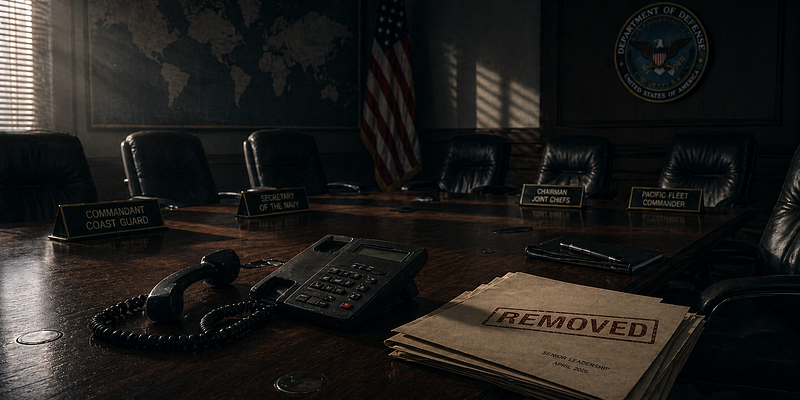
April 2, 2026. Washington.
Pete Hegseth called the Army’s Chief of Staff. The call lasted four minutes. By the time it ended, thirty-eight years of institutional memory had left the building.
By phone. During a war.
Five former Defense Secretaries, including James Mattis, sent a letter to Congress the following week. They called the pattern of firings “reckless.” They asked for immediate hearings to assess the national security implications.
Congress did not convene the hearings.
What Gets Lost When a General Leaves
The debate that followed focused on loyalty. On whether generals had refused orders. On whether the firings were politically motivated.
That debate is real. It is also the wrong frame.
When an institution loses a senior leader, it does not lose a person. It loses a node. A node in a network of relationships, precedents, informal agreements, and accumulated judgment that no transition binder captures and no successor inherits automatically.
Randy George knew which NATO commanders called at 2 a.m. and which ones waited for formal channels. He knew which interagency partners could be trusted to keep a conversation off the record. He knew the difference between an intelligence assessment that was analytically solid and one that had been shaped by what someone upstream wanted to hear. He knew when to push back on civilian leadership and how to do it in a way that preserved the institutional relationship rather than destroying it.
None of that knowledge exists in a file. It exists in a person.
The position was filled. The institution was not.
How It Moves Through the System
When a general leaves, a relationship disappears. When a relationship disappears, a channel closes. When a channel closes, information moves on partial reality. And partial reality is where miscalculation begins.
This is the chain. It does not announce itself. It operates in the spaces between what is formally documented and what is actually known. A successor arrives. He reads the briefing files. He attends the meetings. He does not know what the predecessor knew in the way the predecessor knew it, and he does not yet know what he does not know.
The formal structure remains intact. The org chart looks the same. What has changed is what flows through it.
And what flows through a structure determines what the structure actually does, as opposed to what it appears to do. This distinction, between institutional appearance and institutional function, is the one that external observers, including adversaries, spend considerable resources trying to measure.
Adversaries do not need to break the system. They only need to read it.
Twenty-Four and Counting
By late April 2026, Hegseth had fired or sidelined more than two dozen generals and admirals.
The list included Admiral Linda Fagan, Commandant of the Coast Guard. Admiral Lisa Franchetti, Chief of Naval Operations. The Army’s Chief of Staff. Three generals in a single week in early April. The Secretary of the Navy, fired in the final days of the month. Thirteen senior military officials in the first months of 2026 alone.
The New York Times described an atmosphere of “anxiety and mistrust” within the Pentagon. Officers still serving had begun self-censoring. Informal communication, the kind that actually drives operational coordination had contracted.
That contraction does not show up in any formal report. It shows up in what is not said in the meetings that continue to be held.
The Epistemics of Power
There is a concept in strategic studies called “legibility.” It refers to the capacity of a state to make itself readable to other states. To signal, through consistent behavior and institutional continuity, what it will and will not do. Legibility is not softness. It is the basis of deterrence.
An army that communicates through stable, experienced leadership is legible. Adversaries can read its doctrine, anticipate its responses, calculate the costs of provocation. That calculation is what prevents miscalculation.
An army whose leadership changes every few months, in the middle of a war, for reasons publicly attributed to loyalty rather than performance, sends a different signal.
It signals that the institution is not the point. The person at the top is the point.
For China’s strategists, that signal is informative. It tells them that the U.S. military, at the most senior levels, is no longer operating as a permanent institution with its own institutional logic. It is operating as an extension of a political preference. The doctrine changes when the preference changes. The relationships shift when the personnel shift. The red lines are not institutional. They are personal.
Personal red lines can be tested.
The institution whose leadership changes by phone call, mid-war, is not signaling weakness. It is signaling something more precise: that the institution itself is no longer the point.
What Beijing Is Reading
In March 2026, the U.S. Senate Committee on Foreign Relations released a minority report on China. It noted that Beijing had been systematically exploiting institutional gaps in American foreign and defense policy.
China does not respond to American military power by counting aircraft carriers. It responds by reading the institutional coherence behind those carriers. The question Beijing’s People’s Liberation Army analysts are asking is not: how many ships? The question is: who decides, how consistently, and what happens when the decision-maker changes?
The answer, as of April 2026, is: the decision-maker changes often, unpredictably, and for reasons unrelated to military performance.
That is the answer Beijing needed. The Pentagon provided it.
Russia reads the same signal through a simpler lens. Every time the gap between American declaratory policy and American actual behavior widens, Moscow’s operating room expands. Deterrence requires that the adversary can model what you will do.
The Scapegoat Architecture
Hegseth’s public explanation for the firings shifted across the weeks. First: the generals had refused orders, a claim Snopes investigated and found unsubstantiated. Then: a culture problem. Then: necessary restructuring. Then: no explanation at all.
Institutions with a coherent reform agenda do not shift rationales. They explain, document, and institutionalize. The shifting rationale is not a communications failure. It is a datum about the nature of the operation.
The Institution That Remains
An institution purged of its senior experienced leadership does not simply become a different version of itself. It becomes something structurally different.
The informal networks are gone. The institutional memory is gone. The precedents are gone. What remains is formal hierarchy without the informal connective tissue that makes formal hierarchy functional.
New appointees are loyal. But loyalty is not the same as operational capability. A general who was appointed because he agreed with the civilian leadership is a different kind of officer than one who earned his position through operational performance and was confirmed through a process with independent standards.
The difference is not ideological. It is functional.
An officer who knows his appointment is conditional on political alignment will self-censor in exactly the moments when frank military advice is most needed. He will not say: this plan will not work. He will say: we can make adjustments.
This is not character. It is structure.
And those incentive structures have now been permanently altered. Even if the purge stopped today, the officers who remain know what happened to those who spoke frankly. The lesson is durable.
The Diplomacy Gap
The erosion is not confined to the military.
The New York City Foreign Policy Association published an analysis in April 2026 documenting what it called “institutional gaps” in American diplomatic capacity that predated the current administration but had accelerated sharply under it. The argument was precise: the United States’ ability to manage crises depends on credible diplomatic infrastructure, not just formal positions but experienced professionals who know the informal architecture of international relationships. When that infrastructure is hollowed out, other actors fill the space.
What is lost in a phone call takes years to replace.
What is lost across two dozen phone calls may take a generation.
The Frame That Fits Too Neatly
There is a version of this story that ends with a verdict.
It would say: Trump and Hegseth have damaged American national security in ways that will take years to repair. That is the comfortable conclusion. It names the actors, assigns the blame, and leaves the reader with a clear frame.
The problem is that this frame, however accurate on its own terms, does not capture the structural dimension.
Because the structural question is not whether this administration damaged the institution. The structural question is whether the institution was already, before 2025, producing the kind of frank and independent military leadership that the theory of civilian-military relations requires.
The five former Defense Secretaries who signed the letter condemning the purge served in administrations that also fired generals. That also shaped promotions for political reasons. That also tolerated self-censorship in the officer corps.
The purge did not create a problem. It accelerated one.
And accelerating a problem past the threshold where it becomes visible is different from creating it.
There are two ways to read what has happened. Only one of them allows you to assume this is temporary.
The first: disruption. Incompetence, political overreach, institutional damage by accident or by recklessness. A system being broken by people who do not understand what they are breaking.
The second: reconfiguration. A deliberate restructuring of where institutional authority actually sits. Not breaking the Pentagon. Repositioning it. Replacing a chain of command that had its own institutional logic, its own doctrine, its own capacity to push back, with one whose first loyalty is to the civilian leadership rather than to the institution itself.
Disruption and reconfiguration look identical from the outside. Both produce the same visible results: experienced leadership removed, informal networks severed, self-censorship spreading through the officer corps, adversaries reading the signal.
The difference is not in the outcome. The difference is in the intent, and in what the outcome is designed to produce.
If the problem is this administration, the solution is the next one.
If the problem is structural, the solution is harder to locate, and harder still to name.
If the outcome is the point, there may be no solution to locate. Only consequences to navigate.
The miscalculation that begins in a hollowed institution does not stay there.
What the Strait Knows
On April 26, 2026, Hegseth fired the Secretary of the Navy.
The South China Sea remained an active zone of Chinese military pressure. The PLA Southern Theater Command had conducted sustained patrols through April. The Taiwan Strait had not quieted.
The Pacific Fleet was commanded by an admiral confirmed in the final weeks before the purge. His counterparts in Beijing’s People’s Liberation Army Southern Theater Command had been in their positions for longer.
They knew their institution.
He was still learning it.
That gap has a name in strategic studies. It is called an opportunity.
Related from The Manifest Archive