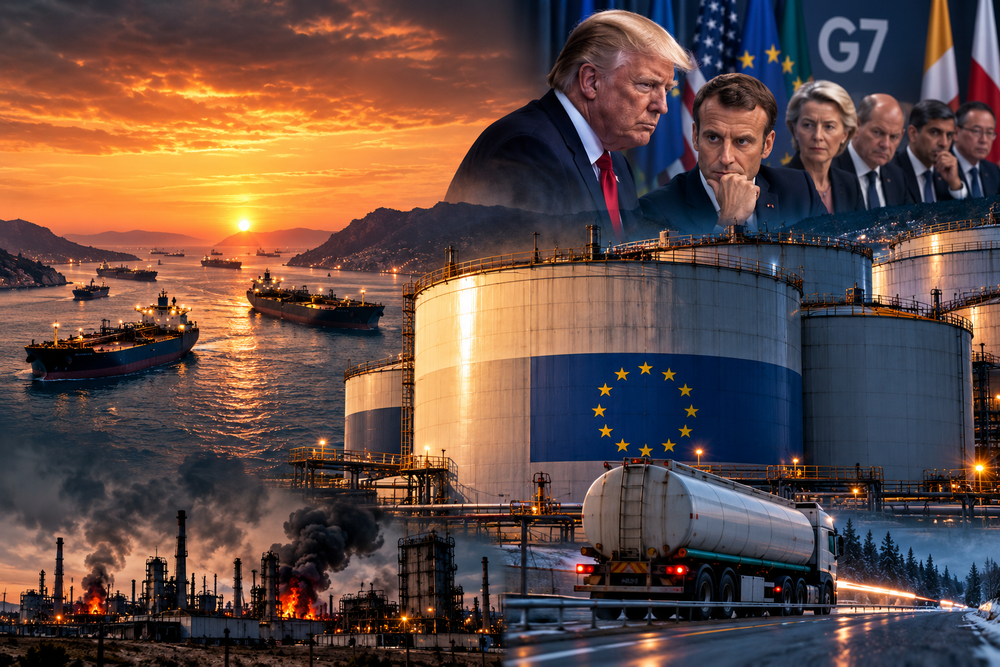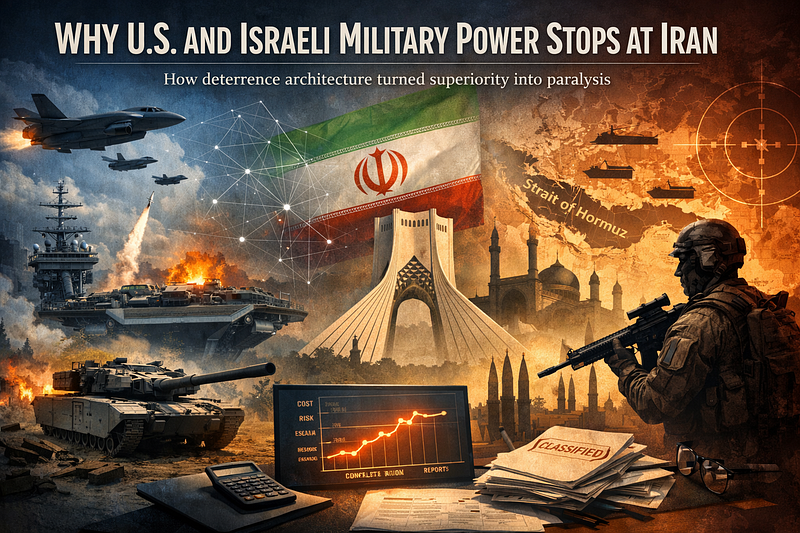
The Calculated Silence
It does not begin with missiles.
It begins with spreadsheets.
In rooms without windows, under fluorescent light that never changes, planners work through scenarios that will never be announced. There are no speeches here, no flags, no uniforms. Only tables. Reaction times measured in minutes. Escalation ladders mapped across weeks. Insurance withdrawal thresholds plotted against missile ranges. Energy price spikes modeled for day three, day seven, day thirty.
This is where war now begins.
Not with intent, but with consequence.
Every possible strike on Iran is translated first into outcomes that are no longer military. Not casualties, but premiums. Not territory, but supply chains. Not victory, but durability. How long domestic tolerance holds. How quickly allies fracture. At what point restraint stops looking like control and starts looking like paralysis.
The outcome is known before the first aircraft leaves the runway.
That is the first signal that this is no longer a conventional power equation.
In earlier eras, war was described as the continuation of politics by other means. In this era, war has become a system stress test whose outcome is known in advance. Not who wins, but what breaks permanently.
Iran is not opaque in this equation. It becomes legible the moment it is no longer treated as an ideological anomaly.
Disorder as Design
What Iran has constructed over decades looks improvised to observers trained to look for symmetry. Militias without uniforms. Missiles that prioritize range over accuracy. Drones that are cheap, numerous, and expendable. Influence without flags. No single front line. No central command that can be decapitated on live television.
But disorder here is not weakness.
It is architecture.
Iran’s strategy does not aim to defeat Israel or the United States in a decisive engagement. It aims to deny them a decisive engagement altogether. Every layer is designed to activate the next without offering a terminus.
A strike on Iran activates Lebanon.
Lebanon draws Israeli civil defense into saturation.
From there, U.S. involvement becomes unavoidable.
Maritime risk follows.
Insurance retreats from the Strait of Hormuz and the Red Sea.
Energy reacts.
Allies absorb the shock.
Legitimacy erodes.
None of this requires an Iranian announcement.
None of it requires an Iranian escalation speech.
This is not command warfare.
It is chain warfare.
And chains do not break by striking the first link.
Israel’s Structural Constraint
Israel understands this logic with particular clarity, because it lives inside its consequences.
Israeli military doctrine is built on speed, preemption, and decisive closure. This is not ideological. It is geographic. Israel has almost no strategic depth. It cannot trade space for time. Any conflict that expands in duration or geography becomes existential by default.
This doctrine has worked repeatedly against adversaries who relied on conventional symmetry. Air superiority. Intelligence dominance. Rapid maneuver. Shock and closure.
Iran does not offer closure.
Hezbollah alone represents a saturation problem that cannot be solved cleanly. Tens of thousands of rockets, dispersed launch sites embedded in civilian terrain, command structures designed for resilience rather than hierarchy. Any attempt to dismantle this network triggers a scale of escalation that Israel cannot localize.
Israeli planners know this. Not in theory, but in rehearsal. It is already simulated, already priced in, already understood.
Israel can strike hard.
It can strike precisely.
What it cannot do is strike conclusively without opening a regional condition it cannot close.
That is not fear.
That is arithmetic.
The American Constraint Is Different, But It Ends the Same Way
The United States approaches the problem from a different position and arrives at the same limit.
American power lies in projection, not absorption. In global reach, not mutual damage. In overwhelming force, not prolonged exposure. A direct war with Iran would not resemble Iraq in 2003, when the battlefield could be geographically contained and politically framed.
A war with Iran would not be a campaign.
It would be a condition.
The United States would not be fighting one opponent, but managing multiple systems simultaneously. Energy flows through Hormuz. Insurance markets in London. Alliance politics in Europe. Domestic tolerance in an election cycle. Strategic credibility in East Asia.
This is not hypothetical. It is rehearsed.
American war games do not ask whether Iran can be defeated militarily. They ask how long global systems remain stable while that defeat is pursued.
The answers converge.
Victory is possible.
Stability is not.
Chain Warfare in Practice
Proxy warfare is not new. What has changed is its permanence.
In earlier conflicts, proxies were transitional instruments. They delayed confrontation until resolution followed. Today, they no longer point toward resolution.
They stabilize non-resolution.
Consider the Red Sea disruptions. Limited Houthi attacks do not shut down global trade. They force insurers to withdraw. Premiums spike. Routes lengthen. Costs ripple outward.
No declaration of war is issued.
No decisive response is triggered.
Everyone adjusts.
The system learns.
Israeli planners know which strikes provoke Hezbollah escalation and which do not. Hezbollah knows how far it can go without triggering full retaliation. U.S. naval commanders calculate acceptable risk bands. Energy traders price volatility as background noise.
Anticipation replaces command.
Deterrence no longer prevents war.
It prevents conclusion.
The Point Without Return
There is a moment in every system where uncertainty ends.
Not because danger disappears, but because knowledge stabilizes. Consequences become predictable. At that point, continuation is no longer hesitation.
It is selection.
That moment has already passed.
This knowledge is not abstract.
It is institutionalized.
It appears in classified war games run repeatedly by U.S. Central Command.
It appears in Israeli General Staff scenario planning.
It appears in cabinet and congressional briefings where escalation outcomes are discussed but never cited publicly.
Decision-makers know what a direct war with Iran would produce. Strike packages. Response timelines. Insurance collapse thresholds. Energy transmission speeds into domestic politics. Alliance fracture points.
This is documented expectation, not fear.
A decisive alternative has existed for years.
A regional war designed to dismantle Hezbollah regardless of cost.
A U.S.-led strike package accepting global economic shock as the price of strategic reset.
These options are not rejected because they are impossible.
They are rejected because their consequences are unmanageable.
This is the point without return.
Actor Exhaustion
From this point forward, motive becomes irrelevant.
The system no longer asks what outcome is desirable, but which damage profile is survivable. Continuation becomes the default not because it is optimal, but because it is familiar.
Iran’s role diminishes.
Not because Iran disappears, but because the environment it helped shape sustains itself. Even without Iranian action, the constraints remain.
The pattern feels familiar long before it is named.
This is actor exhaustion.
Actor Exhaustion Completed
The system now reacts not to Iranian behavior, but to the possibility of Iranian response.
Military planners plan as if escalation has already occurred.
Diplomats manage expectations rather than outcomes.
Markets respond to scenarios rather than events.
The conflict becomes ambient.
This logic is not confined to geopolitics.
In financial crises stabilized but never resolved.
In climate targets acknowledged but postponed.
In political systems preserved despite visible decay.
The reader has seen this before.
Iran did not invent this condition.
It revealed it.
Closing Echo
There is a temptation to ask what breaks the pattern.
A miscalculation.
A provocation too large to absorb.
A leader willing to risk everything.
That temptation misunderstands what has been revealed.
Systems like this do not end in explosions. They endure by narrowing the range of imaginable action until disruption appears irresponsible.
What is described as stability is often only continuity without resolution.
What looks like restraint is often exhaustion.
What looks like caution is often fear of self-damage.
What looks like control is often repetition.
Military power still exists.
But it no longer decides.
Power that cannot conclude does not disappear.
It reorganizes itself around delay.
This is where military power now stops.
Related from The Manifest Archive