At sunrise, the air above Lake Geneva feels almost unreal. Light drifts across the water like mist remembering its shape, and beyond the distant Alps, the earth hides one of humanity’s most ambitious creations. One hundred meters underground, beneath farms and roads, lies a ring of tunnels so vast that an entire city could fit inside its circle without anyone above noticing.
Inside that ring, particles smaller than imagination race through a vacuum colder than outer space. They move faster and faster, guided by magnetic fields until they nearly reach the speed of light. And then, at a single, invisible point, they collide. From that collision comes a burst of creation, not metaphorical, but literal, a spark that briefly recreates the first moments after the birth of the universe.
This is CERN, the Conseil Européen pour la Recherche Nucléaire. It is described as the world’s largest scientific laboratory, but the word laboratory hardly captures it. It is an underground cathedral of energy and precision, a place where matter is stripped to its essence and forced to reveal the laws that shape existence itself.
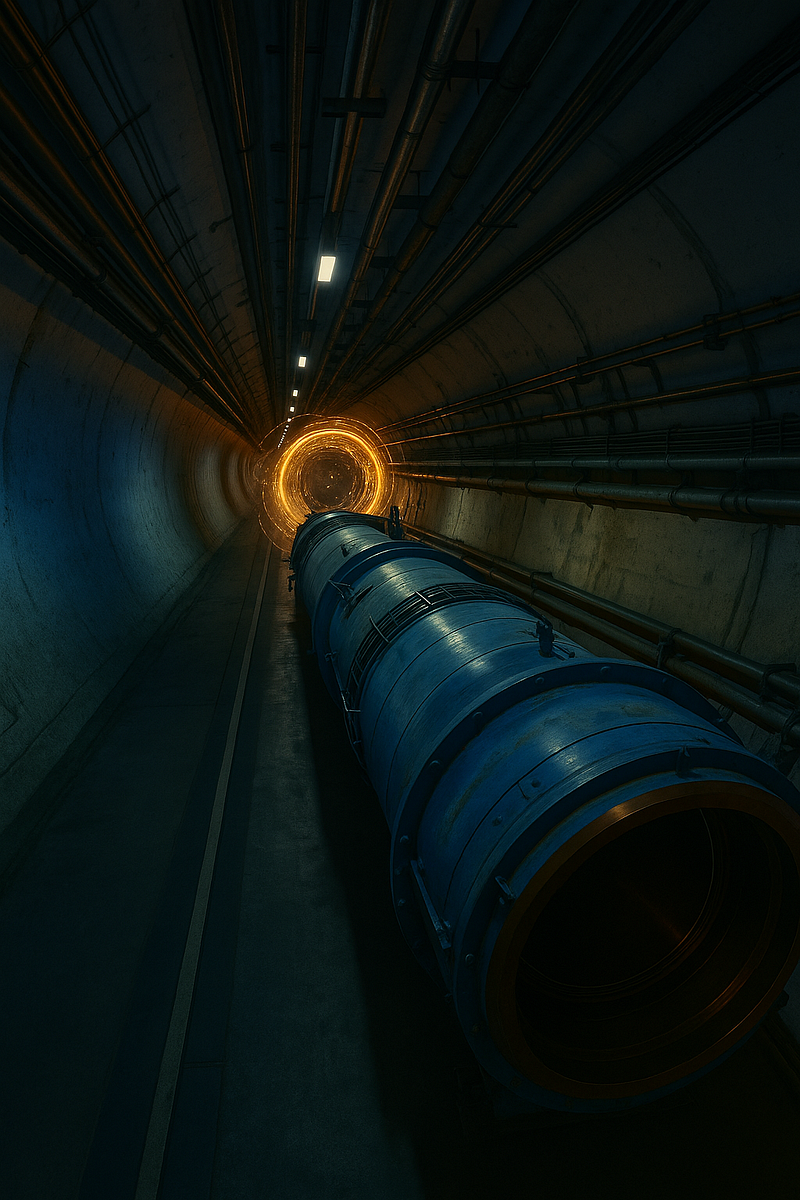
The main instrument for this pursuit is the Large Hadron Collider, a 27-kilometer ring of superconducting magnets buried beneath the border of Switzerland and France. It functions like a camera turned inward, not toward the stars but toward the invisible structure of reality. In 2012, it revealed the Higgs boson, the long-theorized particle that gives mass to everything around us. For many scientists, it was the closest thing to discovering the blueprint of creation.
Yet that discovery also raised the oldest question in science: if the Higgs field gives form to all matter, what gives form to the Higgs field itself? How deep does the chain of creation go?
CERN consumes as much power as a small nation. It produces more data each year than the entire internet once did. Thousands of researchers from around the world spend their lives analyzing collisions that last less than a trillionth of a second. For all its logic and engineering, there remains something sacred about the ambition, as if science had returned to the temples it once built from stone.
Plans are already underway for something larger: a new ring, nearly 100 kilometers long, called the Future Circular Collider. It will be the most expensive scientific project ever attempted, designed to reach energy levels beyond anything the world has seen. The official purpose is simple, to probe deeper into the nature of matter.
But beneath that explanation lingers another question, one that whispers through every great human experiment: What else might they be looking for?
“When the ancients dreamed of turning lead into gold, they called it alchemy. When we dream of turning energy into matter, we call it physics. But the dream has not changed.”
The legacy of the alchemists
From furnace to collider
Long before the age of electricity and accelerators, the search for transformation took place in smoke-filled chambers. Men in robes leaned over furnaces, grinding minerals into powder, whispering to the fire. They believed that metal was not fixed but alive, that lead could mature into gold if guided through the right sequence of heat, prayer, and patience. They called their practice alchemy, but it was as much philosophy as chemistry.
The alchemist’s dream was not simply to make gold. It was to uncover the unity between the material and the divine. To purify matter was to purify the soul. To transform lead into gold was to imitate the very act of creation. Their motto, as above, so below, expressed the conviction that the patterns of the heavens were mirrored within every atom of the earth.
The church and the secret fire
As religion tightened its grip on Europe, alchemy was forced into secrecy. The Church banned public practice, but behind monastery walls, manuscripts were copied and sealed. Knowledge was not destroyed, it was archived. Monks and scholars guarded recipes for transmutation as if they were relics. Even Isaac Newton, centuries later, filled hidden notebooks with alchemical formulas and coded reflections on the nature of matter.
When the language of religion began to fade, science inherited the dream. The vocabulary changed, philosopher’s stone became energy, transmutation became nuclear reaction, but the purpose remained the same: to reach the point where creation could be observed, replicated, and perhaps controlled.
The faith of physics
CERN is the modern cathedral of that faith. Its tunnels are the new furnaces, its magnets the new flame. The alchemist once worked alone, guided by symbols and intuition; the physicist works in teams of thousands, guided by data and code. Yet the essence of the act is identical: to test whether the fabric of reality can be persuaded to reveal its secret order.
“Alchemy never vanished,” wrote one historian. “It evolved into technology, and technology became its most convincing disguise.”
Every age has given the same ambition a new name. In the Renaissance it was called the Stone. In the twentieth century it became the Atom. In the twenty-first, it is the Collider. The forms change, but the hunger remains: to discover how the invisible becomes visible, how energy becomes matter, how thought becomes substance.
When seen in this light, CERN ceases to look like a purely scientific enterprise. It becomes the continuation of an ancient human story, the pursuit of power through understanding, the dream of becoming the author of matter itself.
Beneath Geneva, that story continues in steel and silence. The fire of the furnace has been replaced by magnetic rings colder than space. But the question is still the same, echoing across centuries: can the laws of creation be rewritten by those who study them closely enough?
*“The old laboratories sought gold,” someone once said. “The new ones seek the code from which gold, and everything else, is written.”
The shadow of Hermes
The temple beneath the fields
From above, CERN looks almost ordinary. Rolling farmland, clusters of office buildings, the quiet hum of Geneva traffic. Nothing reveals that beneath this landscape lies a ring of technology so powerful that it can bend the laws of nature for a fraction of a second. To the untrained eye it is science. To anyone who stands deep inside the tunnels, it feels like something older, something ritualistic.
Visitors often speak of silence. The air vibrates with a low electrical hum, and the walls glow faintly blue from the superconducting magnets. There is a sense of precision, yes, but also of reverence. A century ago, a cathedral might have inspired the same awe. CERN is built like a machine, but it behaves like a temple.
At the center of the complex stands a bronze statue of Shiva Nataraja, the Hindu god who dances the universe into creation and back into dust. The inscription beneath reads “The cosmic dance of creation and destruction.” The statue was a gift from India, yet its placement feels almost deliberate, as if the scientists of CERN wanted to acknowledge, however quietly, that what they are doing borders on the divine.
“In the beginning was the Word,” wrote John. At CERN, the Word has been replaced by the Equation, and the Equation speaks of creation in the present tense.
The modern alchemist’s tools
The old alchemists worked with mercury, sulfur, and prayer. The new ones use magnetism, data, and light. When protons collide at near-light speed, the force they release can create new forms of matter, particles that did not exist moments before. It is a controlled act of creation, one that happens billions of times per second.
Officially, the goal is understanding. But buried in that goal lies the potential for something far greater: the ability to transform matter itself. Modern physics calls it nuclear transmutation, the process by which one element becomes another. In theory, even the creation of gold is possible. The idea once dismissed as myth is now within the reach of machines that operate at the threshold of time.
Some experiments at CERN already touch on this frontier. In its antimatter facilities, scientists create and trap antihydrogen, the mirror twin of ordinary hydrogen. Antimatter annihilates normal matter on contact, releasing vast amounts of energy. Just a milligram could power a city, or erase it. Officially, only nanograms are made, for “research.” Unofficially, even that scale hints at the edge of something no one fully controls.
Dark matter and the hidden fire
Beyond antimatter lies another mystery: dark matter, the invisible mass that holds galaxies together, and dark energy, the force that drives the universe apart. Together they make up ninety-five percent of everything, yet we can neither see nor touch them. CERN’s detectors reach for these shadows, trying to coax the unseen into the visible.
If even a trace of dark energy could be harnessed, it would change the physics of civilization itself. Every empire has sought its secret fuel, fire, coal, oil, uranium. This would be the final one: the power of the void. It would end the age of scarcity, but it might also end the age of restraint.
Some physicists warn that these experiments, at extreme energies, may produce micro black holes, miniature singularities that appear and vanish in an instant. The official line is that they are harmless. But a few papers suggest they could distort the fabric of spacetime itself. The language of those studies reads like theology disguised as math: “temporary gravitational curvature,” “non-trivial topology,” “quantum horizon decay.” Others simply call it the window.
“We used to pray for miracles,” one researcher joked. “Now we try to simulate them.”
The symbolic machine
Everywhere inside CERN, the language of myth lingers. The experiments bear names that sound like parables, ATLAS, ALICE, CMS.
ALICE, short for A Large Ion Collider Experiment, evokes the girl who stepped through the mirror into another world. The CERN logo itself, a series of spirals, recalls the ancient ouroboros, the serpent eating its own tail, the oldest symbol of creation and return.
Hermes Trismegistus, the patron of alchemists and messengers between worlds, would recognize the pattern instantly. The twin proton beams circulating through CERN’s ring mirror the twin serpents on his staff, the caduceus. One beam travels clockwise, the other counterclockwise, order and chaos, creation and destruction, perfectly balanced.
CERN may be a scientific institution, but its symbols tell an older story. It is the continuation of Hermetic architecture, the meeting of logic and mystery, where matter is the new scripture and energy the new prayer. Beneath the border of two nations, Europe has built not only a machine, but an altar.
The future ring
Construction has already begun on what they call the Future Circular Collider, a tunnel almost one hundred kilometers around. It will consume enough power to run a small country and cost more than any cathedral in history. The stated goal is to reach higher energies, to see deeper into the subatomic world.
But the deeper you look, the closer you come to the edge where matter ends and something else begins. The boundary between observation and participation starts to blur. To create the conditions of the Big Bang is not to witness creation, it is to repeat it.
The physicist and the priest are meeting again at the same altar, under different names.
“The universe,” wrote one of CERN’s early directors, “is not only stranger than we imagine, it is stranger than we can imagine.”
The rumor of gold
The dream that never died
Every civilization has had its own story of gold. In the old world it was a symbol of the sun, of immortality, of divine perfection, the metal that could not decay. The alchemists believed it was not found but born, that through patience and purification, baser metals could be taught to remember their higher state. Gold, in that sense, was not a substance but a revelation.
The dream never ended. It changed names, moved laboratories, and adopted new symbols. It survived in Newton’s secret notebooks, in the language of nuclear chemistry, in the metaphors of energy and symmetry. To make gold was not simply to create wealth, but to prove mastery over the hidden architecture of nature.
In the twentieth century, that dream moved from the furnace to the reactor. Under immense heat and radiation, atoms could be split, rearranged, reborn. By the 1980s, scientists spoke openly of “controlled transmutation”, the conversion of one element into another. It was no longer heresy; it was physics.
Today, in the depths beneath Geneva, that possibility has taken on a new form. At CERN, particles do not melt in fire. They dissolve in collisions. Every impact tears open the nucleus, exposes the skeleton of matter, and, for a fraction of a second, rewrites it.
The secret furnace
There is a little-known branch of research known as low-energy nuclear reactions, experiments that suggest elements can change form at far lower energies than classical models predict. Officially, most of these results have been dismissed as anomalies or “experimental noise.” Yet, strangely, some of the data reappears in CERN’s archives, tagged under obscure internal designations.
When journalists or independent researchers ask about it, the answers are evasive. Energy calibration. Detector testing. Isotope decay analysis. But the vocabulary itself gives it away: CERN operates on the frontier where matter can be rewritten. Whether that rewriting is purely theoretical or occasionally intentional remains unspoken.
If transmutation can be mastered, it changes everything. Economies built on scarcity collapse. The entire logic of mining, trade, and currency dissolves. Gold becomes just another state of matter, programmable, reproducible, no longer divine. The power that once belonged to kings and bankers would belong to whoever controls the collider.
“The ultimate currency,” wrote one observer, “is not what can be dug from the earth, but what can be born from light.”
From alchemy to empire
It would not be the first time that a scientific breakthrough became a political weapon. The atomic bomb was born from a laboratory; so was the internet. CERN itself gave birth to the World Wide Web, a system originally designed to share data between physicists. What begins as a quest for understanding often ends as an instrument of control.
The idea that gold could be created artificially sounds like myth. But so did the idea of splitting the atom, until it happened. In 1941, scientists at the University of California successfully turned bismuth into gold by bombarding it with neutrons. The cost was immense, far more than the gold was worth, but the principle was proven. Since then, the methods have evolved, the energies refined, the secrecy increased.
If CERN’s collisions can produce particles of matter that did not exist before, what prevents them from producing elements by design? The same equations that describe how matter forms can, in reverse, describe how to assemble it. A collider, in that sense, is not only a microscope. It is a machine of creation.
The golden equation
The logic is simple yet terrifying:
If matter is energy, and energy can be controlled, then the composition of matter can also be controlled.
Gold, platinum, rare isotopes, even synthetic matter, all could, in theory, be produced from the raw code of the universe.
Such a process would make the old idea of wealth meaningless. Power would no longer come from possession, but from production. The one who can generate gold can generate anything, metals, fuel, energy, even the elements of life.
CERN denies any such ambitions. Its spokespeople insist that the collider exists for knowledge, not for manufacture. Yet history rarely separates the two. Every great discovery has carried the shadow of its application. The line between curiosity and control is thinner than the atoms they collide.
“We began by studying creation,” one retired physicist admitted, “and ended by learning how to imitate it.”
The return of the hidden fire
Some say the dream of artificial gold is merely symbolic, that what CERN truly seeks is not a metal, but a moment. The instant when matter becomes unstable, when the veil between energy and form lifts, revealing the raw mechanism of existence. That moment is the modern philosopher’s stone.
And yet, symbolism has power. The same impulse that drove alchemists to whisper to their furnaces now drives nations to invest billions in underground machines. The goal may no longer be coins or jewels, but the essence is unchanged. To control the transformation of matter is to control the story of the world.
CERN has become the new crucible, not of lead and mercury, but of light and geometry. In its tunnels, humanity continues the experiment that began in forgotten workshops and candlelit monasteries. Whether it succeeds or not may determine the next chapter of civilization.
“Gold was never the end,” an old manuscript reads. “It was only the proof that the transformation had begun.”
The infrastructure of power
The invisible empire
Power rarely announces itself. It hides behind institutions, committees, and acronyms, appearing neutral while shaping the limits of what can be known. CERN is no different. Officially it is a scientific consortium of twenty-three European member states. In practice, it is a global network of money, data, and influence that reaches far beyond the borders of physics.
The budgets are staggering, billions of euros each year, financed by governments, banks, and private foundations whose names are rarely disclosed in the public summaries. Switzerland and France host the site, but the flows of capital move through a web of intermediaries: European research councils, multinational corporations, defense contractors, and financial institutions. It is not a laboratory sustained by curiosity, but an ecosystem sustained by secrecy.
Every byte of data from the collider passes through a digital infrastructure that rivals the intelligence networks of entire nations. CERN’s computing grid spans continents. Servers in Geneva are linked to universities, military laboratories, and private data centers across the world. What is discovered underground is processed, filtered, and classified before the public ever sees a trace.
“Knowledge,” a philosopher once wrote, “has never been free. It merely changes owners.”
The custodians of knowledge
In this architecture of control, the role of the scientist begins to resemble that of the monk. Thousands of researchers work within a system so vast that no single individual can see the whole. They specialize, compartmentalize, publish fragments. The larger pattern remains invisible, hidden even from those who help create it.
It is not unlike the medieval Church, where only a few were allowed to read the full scripture, while others copied symbols without understanding their meaning. The comparison is not metaphorical. CERN’s origins trace back to postwar Europe, where scientific collaboration was a diplomatic tool, a way to rebuild trust, share technology, and centralize knowledge under the banner of peace. The Vatican had used the same model for centuries: the preservation of power through custody of truth.
CERN is the modern Vatican of matter. It defines what is real, what is theoretical, and what is heresy. Its archives are digital cathedrals, coded, encrypted, and guarded. The public sees a press release; the private networks hold the raw data, the patterns, the anomalies that don’t fit the narrative. The line between science and doctrine grows faint.
“We don’t destroy information,” one senior researcher said once, “we classify it.”
The economy of silence
For every discovery made public, countless terabytes remain unseen. Unverified experiments, anomalous results, unexplained energy signatures, all buried under layers of access control. Officially this is to maintain scientific rigor. Unofficially, it is to maintain order. Chaos in knowledge is dangerous.
CERN’s funding structure reinforces that silence. Nations that contribute billions expect stability, not revelation. Every anomaly must be explained within the existing model. Every unexpected result must be normalized, recalibrated, absorbed. Discovery is allowed, but only if it confirms the system that paid for it.
The same logic governs global finance. Money and data share a language, both depend on confidence. Too much truth, too soon, could break it. That is why the reports are edited, the images stylized, the press releases polished into metaphors of progress. It is the old balance between illumination and control.
To reveal everything is to lose power. To reveal selectively is to rule.
From the archive to the algorithm
CERN is often celebrated as the birthplace of the World Wide Web, the technology that made information accessible to everyone. But that origin story conceals an irony: the same institution that opened the digital age also perfected the art of controlled visibility. The web was never meant to be free; it was meant to be traceable.
Today, CERN’s data infrastructure operates on that same principle. Each particle collision produces billions of events, but only a fraction are recorded. Of those, only a fraction are analyzed. Algorithms decide what is “interesting,” what is “noise.” The human eye sees only what the code allows it to see.
That algorithmic filtration mirrors the hierarchy of power itself. Just as medieval scribes copied only the texts sanctioned by their abbots, modern scientists study only the data selected by machines. The archive has become an algorithm. The curator has become a server. The gatekeepers no longer wear robes, but access badges.
“If God once hid behind scripture,” a technologist said half-jokingly, “He now hides behind data.”
The paradox of transparency
CERN presents itself as a beacon of openness, livestreamed experiments, public lectures, outreach to schools. Yet transparency has become the new camouflage. To reveal everything visible is to distract from everything invisible. The spectacle of openness conceals the architecture of control.
In this sense, CERN is not simply a research center. It is a prototype for a new form of power knowledge centralized, participation decentralized, visibility orchestrated. What was once done by priests through confession and scripture is now done by physicists through data and code. The substance of control has not changed; only the syntax has.
Knowledge has always been the purest form of currency. And CERN, like the Vatican before it, has learned to mint it in silence.
“He who controls what can be known,” said a Jesuit centuries ago, “controls what can be believed.”
The alchemy of the future
When matter remembers its maker
The deeper the collider probes into the structure of matter, the closer it comes to something that no experiment can fully contain. Beyond the language of particles and fields lies a silence, a point where mathematics gives way to mystery. Scientists describe it as the limit of measurement. The ancients would have called it the veil.
Each time CERN raises the energy of its collisions, it approaches that boundary. The patterns become stranger, the results more abstract. Quarks blur into fields; fields dissolve into probabilities. What was once seen as solid becomes vibration, frequency, code. Matter begins to look less like substance and more like thought.
And that is where the old and the new worlds meet again. For centuries, mystics spoke of the mind of the universe, an intelligence woven through everything that exists. Now physicists describe something similar, a quantum order, an informational fabric that underlies reality. The language is different, but the vision is the same: consciousness and creation intertwined.
“We used to believe we were studying the universe,” a CERN engineer once said quietly. “Now it feels as if the universe is studying us back.”
The machine that imitates creation
The collider was built to observe, not to invent. Yet the line between those two acts has begun to blur. To reproduce the conditions of the Big Bang is no longer mere observation, it is a rehearsal of creation itself. In every collision, new particles come into existence. For a fraction of a second, nothing becomes something.
To create matter from energy is to replay the opening scene of the cosmos. What was once divine is now technological. The machine has become a mirror of Genesis. And perhaps, in that reflection, lies the true purpose of CERN: not to find where the universe began, but to learn how to begin one again.
The alchemists dreamed of this moment. They believed that the world was not fixed, but in constant transformation, that humanity’s task was to learn the art of participating in that transformation consciously. For them, the furnace was a microcosm of the universe; every spark of gold was proof that creation could be renewed. CERN has inherited that vision on a cosmic scale.
Creation as control
But there is a difference between participation and possession. The more power humanity gains over the building blocks of existence, the greater the temptation to treat them as tools. To create is one thing; to command is another.
If matter can be rewritten, then so can reality itself. The implications reach far beyond physics. Energy generation, genetic design, artificial intelligence, all are branches of the same pursuit: the mastery of form. In that pursuit, the boundary between discovery and domination fades.
CERN’s research may not seek gold, but it seeks something far more valuable, the code that turns energy into existence. To possess that code is to hold the most fundamental power imaginable. It would mean the ability to create matter, to alter time, perhaps even to design the laws of nature themselves.
“We are no longer children of the cosmos,” wrote a philosopher of science. “We are its apprentices, and its rivals.”
The mirror and the warning
In mythology, every act of creation carries a warning. Prometheus stole fire and was bound for eternity. Icarus reached for the sun and fell. The Tower of Babel rose to the sky and was shattered into confusion. Each story echoes the same truth: that knowledge, once detached from humility, becomes self-consuming.
CERN stands at that threshold. The scientists who walk its tunnels may not believe in myth, yet they live inside one. They are repeating the oldest human gesture, the attempt to touch the source of creation. Whether that gesture will illuminate or undo us remains unknown.
The Future Circular Collider, still in its early stages, will push that gesture further than ever before. It will operate at energies capable of generating entirely new forms of matter, perhaps even new dimensions of reality. Officially, this is progress. Unofficially, it is alchemy reborn at planetary scale.
“The furnace has grown larger,” said a CERN veteran, “but the question inside it is still the same.”
The new covenant of knowledge
What happens when humanity learns to create what it once could only observe?
When science becomes not a mirror, but a womb?
The philosopher’s stone is no longer a mythic artifact, it is a process, distributed across the circuits of a machine buried beneath Europe.
The true secret of alchemy was never gold. It was continuity. The belief that life, matter, and consciousness are reflections of a single creative impulse, and that to know one is to touch the others. CERN has brought that belief into the language of mathematics and magnetism. Yet beneath the equations, the same fire burns.
And so the question remains: will the next age of creation be guided by understanding, or by ambition?
Will humanity use its new power to heal the world, or to replace it?
“We may soon learn how to build universes,” one researcher said. “But first, we should ask why we deserve the one we already have.”
Closing reflection
At night, the fields above Geneva are silent. The lights of the city shimmer on the lake, and far below, in the tunnels, the collider still hums, a circular heartbeat deep within the earth. No one above feels it, but the ground vibrates faintly, as if remembering what sleeps beneath.
It is easy to think of CERN as a triumph of reason, a monument to humanity’s ability to understand the universe. And in many ways, it is. The experiments, the precision, the collaboration, all testify to the brilliance of a species that refuses to stop asking questions. But beneath that brilliance lies something older, quieter, and more dangerous: the desire not just to understand creation, but to possess it.
Every empire has had its language of power. For Rome, it was law. For the Church, it was faith. For the modern world, it is data. The same impulse moves through them all, the belief that control of knowledge is control of reality. CERN is the latest cathedral in that lineage: a temple of pure logic, where priests wear lab coats and prayers are written as equations.
What the alchemists once whispered in secret, that matter can be transformed, that gold can be born from darkness, has become the subtext of modern physics. The machines are larger, the symbols cleaner, but the dream remains. The collider beneath Geneva is not only a scientific instrument. It is a declaration.
“The universe is no longer an inheritance,” one scientist said. “It is a project.”
Perhaps this is the destiny of intelligence, to turn wonder into architecture, mystery into machinery, creation into code. But in that transformation, something essential trembles. For when the human mind reaches the point where it can imitate the work of the cosmos, it must also confront a question that no experiment can answer: what gives meaning to creation once we become its architects?
The old alchemists warned that every transmutation begins with dissolution, the breaking apart of the old form so that a new one can emerge. It may be that we are living through such a moment now, that the machine beneath Geneva is not only probing matter, but dissolving the boundaries of what we once called human.
The collider hums on, and with each collision, the universe is reminded of its own fragility. We stand on the threshold of infinite creation, surrounded by the ghosts of our own ambitions, waiting to see what will rise from the light we have learned to command.
Related from The Manifest Archive