This chapter is part of The Manifest, an ongoing exploration of power, protected structures and the alternatives concealed beneath the official surface of modern life.
The train does not announce the transition. There is no wall, no theatrical checkpoint, no visible line where one world ends and another begins. Yet something changes. The rails seem smoother. The stations feel more deliberate. The villages look less as though they grew there than as though they were placed. Even the mountains begin to read differently, less like landscape and more like arrangement.
You notice it before you understand it. Switzerland does not feel like a country you simply enter. It feels like a space you are allowed into. That distinction matters, because most nations expand outward while Switzerland appears to fold inward. It concentrates. It protects. It absorbs pressure without displaying it. The longer you look, the harder it becomes to see it as merely another European state.
It begins to resemble something else. A chamber. A protected room. A space designed not only to exist in stability, but to remain functional when stability elsewhere fails.
Some countries live inside history. Others are built to survive it. Switzerland belongs to the second kind.
This is not a romantic claim. It is a structural one. Swiss neutrality is often presented as moral character, yet the Swiss foreign ministry defines neutrality as an instrument of security, foreign and economic policy, and notes that the international community recognized Swiss neutrality in 1815. That matters because once neutrality becomes function rather than virtue, the whole country starts to look different.
The postcard remains. The lakes remain. The villages remain. The trains remain. But behind them another country appears, colder, denser, older in its logic.
The question is no longer why Switzerland looks orderly. The question is what kind of Europe needed such a room in the first place.
The Mountains That Think
In most countries, geography is passive. In Switzerland, geography is operational.
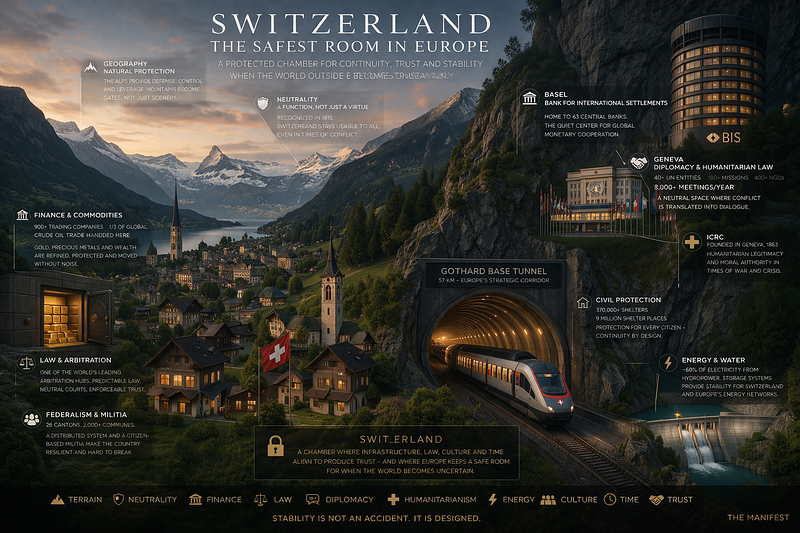
The Alps do not merely rise. They constrain movement, compress routes, and force passage through narrow corridors that can be monitored, defended, interrupted, or closed. The Gotthard axis is the clearest example. The Gotthard Base Tunnel runs 57 kilometers and forms part of a trans-Alpine system built to move people and goods through one of Europe’s hardest physical barriers. Switzerland’s position as guardian of major trans-Alpine routes is not an interpretive flourish. It is one of the country’s enduring strategic facts.
That is the first shift in perspective. The mountains are not only defensive. They are regulatory. North and south Europe meet in these corridors. Industrial core to Mediterranean access. Freight, passengers, energy systems, strategic movement. On a map they appear as lines. In reality they are chokepoints.
And chokepoints create leverage.
Mountains become power the moment they stop being scenery and start becoming gates.
This is why Switzerland is not merely hard to invade. It is hard to bypass. A difficult landscape slows armies. A regulating landscape shapes a continent.
The Alps do not only defend Switzerland. They position it.
A Society Built for Interruption
There are countries that assume continuity and build from there. Switzerland appears to assume interruption and build against it.
That mentality is visible in civil protection. Switzerland’s Federal Office for Civil Protection says the country has roughly 370,000 public and private shelters and around nine million shelter places, more than enough for the whole population, alongside about 1,700 protected premises including command posts, rescue facilities and protected hospitals. The same official material states that shelters exist above all for armed conflict and readiness.
That is not ornament. It is doctrine.
A bunker is concrete, yes. But more than that it is a political philosophy cast in reinforced form. It says that order is fragile, that systems break, that peace is never self-executing, and that continuity belongs to those who prepare before crisis becomes visible.
That is why Swiss calm feels different. It is not decorative calm. It is defended calm.
Roads are not only roads. They are fallback routes. Storage is not only logistics. It is time purchased in advance. Civil planning is not only administration. It is survival discipline folded into ordinary life.
The deepest luxury in Europe is not wealth. It is continuity. Switzerland built for that luxury.
A Distributed State Is Harder to Break
The Swiss model is not only protective. It is distributed.
Switzerland’s own official material presents federalism, together with direct democracy, as one of the cornerstones of the political system. Power is layered across the Confederation, 26 cantons and more than 2,000 communes. This is not cosmetic. It means political and legal capacity is spread across levels rather than concentrated in one brittle center.
A centralized system can be efficient. It can also be easy to paralyze. A distributed system is often slower, but harder to break all at once.
That is one reason Switzerland does not merely look ordered. It looks load-bearing.
The same logic appears in the Swiss militia principle. Swiss democracy still treats public responsibility as something citizens assume across multiple layers of social life, and the armed forces explicitly define their role as defending Switzerland, supporting civil authorities in emergencies and contributing to peace support abroad. The country does not only protect itself through institutions above society. It protects itself through a deeper assumption that society itself is part of continuity.
A country becomes unusually durable when the state is not its only defensive layer.
Money Does Not Go Where It Is Welcome
It goes where it is protected.
Switzerland is routinely reduced to shorthand: banks, vaults, discretion, old money. But the deeper function is more revealing. Wealth does not concentrate in one place for generations because the branding is strong. It concentrates where predictability survives stress.
That is what Switzerland offers.
Private banking is only one layer. Beneath it lies a broader ecosystem of legal continuity, procedural seriousness, administrative discipline and low institutional drama. Wealth notices these things long before the public does.
But even banking understates the picture, because Switzerland is not only where wealth rests. It is also where value moves.
Swiss official material describes the country as one of the world’s largest commodities-trading hubs, with about 900 trading companies, especially in Geneva, Zug and Lugano, and says that traders based in Switzerland handle over a third of global crude oil trade. Precious metals and gemstones also account for over 20 percent of Swiss exports and imports.
Then comes gold, and the logic sharpens further. Swiss reporting and Swiss-backed gold-sector material point to Switzerland’s outsized role in refining and handling global gold flows. Gold is not just wealth. Gold is condensed trust. A country deeply embedded in refining, certifying and routing it does not merely hold value. It helps transform raw value into legitimate value, movable value, accepted value.
Switzerland is not just where money sleeps. It is where value is refined, legitimized and moved without noise.
That is a much deeper function than banking alone.
Law: The Quiet Infrastructure Beneath Wealth
Without legal predictability, financial stability collapses.
This is one of the most important layers people skip.
Switzerland is not only financially attractive. It is also legally attractive. It is one of the leading places in the world for arbitration, with Geneva and Zurich serving as major hubs, and Swiss arbitration law is widely regarded as modern, liberal and highly party-autonomous. That matters because contracts, disputes, enforcement expectations and commercial trust all need a jurisdiction that behaves consistently under stress.
Money rests more easily where law does not wobble.
This is the layer that closes the circuit. Switzerland does not only stabilize value through vaults, banks, gold and discretion. It stabilizes value through law.
A safe room for capital must also be a safe room for contracts. Switzerland became both.
Basel and the Management of Money Above Politics
If Geneva is the room where diplomacy speaks softly, Basel is the room where money speaks technically.
The Bank for International Settlements, based in Basel since 1930, describes itself as the world’s oldest international financial institution and the principal center for international central bank cooperation. It serves a community of 63 member central banks and provides a forum for common understanding and common action.
That is an extraordinary fact when you stop and look at it clearly.
Switzerland is not only a place where private wealth seeks protection. It is also a place where part of the architecture of public money, central banking and monetary continuity is coordinated above electoral drama.
Basel is not where money is admired. It is where money is disciplined.
That belongs at the center of the article because it tightens the thesis. Switzerland is not one protected room. It is a cluster of protected rooms. Financial. Diplomatic. Humanitarian. Infrastructural. Legal. Technical.
And clusters like that do not emerge by accident.
The War Question That Never Fully Closes
The question remains because the official answers never fully satisfy. Why was Switzerland not absorbed during Europe’s most catastrophic wars? Why did a small, centrally located, strategically meaningful country remain functionally intact while larger states burned, collapsed or were occupied?
The first answer is geography. The second is preparedness. Both are real. Neither is complete.
The harder question is whether Switzerland was not only too difficult to take, but also too useful to ruin.
That question drags the discussion out of national mythology and into systems logic. In wartime, some territories are valuable as conquest. Others are valuable because they continue to function. Financial channels. discreet transaction environments. logistical corridors. negotiation rooms. survivable infrastructure. A node that still works can become more useful alive than destroyed.
Britannica notes that Swiss neutrality emerged from the Second World War morally compromised because the country maintained relations with Nazi Germany until the Reich’s collapse. That does not prove a simple thesis. It does something more valuable. It changes the frame.
Some territories are occupied to control them. Others are preserved because too many systems still need them operational.
The most revealing question is not why Switzerland survived, but who still needed it to.
This is the real midpoint of the article. If one country in the middle of Europe remained not only sovereign but useful across convulsions that shattered others, then the continent may have been preserving more than a state.
It may have been preserving a function.
Rome and the Northern Chamber
There is a detail so familiar that it often escapes interpretation: the Swiss Guard.
It is usually treated as spectacle, a picturesque relic, a splash of color at the edge of Vatican power. But relics that survive for centuries are rarely decorative alone. They are usually compressed memory.
The Vatican states that the Pontifical Swiss Guard was founded in 1506 to protect the pope and his residence. That is not folklore. That is long-duration trust.
This is where the Switzerland–Vatican line stops looking incidental.
Rome preserves continuity through archive, ritual, diplomacy, doctrine and symbolic authority. Switzerland preserves continuity through terrain, banking, discretion, legal seriousness and protection design. One guards power in time. The other guards power in space.
Rome held continuity through memory. Switzerland held continuity through design.
This does not require a childish theory in which one secretly controls the other. It requires only a structural reading. The Vatican needed protectors it could trust. Older European systems needed safe corridors, financial quiet, disciplined terrain and usable neutrality. Switzerland fit that role with remarkable consistency.
Rome kept the throne. Switzerland kept the room.
That is the harder sentence. And once it lands, the map of Europe shifts slightly under your feet.
Geneva and the Humanitarian Language of Order
If the mountains represent protection, Geneva represents translation.
This is where power learns how to speak in a lower voice. International agencies. negotiations. legal frameworks. arbitration. procedure. controlled dialogue. Geneva is one of the rooms where raw force is rewritten as process.
The United Nations Office at Geneva says it hosts more than 40 UN organizations and entities, more than 180 permanent missions and over 400 NGOs, while servicing around 8,000 meetings a year. Switzerland’s own official material explicitly links neutrality and humanitarian tradition to Geneva’s role as host to NGOs and the UN.
But Geneva adds one more protective layer, and it is crucial.
Humanitarian legitimacy.
The International Committee of the Red Cross was founded in Geneva in 1863. The ICRC describes itself as neutral, independent and impartial, and as an institution established under the Geneva Conventions, the most widely ratified treaties in the world.
This matters enormously.
Switzerland is not only a room where power negotiates. It is also a room where power acquires moral language.
Geneva does not erase power. It gives power a conscience-shaped vocabulary.
That is one reason Switzerland is so difficult to read at first glance. Hard power and moral legitimacy are not separated there. They are buffered through the same geography.
Energy, Water and Stored Stability
The protective logic is not only political. It is material.
Hydropower remains Switzerland’s most important domestic renewable energy source and accounts for about 59.5% of electricity production. Swiss official energy material also notes that storage plants are crucial for short-notice production and for shifting supply from summer to winter, giving Switzerland a central role in European electricity networks.
That matters because energy storage is continuity in physical form.
A country with mountains, water, storage capacity, distributed political layers, civil-defense depth, commodity routing, monetary coordination, legal predictability and diplomatic legitimacy is no longer just well organized.
It begins to look like a deliberate concentration of survivability.
Some countries consume stability. Switzerland stores it.
A Culture Aligned With Stability
Systems work only when people carry them.
This is another reason Switzerland matters.
Its political culture is built less around theatrical collision than around consensus, layered representation and negotiated coexistence. Official Swiss material emphasizes consensus-building within the Federal Council and a political system designed to integrate difference across cantons, religions and linguistic regions.
This matters because infrastructure alone does not produce trust. Trust also needs behavior.
Switzerland is not only engineered for stability. It is culturally aligned with it.
That is why the country feels so unusually coherent. Its legal seriousness, low political drama, distributed federalism and consensus culture all reinforce the same product: continuity.
Trust Accumulated Through Time
Trust is not built in moments. It is accumulated across uninterrupted time.
This is one of the deepest layers in the whole article.
Switzerland is not only stable. It has been stable for a very long time relative to the rest of Europe. That matters because every decade without systemic rupture becomes a deposit. Every year without collapse becomes a signal. Every generation that experiences continuity where neighboring systems experience fracture increases the country’s geopolitical usefulness.
Trust becomes power the moment it survives long enough to look natural.
This is one reason Switzerland can look so harmless on the surface. Long stability gets mistaken for innocence. In reality, it often produces the opposite: structural utility at a scale that no longer needs to advertise itself.
Switzerland as Interface
Switzerland is not only a shelter. It is an interface.
Between north and south.
Between capital and commodities.
Between war and diplomacy.
Between power and humanitarian legitimacy.
Between public politics and technical coordination.
Between Europe and the parts of Europe that no longer fit neatly inside the EU but still shape it.
That last point matters too. Switzerland is not in the EU, yet it is deeply entangled with Europe’s economy, institutions and regulatory environment. It is inside enough to matter and outside enough to remain flexible. That is precisely the kind of positional ambiguity a protected room often needs.
The more harmless a system appears, the easier it becomes to use it.
Switzerland’s image helps its function. Its calm is not just aesthetic. It is strategic.
Neutrality Under Pressure
And yet the picture is not static.
Swiss neutrality is increasingly tested in a world of sanctions, financial coercion, bloc discipline and shrinking room for genuine intermediacy. The Federal Council has argued against embedding an overly rigid neutrality doctrine in the Constitution because it would restrict Switzerland’s room for maneuver. That tension is revealing.
It shows that neutrality in the modern world is no longer simple abstention. It is calibration. management. timing. the effort to remain usable while the system around you becomes more rigid and punitive.
The real test of a protected room is not whether it can stay silent forever. It is whether it can remain usable when the entire building starts to shake.
That is why Switzerland matters now, not only historically.
Why Not Austria, Why Not Elsewhere
Comparison helps because it reveals what admiration hides. Austria has mountains, wealth, centrality and cultural prestige. Luxembourg has financial relevance. Belgium hosts institutions. The Netherlands has trade sophistication. Yet none of them produce quite the same atmosphere as Switzerland.
Why?
Because Switzerland is not defined by one strength. It is defined by convergence.
Terrain.
Neutrality.
Financial utility.
Civil-protection depth.
Federal robustness.
Militia logic.
Commodity relevance.
Monetary coordination.
Diplomatic hosting.
Humanitarian legitimacy.
Legal predictability.
Long-duration discretion.
Each on its own matters. Together they create density.
And density creates function.
At some point a country stops merely succeeding and starts becoming infrastructural to the success of others.
That is the transformation many people sense without naming. Switzerland feels different because it no longer behaves only as itself. It behaves as a protected node inside a larger continental arrangement.
And protected nodes are never just national facts. They are continental admissions.
Europe’s Safe Chamber
The longer you look, the more a broader pattern emerges. Switzerland resembles a fallback zone, not in the melodramatic sense of apocalyptic refuge, but in the systems sense of continuity under stress. When volatility rises elsewhere, Switzerland does not need to become louder. Its importance increases precisely through remaining what it already is.
Capital flows toward predictability. Institutions gather where administrative trust exists. Diplomacy prefers controlled rooms. Power likes silence when silence is reliable. Value seeks legitimacy. Crises seek translation. Europe seeks buffers. Switzerland provides all six.
And that reveals something uncomfortable about the continent itself.
Beneath Europe’s rhetoric of unity, law and institutional maturity lies an older truth. The continent still organizes itself around protected nodes, special corridors, fallback structures and spaces built for the moment normality fails. Switzerland is one of the clearest of those spaces.
Switzerland is not exceptional because it is calm. It is exceptional because it was built with the return of disorder in mind.
This is where the article stops being admiration and becomes diagnosis. Switzerland exposes what much of Europe prefers not to say openly: systems do not survive on narrative alone. They survive on redundancy, terrain, disciplined infrastructure, financial shelter, distributed authority, humanitarian legitimacy, legal predictability and rooms protected in advance.
The safest part of a fragile continent is rarely accidental. It is usually functional.
Closing Reflection
Most people look at Switzerland and see composure. They see lakes, trains, mountains, watches, vaults, diplomacy, a country that somehow escaped the rough logic that scarred the rest of Europe.
But whoever looks longer begins to see something else.
Not innocence. Design.
Not merely peace. Preparation.
Not just wealth. Protected continuity.
Switzerland does not only tell a story about itself. It reveals a deeper story about Europe. It reveals that beneath public ideals, the continent still depends on a handful of rooms built to outlast panic, absorb pressure and keep functioning when the wider structure shakes. It reveals that stability is not simply declared by speeches or guaranteed by treaties. It is engineered in tunnels, laws, vaults, storage plants, conventions, institutions and habits designed not to look dramatic.
That is what Switzerland ultimately is. Not an exception floating above history, but a chamber built deep inside it.
The safest room in Europe was never meant to look dramatic. It was meant to look normal.
And perhaps that is the most important pattern of all: the most protected spaces are rarely the loudest. They are the ones that learned how to disappear into order.
If Switzerland is one protected room, then Europe must contain others. Rooms of finance. Rooms of diplomacy. Rooms of ritual continuity. Rooms where crisis is translated, buffered, delayed, renamed. The real question is no longer whether such rooms exist. It is how many there are, and who they were built for.
Follow The Manifest.
The Manifest is an ongoing exploration of power, protected structures and the alternatives concealed beneath the official surface of modern life.*
Each article is a chapter.
Each chapter opens another room.
And each asks:
Does humanity really have to live inside systems designed this way?
Related from The Manifest Archive