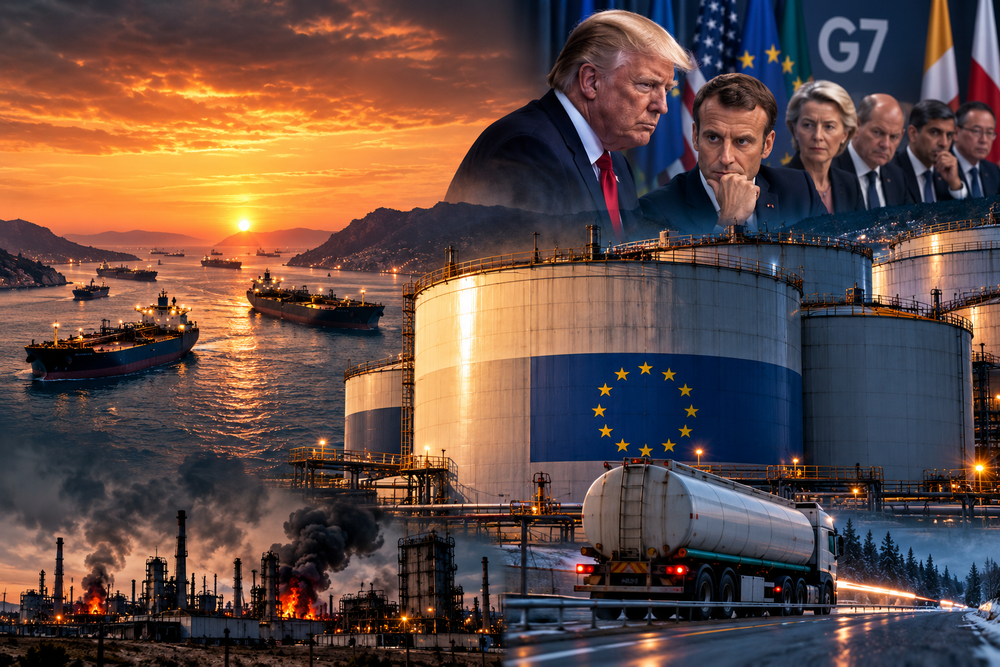
The Absence Of Response
Nothing happens when power crosses a line anymore.
No court convenes.
No leader resigns.
No system pauses.
There is no announcement, no rupture, no visible threshold being breached. What once would have triggered alarm now passes as procedure.
The absence of response is not accidental.
It is structural.
Power does not become dangerous at the moment it acts.
It becomes dangerous at the moment nothing answers back.
Danger does not begin with aggression.
It begins when action no longer produces consequence.
This is not a moral failure.
It is a systemic condition.
Friction as a forgotten requirement
Every functioning system once relied on resistance.
Not as obstruction, but as feedback.
Machines overheat.
Bodies feel pain.
Civilizations once encountered limits.
Friction was how systems recognized themselves. It slowed motion, forced reflection, created memory. Without it, movement did not stop. It accelerated.
Nature enforces friction automatically.
Human systems must construct it.
Law was designed as friction.
So was accountability.
So was public consequence, political cost, reputational damage.
Not to eliminate power, but to make it feel its own weight.
When these mechanisms weaken, power does not collapse. It smooths out. It becomes efficient.
And efficiency, without resistance, is lethal.
Power does not need intent to become destructive.
It only needs the absence of return.
When consequence disappears, precedent takes over
In the absence of consequence, systems stop asking whether something should be done. They ask what happened last time.
This is how precedent replaces morality.
Bombings are compared to previous bombings.
Sanctions to previous sanctions.
Escalations to earlier escalations.
Not to judge them, but to normalize them.
What occurred without punishment becomes permissible.
What becomes permissible becomes routine.
What becomes routine no longer requires justification.
Precedent is morality without conscience.
Boundaries do not vanish in a single decision. They erode through repetition. Each action slightly lowers the cost of the next.
Yesterday’s exception becomes today’s complexity.
Today’s complexity becomes tomorrow’s necessity.
Nothing dramatic happens.
That is the danger.
Power without return
For most of human history, power expected consequence.
Empires expected revolt.
Kings expected execution.
Rulers expected collapse.
Return was built into the imagination of authority. Even tyrants understood that force would eventually answer itself.
The modern system no longer assumes return.
Costs are externalized.
Damage is displaced.
Responsibility is diffused.
Power moves freely, but consequence no longer travels with it.
This is not because leaders are uniquely reckless.
It is because the structure no longer delivers feedback.
A system that never corrects itself
learns only that it can continue.
The insulation of the center
The contemporary center of power did not merely accumulate strength.
It accumulated insulation.
Geography played a role.
Allies played a role.
Technology played a role.
But structure mattered most.
Wars are fought elsewhere.
Bodies accumulate elsewhere.
Legal exposure occurs elsewhere.
Vietnam did not end where it was decided.
Neither did Iraq.
Afghanistan dissolved not into accountability, but into reports.
The documents were archived.
The language adjusted.
The system persisted.
No doctrine dismantled itself.
No architecture of power retracted.
Experience accumulated.
Correction did not.
Technology as moral dilution
Technology did not create consequence-free power.
It optimized it.
Distance replaced proximity.
Screens replaced bodies.
Systems replaced witnesses.
Risk became external.
Death became abstract.
Decision-making became administrative.
When no one bleeds, the moral calculus shifts.
Not because people are indifferent.
But because systems are efficient.
Efficiency has no ethics.
Only momentum.
Violence no longer appears as violence.
It appears as process.
Europe as buffer, not counterweight
Within this architecture, Europe does not function as resistance.
It functions as buffer.
Not because it intends to.
Because it is designed to.
Decisions are taken collectively, so no one bears them alone.
Responsibility is distributed, so it lands nowhere.
Democratic legitimacy is invoked, though no public mandate exists.
What appears externally as unity is internally dilution.
When everyone decides,
no one is accountable.
Europe absorbs pressure.
It translates escalation into management.
It legitimizes motion without opposing it.
A center without consequence is surrounded by a periphery without friction.
War as administrative condition
The most dangerous moment in any conflict is not the first strike.
It is the moment escalation becomes routine.
When war ceases to be rupture and becomes background condition.
When deaths become figures.
When destruction becomes data.
Not because people stop caring.
But because systems adapt.
Language softens.
Images thin out.
Debate shifts from whether to how.
Once war is administered,
it has already been normalized.
Law without reach
International law exists.
But law without enforcement is not resistance.
Institutions prosecute those who are reachable.
Not those who are insulated.
A hierarchy of justice emerges.
Unofficial, but unmistakable.
Some acts are crimes.
Others are policy.
Not because of severity,
but because of position.
Justice becomes spatial.
Accountability becomes optional.
Institutions as filters, not correctives
Institutions rarely destroy truth.
They process it.
Investigations are launched.
Reports are issued.
Findings are acknowledged.
Language is precise.
Tone is neutral.
Impact is negligible.
The institution did its job.
The system moved on.
History is not erased.
It is archived.
What cannot be denied is catalogued.
What cannot be catalogued is reframed.
What cannot be reframed disappears behind access.
Silence does not require censorship.
Only procedure.
The illusion of stability
A system without consequence appears stable.
No internal rupture.
No visible crisis.
No correction.
But this stability is deceptive.
What is never slowed accumulates strain.
What is never corrected corrects itself.
And self-correction is rarely controlled.
Closing reflection
Power without consequence feels efficient.
Until reality reintroduces friction.
Then everything returns at once.
Not as debate.
Not as reform.
But as rupture.
Those who later ask how this became possible
will discover it did not begin with aggression,
but with something quieter.
A world that forgot
that power is only bearable
when it is constrained.
Never forget where it began,
and who could afford
for it to meet no resistance at all.
Related from The Manifest Archive