The alliance still stands in photographs.
Flags still hang behind podiums. Motorcades still arrive on time. Spokesmen still use the old words. Partnership. Security. Responsibility. Shared values.
But alliances do not reveal themselves in photographs. They reveal themselves when a runway is denied, when a corridor is closed, when a base remains physically present but politically unavailable.
That is where the truth begins.
What is happening now across Europe is not only a reaction to the war on Iran. It is a reaction to something older, ruder, and more dangerous. It is a reaction to the assumption that the United States may escalate first, consult later, and still expect allied territory, allied infrastructure, and allied discipline to remain permanently on call. Spain denied U.S. military use of bases for attacks on Iran and later closed its airspace to U.S. military aircraft involved in the war. Italy also denied the use of Sigonella airbase in Sicily for U.S. planes carrying weapons for the conflict. Those were not symbolic gestures. They were operational refusals.
The war widened elsewhere.
The pressure arrived here.
And as ever, the bill was sent outward.
Do not forget where it began, and who set it in motion.
The moment the language fails
States speak in morality when they want legitimacy. They speak in procedure when they want obedience. But power speaks most honestly through infrastructure.
That is why the important question is never what leaders say they believe. The important question is what still moves when a crisis begins.
Who gets access to the base.
Who receives overflight permission.
Who is told to wait.
Who is told to comply.
Who carries the consequences when the decision has already been made elsewhere.
This is where the soft language of alliance begins to rot. Not because the words disappear, but because they no longer describe the structure underneath.
A real partnership treats refusal as disagreement.
A hierarchy treats refusal as disobedience.
That distinction is no longer abstract. It has become visible in airspace, logistics, and access. Reporting from The Guardian and The Washington Post makes that plain. Spain refused operational use of its territory for the Iran war. Italy drew lines around Sigonella. Washington responded not with calm respect for sovereign difference, but with pressure on reluctant allies.
This is not the collapse of an alliance.
Not yet.
It is the exposure of its internal shape.
Spain is not the story
Spain did not suddenly create a new Europe. Spain simply became the place where the façade cracked first.
That matters.
Because the easiest mistake is to turn Spain into a character in a morality play. The brave dissenter. The outlier. The exception. That reading is far too small.
Spain matters because it revealed what had long been hidden in plain sight. It showed that allied sovereignty has too often been treated not as a fact, but as a variable. Something acknowledged in speeches, then bypassed in practice. Something respected in theory, then pressured in moments of urgency.
The assumption had always been there. Allied territory as reserve space for American action. Allied compliance as a reflex. Allied hesitation as a problem to be managed.
Spain did not invent that assumption.
It interrupted it.
And interruption is dangerous, because interruption makes the machinery visible.
Italy and the politics of hesitation
Italy matters for a quieter reason.
Spain was the sharper break. Italy was the more revealing hesitation.
There is a kind of resistance that announces itself. It is dramatic, public, easy to frame. Then there is the more serious kind. The kind that arrives through caveats, authorizations, procedures, and delays. The kind that says no without shouting.
That is often the more meaningful signal, because it tells you the pressure has exceeded even the tolerance of those who are structurally built to absorb it.
European governing elites have spent years translating American demands into diplomatic language. They soften the edge. They preserve the ritual. They turn hierarchy into coordination and subordination into maturity. That is one of their central functions.
So when even that class begins to hesitate, the meaning changes.
It means the strain is no longer confined to the street.
It has entered the structure itself.
A population in revolt can always be dismissed. It can be called emotional, populist, unstable, irresponsible.
A governing class that begins to slow the machinery is much harder to explain away.
When even the class that usually manages obedience begins to resist, the strain has already become structural.
An alliance without reciprocity
The arrangement is called an alliance.
It does not function like one.
That is the hardest line in the piece, and also the most important.
Because what is being exposed now is not simply tension among partners. It is the absence of reciprocity at the core of the relationship. Decisions are made at the center. Costs are distributed outward. Escalation happens in one place. Exposure spreads across many.
Washington acts.
Others absorb.
Hesitation is moralized.
Refusal is disciplined.
Submission is renamed as solidarity.
This is how empires endure in polite clothing. Not by calling themselves empires, but by presenting command as process and dependence as duty.
Trump did not invent that architecture. He vulgarized it. He stripped away the diplomatic wrapping that made it easier to tolerate. He made the contempt plainer. He made the hierarchy visible. He made the underlying disrespect for European sovereignty harder to camouflage. The Washington Post reported that Trump publicly criticized European NATO allies for reluctance to support the Iran war more fully and that Washington used broader alliance pressure to discipline reluctant partners.
He did not create the logic.
He removed the mask.
And sometimes that is more destabilizing than a revolution.
The war starts somewhere. The consequences spread everywhere.
This point must not be softened.
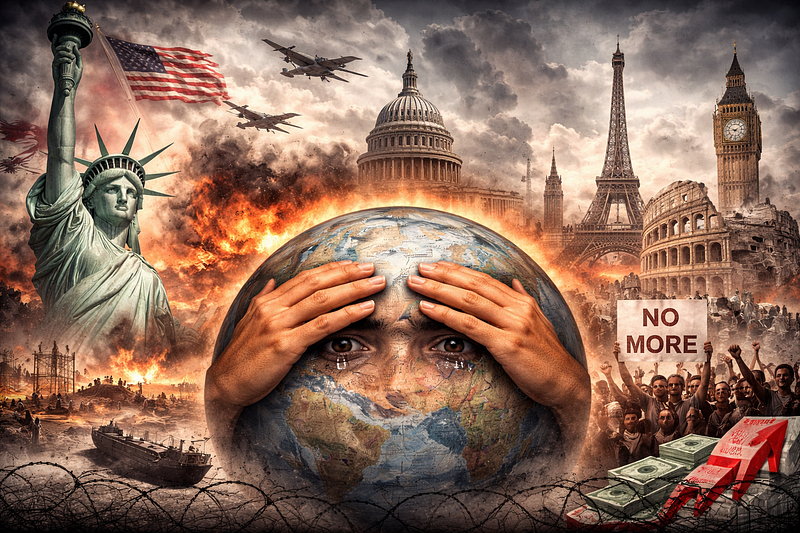
Europe, and increasingly the rest of the world, are being forced to absorb the consequences of wars they did not choose, triggered by decisions they did not control.
The IMF warned on March 9 that traffic through the Strait of Hormuz had fallen by 90 percent, that around one fifth of global oil supply and LNG trade normally moves through Hormuz, and that a prolonged conflict could hit inflation, growth, and market sentiment globally. AP reported that the conflict also disrupted a corridor carrying roughly one fifth of the world’s oil, forcing major importers to search for alternatives.
That is not a regional problem.
That is the architecture of globalized fallout.
The war starts somewhere.
The consequences spread everywhere.
Not everyone gets to decide.
Everyone gets to pay.
That is why the world has every right to judge what is happening. Not because every government is innocent. Not because every critic is pure. But because the cost of this kind of escalation never remains with those who initiate it. It travels through oil, shipping, insurance, inflation, industrial exposure, household budgets, political distrust, and institutional decay.
The center acts.
The periphery pays.
That is not an accident of the system.
That is one of its functions.
A miscalculation at the center becomes instability at the edge
This is where the ugliness becomes impossible to hide.
When the United States and Israel ignite a war in a zone tied to oil, shipping, and strategic chokepoints, the resulting instability is not some unfortunate side effect others should nobly endure in silence. It is the export of risk from the place of decision to the places of consequence.
Those who triggered the crisis keep the language of necessity.
Those forced to absorb the fallout are told to behave responsibly.
The ones who make the move claim urgency.
The ones who inherit the damage are expected to show restraint.
That inversion is not incidental. It is one of the central moral signatures of modern imperial behavior. The right to act rashly at the center. The demand for maturity at the edge.
Europe is living inside that inversion now.
So is much of the rest of the world.
The damage comes home
No war of this kind remains foreign for long.
That is one of the great lies told by distant power. That geography still protects societies from decisions made elsewhere. That if the map is far enough away, the consequences will remain abstract.
They do not.
They arrive through energy prices, inflation, budget strain, migration pressure, weakened trust, and the sense that the most important decisions are always made somewhere else. Over time, people begin to understand the pattern even if they do not always have the vocabulary for it.
They pay.
But they do not decide.
That is how trust erodes.
OECD findings show that more people report low or no trust in their national government than high or moderate trust, while trust in local government is higher. The same work shows that trust collapses when people feel they have little voice in political decision-making. In the EU, the Joint Research Centre reported in late 2025 that rural residents in particular show stronger trust in local and regional authorities than in more distant institutional layers.
That matters because this is not only a foreign policy story. It is a domestic political story too.
Washington externalizes risk.
European elites help administer the fallout.
Local populations live with the result.
Then they stop rewarding the center.
You can call that populism if you want.
Before it is a label, it is a symptom.
This is not new
That is what makes the present moment heavier than a single war.
The world has seen this pattern before. Iraq did not remain Iraq. Afghanistan did not remain Afghanistan. Syria did not remain Syria. Violence at the center of intervention became displacement at the edge, instability in neighboring states, migration pressure in Europe, and long after the headlines moved on, enduring fracture in the societies forced to live with the consequences.
UNHCR still counted 6.5 million internally displaced Syrians and 4.3 million registered Syrian refugees in neighboring countries as of December 2025. Iraq still had around 1 million internally displaced people long after the phase of invasion that shattered its structure.
These are not local scars.
They are exported damage.
And that is the part the world has spent years pretending not to see.
Ukraine as mirror
Ukraine belongs in this article not because it is the same war, but because it belongs to the same underlying structure.
The road to that war did not begin in February 2022. By then, the pressure system had already been built. NATO’s post-Bucharest declarations repeatedly reaffirmed that Ukraine and Georgia would become members of NATO. What Washington treated as strategic routine, Moscow read as encroachment into a vital security perimeter.
That does not erase Russian agency.
It restores chronology.
And chronology matters because it reveals the shape of the pressure long before the explosion becomes visible.
Once again the center built the tension.
Once again Europe absorbed the fire.
Energy shock.
Industrial strain.
Military pressure.
Political fragmentation.
Again the same pattern.
Washington helps construct the pressure system.
Europe is told to manage the consequences.
What most coverage still refuses to say
Most reporting still clings to the surface. Tension. Diplomacy. Disagreement. Statements. Leaders.
It avoids the mechanism.
Hierarchy.
Access.
Pressure.
Cost distribution.
Exported consequence.
Because once the mechanism becomes visible, the story changes completely.
This is no longer a disagreement among equals.
It is a crisis in a structure that has depended for years on others accepting costs they did not create, in exchange for language they were told to call alliance.
And that bargain is failing.
What a stressed alliance actually looks like
A stressed alliance does not collapse in a single gesture. It slows. It hesitates. It introduces friction where once there was automaticity.
Permissions take longer.
Access becomes conditional.
Compliance becomes negotiated.~
Silence becomes caution.
Caution becomes refusal.
That is what we are seeing now.
The alliance still exists.
But it no longer moves without resistance.
That matters more than any speech because it tells you the pressure has finally reached the level where ritual no longer guarantees obedience.
This is not one war.
Not one refusal.`
Not one diplomatic rupture.
It is a pattern.
The world has known for years how the United States behaves.
It kept looking away.
Now it can’t.
The fallout is too large.
The costs are too visible.
The damage no longer stays at the edges.
Closing reflection
The current backlash did not begin with one leader and it will not end with one post, one summit, or one war.
It began with a system that repeatedly made decisions at the center and exported the consequences outward.
For years, that arrangement held. The costs were absorbable. The language still worked. The pressure could still be translated, softened, and redistributed.
That is changing now.
Not because the behavior is new.
Because the limit is.
The costs are rising.
The exposure is widening.
The willingness to absorb is weakening.
And that is what makes this moment serious.
Not that Washington has suddenly become reckless.
That the rest of the world can no longer pretend not to notice.
Alliances do not crack because partners disagree. They crack when one side behaves like the owner and the others finally stop accepting the role of managed territory.
Related chapters from The Manifest
The Age of Managed CrisisHow instability is prolonged, managed, and redistributed instead of resolved.
The Architecture of Aid: How Help Becomes ControlWhy support so often functions as dependency in disguise.
How the ECB, Brussels and NATO Decide Your Life Without a VoteThe European layer of obedience, administration, and managed consent.
The Architecture of Power: How Modern Empires Hide in Plain SightHow hierarchy survives by presenting itself as order.
Related from The Manifest Archive