Introduction | The morning the music went quiet
The morning of April 21, 2016.
Paisley Park was still humming with yesterday’s echoes when officers entered the elevator hall.
They found him there, motionless, immaculate, the light still on.
The scene felt too quiet, as if the air itself had forgotten how to vibrate.
The report called it accidental fentanyl overdose.
The pills looked like Vicodin, but inside was a synthetic opioid a hundred times stronger than morphine.
He had no prescription.
No one was charged.
Within weeks the case was closed, sealed in administrative calm.
Six days earlier his private jet had made an emergency landing.
He had been revived with Narcan, refused to stay in the hospital, smiled for the cameras, performed again.
Then came silence.
These are the verified facts.
They explain nothing.
They show only the outline of a story about a man who spent his life avoiding ownership, and was claimed by it in the end.
He wasn’t only a musician. He was a philosophy in motion.
Prince built Paisley Park as a refuge where art and ownership could finally separate.
For decades he followed one rule: what you create must belong to you.
That conviction made him rich, then dangerous, then alone.
He fought labels, refused digital licensing, sued every platform that streamed his songs without consent.
In 2014 he won back his masters, a victory few artists have ever achieved.
Everything was deliberate.
Until the moment it wasn’t.
Then the precision collapsed, and the silence took over.
The war for masters
He saw the trap long before anyone else.
Contracts, clauses, percentages, polite vocabulary for servitude.
To the public he was eccentric; to insiders, prophetic.
He said it plainly: “If you don’t own your masters, your masters own you.”
Under Warner Bros., he was one of the most successful musicians on earth, yet he owned nothing he made.
Every recording, every reproduction, every song that bore his name was corporate property.
The contradiction wasn’t personal; it was structural.
The man who wrote Purple Rain needed permission to release his own work.
So he did what no artist dared.
He stopped playing by their language.
In 1993 he changed his name to a symbol, a gesture that was both rebellion and legal loophole.
The industry couldn’t pronounce it, print it, or file it.
By stepping outside language, he stepped outside contract.
Executives called him insane; journalists called him impossible.
But his reasoning was precise: if control requires a name, erase the name.
He performed as The Artist Formerly Known as Prince, his face marked with the word SLAVE.
It wasn’t theatre. It was documentation.
The label financed tours and videos, then owned them.
Even millionaires were debtors, the more they earned, the more they owed.
He filed suits, built his own studios, pressed his own records.
He was one of the first major artists to distribute music online, years before iTunes existed.
Freedom, for him, was not rebellion; it was administration.
Radio stopped playing him.
Award shows stopped inviting him.
The silence people mistook for retreat was strategy, a slow withdrawal from a machine that archived its artists alive.
In 2014 Warner Bros. returned his masters.
The press called it reconciliation. Insiders called it strange.
Labels don’t return assets worth hundreds of millions.
He smiled and said only, “They made me an offer I couldn’t refuse, my own soul.”
It sounded like triumph. It read like warning.
He began speaking again, praising independence but calling streaming “the new slavery.”
He warned that algorithms would replace contracts, that data would become the new property.
He spoke not as a prophet but as a survivor.
For a while, he seemed free.
But systems, unlike artists, do not forgive.
They wait.
Six days before
The fall from the sky
April 15, 2016.
His jet cut through the Midwest night after a concert in Atlanta, two encores, a gospel coda, and a smile that convinced everyone he was fine.
An hour later, he was found unresponsive.
The pilot dropped altitude.
At 1:15 a.m., they landed in Moline, Illinois.
Paramedics boarded, injected Narcan, and within minutes he was conscious again, dazed but alert.
He refused to stay overnight.
By morning he was flying home.
The press never learned details.
His team said dehydration; the hospital said nothing.
The FAA logged it as medical and sealed the file.
No one confirmed who had given the Narcan, or why.
The return to silence
Two days later he appeared at a record store, buying vinyl copies of his own albums.
He smiled and told fans, “Wait a few days before you waste any prayers.”
It sounded playful then.
In retrospect, it was the edge of something invisible.
He rehearsed, rode his bike, hosted a small party, played unreleased tracks.
Witnesses said he looked pale but energetic, talking about new projects and a memoir.
Movement was his nature; stillness belonged to other people.
On April 20 he called his physician, asking for a home visit.
That evening, prescriptions were filled under his assistant’s name, a method used to protect celebrity privacy.
By morning, he was found in the elevator.
He spent a lifetime mastering sound.
What killed him was silence in chemical form.
The fatal pill
The last twelve hours of his life remain a vacuum.
Messages to staff, plans for breakfast, nothing unusual.
Security cameras recorded movement inside the studio, but the footage never surfaced.
No one saw him collapse.
No timeline shows when he took the pill.
The only certainty was its deceit.
The tablet stamped Watson 853 looked legal but wasn’t.
Inside was fentanyl, cut with inert powder, a compound so potent that two milligrams, the weight of a grain of salt, can stop the heart.
Toxicology measured sixty-seven micrograms per litre in his blood.
Enough to kill instantly, without visible trauma, without a sound.
Investigators tested other pills in the same bottle.
Some were real Vicodin. Others nothing but sugar.
A bottle of disguises.
Control had defined his life; this was its perfect inversion, chaos pretending to be medicine.
The artist who fought imitation was killed by a counterfeit.
Agents traced the prescriptions through pharmacies and distributors.
The trail dissolved where the names changed.
Dr Michael Schulenberg admitted writing medication under the name of Prince’s assistant, Kirk Johnson.
He said it protected privacy.
The DEA called it “common, but technically improper.”
A thirty-thousand-dollar fine closed the matter.
No one traced the counterfeit’s source.
No one was charged.
The verdict, accidental ingestion, was an ending disguised as explanation.
Fentanyl is designed for precision.
The black-market version erases it.
That paradox became the allegory of his death: a man obsessed with exactness undone by its absence.
After the autopsy
The autopsy confirmed what everyone already feared and no one understood.
A microscopic dose.
No alcohol.
No long-term drug use.
A healthy heart.
A clean, sudden end.
The body was cremated within a week.
Within two months, the vault was opened.
Thousands of tapes, journals, photographs, catalogued, insured, appraised.
The estate was valued above two hundred million dollars.
The same institutions that once owned his masters now managed his remains.
Closure is an administrative word. It doesn’t mean understanding. It means the file has reached a shape that looks acceptable.
There were no villains, only participants.
A doctor following procedure.
An assistant following trust.
A pharmacist following order.
Each link intact, the outcome fatal.
It is difficult to accept that a system can function correctly and still destroy what it was built to protect.
Requests for full disclosure brought redacted documents, timelines without hours, interviews without questions, data without context.
Even his autopsy photographs were sealed indefinitely.
What the public record contained most abundantly was absence.
And perhaps that was the point.
When art becomes property, and property becomes liability, death becomes administration.
Prince’s last performance, the closing of a file, the division of his estate, all parts of the same choreography of silence.
Not a conspiracy, but a reflex: a system protecting itself from the embarrassment of imperfection.
Some truths die not by suppression but by management.
The machinery of death and profit
The business of afterlife
When the lights dimmed in Paisley Park, they brightened elsewhere.
Phones rang in law offices, labels, and banks.
The first calls were not about mourning but about management.
He left no will, but he left enormous value: nearly forty albums, a vault of thousands of unreleased songs, manuscripts, and film reels.
Each item represented potential capital, streaming, licensing, merchandising.
In modern music, legacy begins the moment the pulse stops.
Death is not loss; it is liquidity.
In an industry that measures grief by royalties, immortality has a quarterly return.
Comerica Bank took charge of the estate.
Consultants were hired, valuations made, contracts renewed.
Every sound was digitised, logged, converted into property again.
The process that had once enslaved him resumed as tribute.
The vault and the key
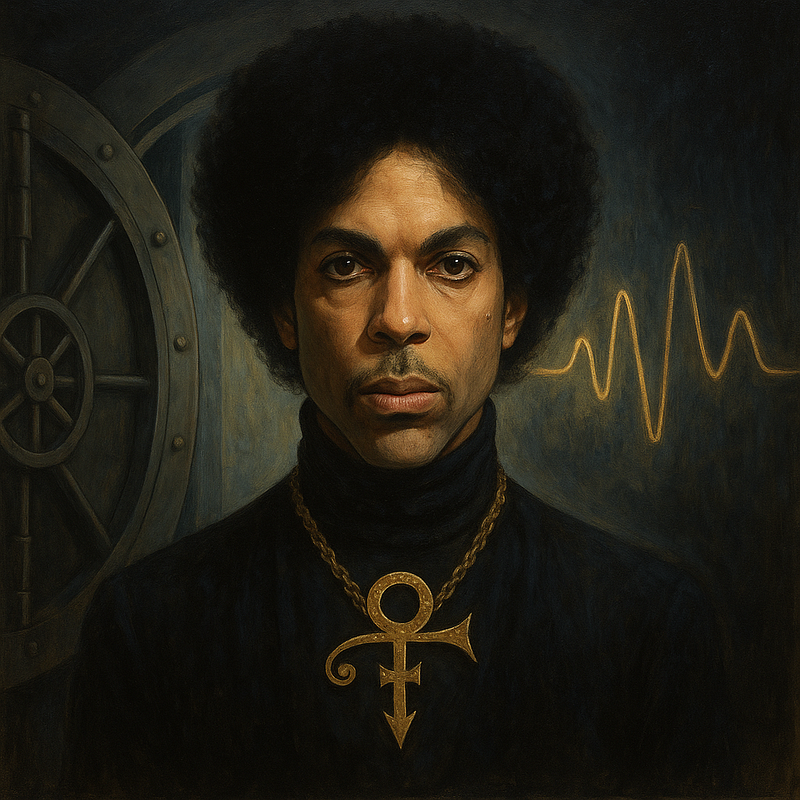
The vault was real, a reinforced room with steel doors and no index.
He alone knew its contents.
After his death, technicians drilled through the metal.
Inside they found decades of music labelled in symbols only he understood.
For him, it had been sanctuary.
For them, it was inventory.
Every reel received a barcode.
Each song a price.
What had been private faith in sound became marketable eternity.
He built a temple for art; they reopened it as warehouse.
The insurance of immortality
In the logic of entertainment, mortality is actuarial.
Life-insurance policies on performers are common; estates are investment vehicles.
When a high-profile artist dies, revenues spike.
They call it the catalogue effect.
In the year after his death, his music earned more than in the previous five combined.
Streaming doubled, merchandise tripled, licensing soared.
Even his silence had yield.
The more perfectly a system can monetise grief, the safer it feels.
Death, for the entertainment economy, is not an ending. It’s a relaunch.
From mourning to marketing
Paisley Park reopened as a museum within six months.
Tours cost forty-six dollars and ninety-nine cents, a wink to 1999.
Visitors walked past his motorcycles and jackets, through rooms lit in purple glow.
Each relic became a revenue line.
The walls preached reverence; the gift shop balanced the books.
For fans, it was pilgrimage.
For accountants, optimisation.
Each artefact, another asset.
The legend of independence was now a curated experience, profitable and polite.
The inheritors
He died without a will.
Six siblings, two later deceased, fought for control.
The IRS valued the estate at one hundred fifty-six million; lawyers argued it was half that.
After six years, they compromised.
Half went to a family trust.
Half to a company called Primary Wave, specialising in “legacy management.”
Its mission: to amplify iconic voices for new generations.
In corporate language, amplify means monetise.
Iconic means profitable.
He achieved in death what life denied him, perfect market stability.
The vault
A fortress of sound
Deep beneath Paisley Park, past mirrored halls and silent rehearsal rooms, lay the chamber that explained him better than any biography.
A thick steel door sealed the entrance.
Inside, shelves of reels and notebooks stretched into shadow.
He called it the Vault.
No one else had a key.
He stored combinations in his mind, kept assistants outside the door, allowed dust but not intrusion.
It wasn’t storage. It was sovereignty.
Every empire builds walls. His were made of rhythm.
The Vault was not where he hid music. It was where he kept freedom breathing.
Each album he released was a fraction of what he recorded.
For every song the world knew, five waited below.
He said he would release them when the world was ready.
It was prophecy and protection at once, a refusal to let time belong to anyone else.
The drilling of the door
After his death, the combination died with him.
For days the staff waited for instructions that would never come.
Then, under legal order, locksmiths drilled through the steel.
The sound echoed through the halls like the last note of a concert refusing to end.
Inside they found hundreds of tapes, digital drives, hand-written lyrics, videos and sermons.
Some catalogued, others raw instinct.
To lawyers, the find was an asset.
To engineers, a rescue.
To those who had known him, a trespass.
The first violation after death is always administrative.
The industry descends
Comerica Bank hired archivists to appraise, barcode and digitise every fragment.
The project took years.
What had once been an ungoverned garden of sound became an archive of value.
Albums emerged as rediscoveries, Piano & a Microphone 1983, Welcome 2 America, each promoted as a miracle unearthed.
For listeners they were gifts.
For the industry, renewals of copyright.
The longer an artist resists control, the more profitable his surrender becomes.
The meaning of the lock
He built the Vault because he knew that every revolution needs containment.
He had watched what happened to Hendrix, to Jackson, to every artist whose fragments became someone else’s property.
If he couldn’t own time, he could at least delay it.
The lock said Not yet.
It said This still belongs to me.
When the world drilled through that door, it didn’t just recover lost music.
It crossed his final boundary.
He tried to build eternity in a room. The world turned it into inventory.
The alchemy of legacy
From memory to merchandise
Legacy once meant endurance.
Now it means conversion.
What cannot be forgotten must be reformatted.
Within months of his death, the transformation began.
Paisley Park reopened not as sanctuary but as enterprise: museum tours, curated exhibits, licensing deals.
His face appeared on sneakers and perfumes, his voice on streaming ads.
The colour that had symbolised sovereignty became a marketing code.
The estate filed trademarks, licensed film projects, approved documentaries.
Efficiency replaced reverence.
Even remembrance had a management plan.
The easiest way to control a rebel is to turn him into décor.
The industry of immortality
When global figures die, continuity activates automatically.
Publishers, platforms, investors need clarity, not mourning.
Tribute becomes transaction.
The same corporations that once owned his masters now called themselves caretakers of his vision.
Press releases spoke of honour; balance sheets spoke of growth.
Reverence had its revenue column.
Sales soared.
His catalogue re-entered charts he had abandoned.
Box sets sold out; documentaries multiplied.
Defiance itself had become a subscription model.
The erasure within the echo
New narratives focused on brilliance, style, colour, not autonomy.
His warnings about ownership vanished from official scripts.
Curators called it focus; archivists called it context.
It was, in truth, a gentle forgetting.
He wasn’t censored; he was edited.
The inconvenient prophet became a universal mascot.
A man who distrusted technology was reintroduced through algorithms.
A rebel against record labels returned as playlist icon.
The echo can survive long after the voice has been tuned out.
Family, faith, and the filter of grief
Relatives spoke of his faith, his abstinence, his philanthropy.
They argued that addiction contradicted the man they knew.
But grief has little power against infrastructure.
Their voices faded beneath the hum of commerce.
Friends remembered him as obsessed with justice, musical, social, spiritual.
He donated quietly, fought for Black ownership, preached creative independence as moral duty.
Such truths rarely made it into documentaries.
They were less marketable than purple mystique.
Grief edits to make pain tolerable.
Commerce edits to make memory useful.
The philosopher in disguise
Behind the spectacle lived a thinker of control.
He saw technology as theology, tools turning into gods.
He called sound spiritual architecture, vibration as proof of the divine.
To him, music was not product but prayer.
That philosophy frightened the institutions that now celebrate him.
He once said, “Real power is knowledge that you don’t sell.”
Today, seminars dissect his business model and start-ups use his name for blockchain marketing.
He taught ownership as faith.
The world learned it as branding.
The pattern of erasure
The ritual of forgetting
Every age invents its own method of forgetting.
Once it was exile or fire.
Now it is revision, the slow editing of narrative until it offends nothing.
Prince’s story underwent that purification.
The man who warned of ownership became a symbol of glamour.
The artist who distrusted machines became an emblem for streaming culture.
The prophet of independence turned saint of nostalgia.
Not through plot, but through habit.
The most efficient form of censorship is reverence.
The industry’s memory machine
Corporations call it legacy management.
Historians call it canon formation.
Both mean reshaping the past to stabilise the present.
His lawsuits and refusals were re-described as eccentricity, his strategies as quirks of genius.
Documentaries showed the light and the leather, not the paperwork and the fight.
Spectacle replaced truth.
When institutions curate rebellion, they neutralise it.
The audience feels comforted, not challenged.
And the system continues, inoculated by homage.
Rebellion becomes heritage the moment it earns profit.
Echoes of others
He wasn’t the first to be rewritten.
Hendrix, Joplin, Morrison, Cobain, each absorbed, polished, repackaged.
The choreography repeats: outrage, mourning, tribute, sale.
Even their defiance became franchise.
Culture tames danger by putting it on display.
Prince foresaw it.
He predicted the digital economy of control, the rise of algorithmic taste, the hollowing of individuality.
He spoke of ownership as salvation when few listened.
Now those words sound prophetic, and inconvenient.
The silence that protects
Archives carry no malice; they operate on courtesy.
They omit through order, not intent.
His journals and unfinished memoir remain unpublished.
Editors cite privacy.
Perhaps it is respect. Perhaps vocabulary for disappearance.
Every empire, cultural or political, depends on archives that omit just enough to survive.
Respect, fear, and convenience blur until they look identical.
In that blur, memory loses its edge.
To preserve a man completely, you must first dismantle his meaning.
Closing reflection | The man who became a frequency
He tried to make music immortal by keeping it human.
Every chord, every breath, was an argument against control, proof that spontaneity still mattered.
He believed that sound could tell truth more faithfully than language, that vibration itself was divine.
In the end, vibration was all that remained.
The world around him turned that belief into infrastructure.
His vault became database.
His masters became assets.
His rebellion became curriculum.
And yet, within all that circuitry, the music still shivers.
Technology can imitate tone, but it cannot counterfeit intent.
When historians write about him, they will list innovations: guitars, falsetto, independence.
They will mention lawsuits and fashion, the purple mythology, the spectacle.
But what matters most is the method, a life lived as an experiment in ownership.
He tested whether freedom could survive inside commerce, whether faith could outlast profit.
The answer remains ambiguous.
He lost the war for permanence, yet won something quieter.
He left behind a template for resistance, not through slogans, but through practice.
He proved that a single artist could terrify an empire simply by reading his own contract.
The most radical act is still to know what belongs to you.
Every era believes it is freer than the one before.
Ours measures liberty in access codes and data plans.
We call it connection, but it feels like exposure.
Prince foresaw this long before most of his peers.
He warned that the new masters would be invisible, written in code instead of ink.
He saw that music would become metadata, that creativity itself would be quantified.
He was right.
Algorithms now compose choruses; platforms decide taste; artificial voices fill the air.
Artists are taught to become brands, their lives streamed as performance loops.
The line between expression and obedience grows thinner each year.
Against that horizon, his defiance looks almost sacred.
He built a sanctuary in a time that worships transparency.
And within that sanctuary he proved that privacy can be a form of faith.
Sound never really disappears.
It weakens, bends with distance, but a trace always remains.
Physicists call it decay.
Poets call it echo.
That is what he became, not a man, not a myth, but a wavelength still bouncing through memory.
When Purple Rain plays today, you hear more than nostalgia.
You hear the tension between creation and control, the pulse of someone who refused to be formatted.
Each chord still asks the same question his life asked:
Who owns what you feel when you hear this?
There are no villains left to accuse.
Only systems, vast, unfeeling, self-sustaining.
They do not silence; they absorb.
They do not punish; they rebrand.
And yet, beneath that machinery, resistance still hums.
Prince’s legacy is not his catalogue or his style.
It is the awareness that art, once conscious of its own exploitation, can still choose dignity.
His death remains surrounded by coincidences.
But his life remains proof that coincidence is never the whole story.
He became a frequency, impossible to own, impossible to silence.
Epilogue | The sound of ownership
Somewhere in a climate-controlled room, a fragment of his unreleased music still waits.
It rests on a drive labelled in symbols only he understood.
One day, engineers will open it, restore the data, polish the sound.
The vault will breathe again, and the world will call it resurrection.
But for those who listen closely, there will be something else beneath the remaster:
a pulse that refuses automation,
a rhythm slightly out of sync,
a voice still asking for its name back.
Every time his music plays, the system profits.
Every time his music plays, it also trembles.
And in that tremor lives the last unowned thing he left behind.
Freedom was never a product. It was always a frequency.
Related Chapters from The Manifest
The Second Civil War: The Implosion of the American Dream, When a nation begins to fear itself, entertainment replaces reflection.
The Tsunami Effect: Why Gold Rises Before the Flood, Every shimmer of safety is the sea pulling back before collapse.
Digital ID: The New Face of Obedience, Freedom was never lost, it was redesigned as verification.
Related from The Manifest Archive