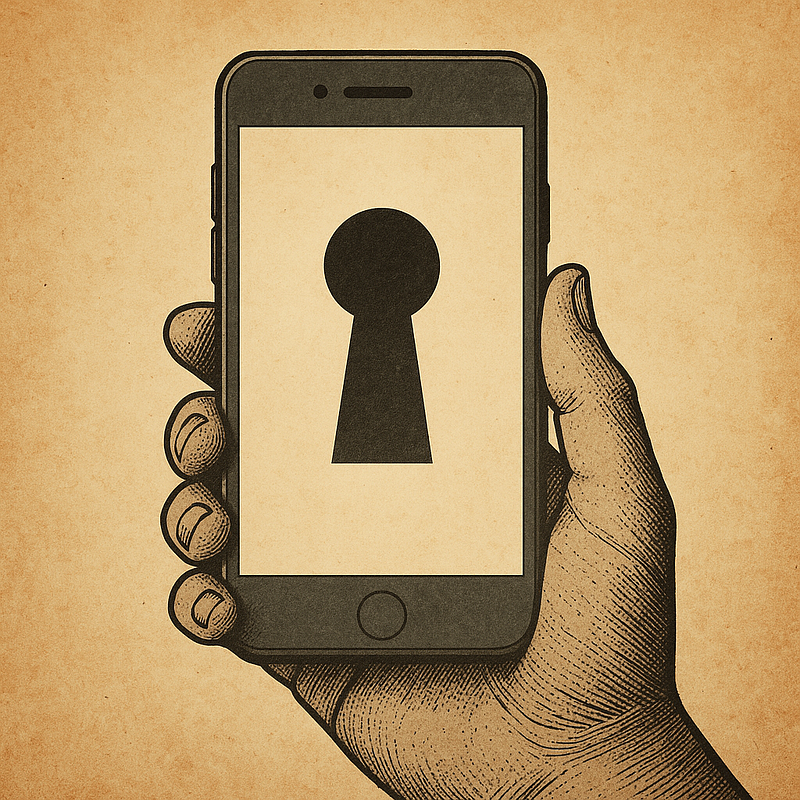
The mask of comfort
The arrival of ease
Every age welcomes its machines as gifts. The Roman census was introduced as fairness, the printing press as enlightenment, the radio as community. In each case, what appeared as liberation concealed control. Technology rarely arrives with chains. It arrives with ribbons.
The twentieth century perfected this art. IBM’s punch cards counted populations with the promise of efficiency, while quietly enabling states to catalogue entire societies. Microsoft’s personal computer was marketed as empowerment, but standardized global interfaces that made every keystroke part of a system designed elsewhere.
Each invention came draped in the language of freedom. Yet each created a deeper archive, a framework within which lives could be recorded, measured, and eventually steered.
“Every technology enters the home as a friend. Only later does it reveal the ledger it carries.”
The psychology of comfort
Comfort disarms resistance. When a device saves time, simplifies a task, or entertains a child, its hidden costs vanish from view. The first thrill of clicking a mouse, the ease of typing a letter without ink stains, the excitement of opening Encarta or sending an email, all felt like progress.
But comfort is never neutral. It is the anesthetic of control. By making the act of surrender pleasant, it ensures no one notices the surrender at all.
The self-built panopticon
Feeding the archive
The genius of modern surveillance is that it no longer needs to hide. We feed it openly. We train facial recognition with endless selfies, taken for fun, stored forever. We volunteer our fingerprints to unlock phones. We map the world in real time with GPS-tagged photos, unwittingly creating the most comprehensive atlas in history.
What once required spies, interrogators, and clerks is now performed by the crowd itself. Citizens become archivists of their own lives, recording everything, tagging everything, storing everything.
“Surveillance today is not imposed. It is celebrated.”
From secrecy to intimacy
Where once surveillance was a distant institution, a census bureau, a police archive, an intelligence office, it has now become intimate. The device in your pocket listens as you speak, notes where you travel, learns what you desire. Wearables monitor heart rates, sleep patterns, oxygen levels. Your body itself has become a data feed.
Governments barely need coercion. Corporations barely need persuasion. Citizens subscribe to surveillance, convinced they are subscribing to comfort.
The open eyes
The most striking feature of this system is not deception but participation. We know what these devices do. We know that GPS tags location, that fingerprints are biometric keys, that selfies feed recognition algorithms. Yet we continue, smiling into the lens, pressing our fingers against glass, uploading our memories to clouds that are not ours.
“The panopticon no longer surrounds us. We carry it in our pockets.”
From census to cloud
The empire of records
Every empire begins with a record. Rome’s censuses, cloaked in the promise of fairness, enabled taxation and conscription. The Vatican’s archives, preserved in the name of knowledge, determined which ideas would circulate and which would disappear. IBM’s punch cards, sold as efficiency, made possible the bureaucratic machinery of the twentieth century, from social security to genocide.
To count is to control. To write is to rule. This lesson repeats across centuries. What changes is not the principle but the intimacy of the archive.
Where once data was collected at borders, tax offices, or parish registries, the cloud has dissolved all distance. The census no longer waits for you to report yourself. The census now lives in your hand, tracking without pause, logging without consent.
“The cloud is not a place. It is a census without end.”
The continuity of power
It is tempting to imagine technology as rupture, each invention as a break from the past. In truth, it is continuity. The punch card became the database. The database became the interface. The interface became the phone. The phone became the body.
Every step carried the same promise: ease, fairness, empowerment. Every step carried the same result: a deeper archive, a more perfect visibility of human life.
The Trojan horse of philanthropy
The classroom conquest
When Microsoft entered schools in the 1980s and 1990s, it was under the banner of philanthropy. Computers were donated, software discounted, licenses distributed. Children thought they were learning modern literacy. Teachers celebrated new tools. Officials praised generosity.
But philanthropy was the mask. Standardization was the goal. By making Office and Windows the lingua franca of classrooms, entire generations were raised inside a single walled garden. To type a school essay in Word was to adopt Microsoft’s language. To learn PowerPoint was to adopt its logic. To save in .doc was to surrender to its archive.
“The gift to the classroom was the key to the kingdom.”
The ecosystem of dependence
Governments followed schools. Institutions standardized on Windows. Corporations aligned their workflows to Office. The cost of exit became unthinkable. The brilliance was not technological alone but infrastructural: by shaping the conditions of literacy, Microsoft shaped the conditions of dependence.
When Snowden revealed in 2013 that Microsoft, codenamed Partner One, had collaborated with PRISM, the shock was not that data flowed outward, but that it flowed so easily. The archive had already been built. The only question was who could read it.
“Philanthropy in the daylight, surveillance in the dark.”
Influence beyond surveillance
From watching to steering
Surveillance is never the end. It is the beginning. To record is to predict, and to predict is to influence. The archive does not just remember what you did. It learns what you will do.
Algorithms trained on your searches suggest what to buy, who to follow, what to watch. Notifications nudge you to open, scroll, engage. The feed is no longer a mirror of your choices; it is a guide shaping them.
“The point of surveillance is not to watch you. It is to make you predictable.”
Where once governments needed laws to steer citizens, and corporations needed advertisements, now influence arrives invisibly. A headline placed higher, a message delivered sooner, a choice framed slightly differently. Freedom remains intact in appearance, but in practice the path is gently bent.
The paradox deepens: comfort becomes control not only by recording us, but by directing us.
The invisible architecture
Every architecture is a form of power. Bridges determine where you cross, grids decide where you live, and digital infrastructures decide what you see. The neutrality of technology is the greatest illusion. There is no neutral algorithm, no neutral interface. Each is designed, and design is always ideology made code.
The intimacy of biometrics
Data in the bloodstream
The shift from institutional surveillance to personal devices was profound. Yet the leap into biometrics made it intimate. Fingerprints that once belonged only on police files became the keys to unlock phones. Faces that once appeared only on passports became the passwords to bank accounts.
Our bodies themselves became the archive.
Wearables log heartbeats, sleep cycles, oxygen levels. Smart scales record weight fluctuations. Genetic testing companies sequence DNA in the name of ancestry and health. What was once whispered in the privacy of the doctor’s office now streams directly to servers across the globe.
“The archive no longer stops at the skin. It flows through the veins.”
The volunteered panopticon
What makes this transformation astonishing is that it was not coerced. It was purchased. We bought the watches, we downloaded the apps, we signed the terms. We celebrated each step, believing it to be freedom.
Governments and corporations no longer needed to impose surveillance. Citizens lined up to adopt it, smiling as they handed over fingerprints, scanning their faces with delight, posting selfies by the billions.
The panopticon of our age is not a prison. It is a marketplace. And its prisoners are also its customers.
“We no longer resist surveillance. We subscribe to it.”
The open eyes
The awareness we ignore
Perhaps the most striking feature of our age is not deception but complicity. We know what these devices do. We know that every photo carries GPS data, that every fingerprint is stored, that every selfie trains recognition systems. The revelations of Snowden did not end surveillance. They normalized it.
We continue anyway. We unlock with our faces, share our locations, track our bodies. The excuse is always the same: it is comfortable, it is easy, it is fun.
“We are not deceived. We are seduced.”
The panopticon of our time does not hide in basements of ministries. It glows in the palms of our hands, on the dashboards of our cars, in the voices of our assistants. We walk into it with open eyes, persuaded that there is nothing to fear in what everyone else is doing too.
The trap of resignation
Comfort reshapes not only our habits but our expectations. We no longer imagine life without maps, without constant messaging, without instant knowledge. To step outside these infrastructures feels impossible. The trade has already been made.
This is the trap: we cannot resist because we cannot imagine living without it.
Closing reflection, the price of ease
The family in the 1990s could not imagine that their children would one day carry devices recording every step, every word, every breath. For them, technology was a window to knowledge. For us, it has become a mirror that reflects us endlessly to powers we cannot see.
The façade of comfort remains seductive. Nobody wants to abandon instant maps, free communication, digital access. But the question sharpens each year:
“If comfort is the promise, what is the price we are not asked to see?”
Perhaps the real question is not what technology offers us, but what we are willing to trade for the illusion of ease.
Related from The Manifest Archive