Three dead, five seriously wounded, 150+ tankers stalled. A four to five day gamble turns into a war with no off ramp.
A captain on a tanker does not need a briefing to understand escalation.
He understands it when the radio goes quiet, when the corridor that is supposed to move the world turns into a parking lot, when the horizon fills with ships that should be in motion but are not. He understands it when the sea looks calm and the system does not.
The Strait of Hormuz is at a standstill. Over 150 tankers sit anchored on either side of the choke point. The world sees a line on a map. The market sees a vein. This is where global order reveals its wiring, not in speeches, but in stoppages.
If you are looking at the Middle East right now, what you are seeing is not a victory lap. It is not a surgical strike followed by a clean exit. What you are seeing is an American president who reportedly bet everything on a four to five day war and is now staring down the barrel of a conflict with no off ramp.
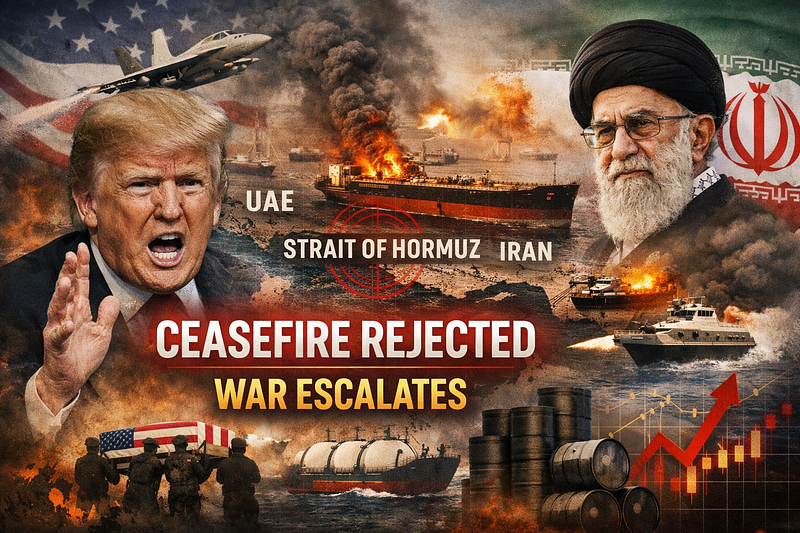
Iran has rejected Donald Trump’s ceasefire offer. Three U.S. service members are confirmed dead. Five more are seriously wounded. The Iranian regime, far from collapsing, has launched its seventh and eighth waves of retaliatory strikes across the entire region.
This does not look like a mission accomplished moment. It looks like a controlled demolition of American strategic credibility in real time.
The war did not end quickly.
It revealed how expensive “quick” really is.
This chapter belongs to The Manifest. Related chapters are linked at the end.
Strait of Hormuz Stalls After Iran Ceasefire Rejection
Why Hormuz Is the Global Chokepoint
There are moments when geopolitics stops being rhetoric and becomes traffic.
The Strait of Hormuz is one of those places. It is not simply water. It is a bottleneck that modern economies depend on. When it stalls, the world does not merely watch a regional confrontation. It feels a systemic tremor.
Iran has rejected Trump’s ceasefire offer. The next facts are not abstract. They have names and families behind them. Three U.S. service members are confirmed dead. Five more are seriously wounded. The choke point is clogged, with over 150 tankers anchored on either side.
The war has not produced a clean exit. It has produced a new condition.
The Four to Five Day Iran War Assumption
Imagine you have a business partner. Every adviser you trust, every analyst you pay tells you that if you burn down your partner’s office, you will not get a better deal. You will get a counterattack, a lawsuit, and years of chaos. But you light the match anyway because you convinced yourself you know better than everyone in the room. Now your own building is on fire and you are calling your partner begging to negotiate.
How long do you keep pretending this was the plan.
According to multiple reports, the war plan against Iran was built on one catastrophic assumption. Kill the Ayatollah and the regime folds. The planning window was reportedly four to five days. The theory was elegant in its simplicity. Decapitate the leadership, watch the country fracture, offer a ceasefire from a position of total dominance, declare victory, move on.
Quick. Clean. The kind of footage that plays well on cable news.
But the warning was there. The CIA warned it would not work that way. Intelligence analysts reportedly made clear that killing Ayatollah Khamenei would not disable the Iranian state. It would radicalize it. It would produce a more extreme successor. It would activate proxy networks across the entire region from Yemen to Lebanon to Iraq. And it would transform what was supposed to be a contained operation into a sprawling multi front conflict with no clear exit strategy.
Trump dismissed those warnings. He went with his gut. And his gut was catastrophically wrong.
A plan that depends on instant capitulation is not a plan.
It is a wager with human lives as the stake.
Ceasefire Rejected: Iran Rejects Trump’s Offer
After launching what his administration branded Operation Epic Fury, Trump reached out to Iran seeking a ceasefire. Iran did not just decline. Iran made the rejection public. The message from Tehran was unambiguous. Any ceasefire will happen on our terms, not yours.
That is not the language of a regime on its knees. That is the language of a government that believes it holds leverage.
Trump planned for immediate capitulation. He got public defiance. And in the gap between that expectation and that reality, American soldiers are now dying.
US Casualties Reported: Three Dead, Five Seriously Wounded
Bahrain, Kuwait, UAE: Bases Under Pressure
U.S. Central Command confirmed three American service members killed in action and five seriously wounded.
Open source intelligence analysts have noted these casualties appear to result from Iranian ballistic missiles and one way attack drones striking U.S. bases in Bahrain, Kuwait, and the United Arab Emirates.
Then comes the part that should make your blood boil. Several of these bases reportedly sustained far more serious damage than CENTCOM initially disclosed. The government told the public the strikes were not serious. Then we learned service members were dead.
That is not a fog of war issue. That is a trust issue. When your own military command is understating the severity of attacks on your own forces, you are not managing information. You are constructing a narrative and calling it reality.
IRGC Claims 560 US Casualties in Information War
And this is where modern war becomes something worse than explosives. It becomes competing information systems using numbers as weapons. Each side inflates, edits, delays, frames, not because it is confused, but because control is part of the campaign.
The IRGC claims 560 American casualties, meaning killed or wounded, a figure designed to dominate the psychological terrain. The administration on the other side is accused of minimizing and staging its own numbers for political containment. Between those machines, the public is left with fragments.
In war you can absorb setbacks.
The moment you lose a shared reality, everything becomes combustible.
150+ Oil and LNG Tankers Anchored Near the Strait of Hormuz
LNG Supply Risk: 20–25% Through One Waterway
Then comes the hinge that exceeds the region.
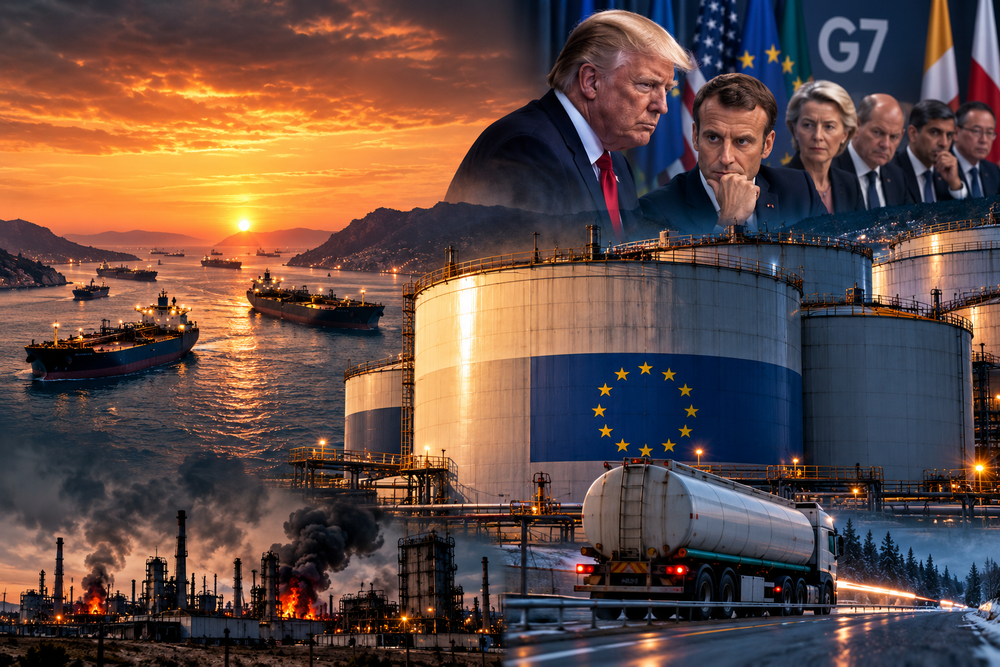
At least 150 tankers, including crude oil and liquefied natural gas vessels, dropped anchor in open Gulf waters beyond the Strait of Hormuz. Dozens more sit stationary on the other side. Iran has reportedly begun firing on oil tankers near the Strait.
Twenty to twenty five percent of the world’s liquefied natural gas supply transits that narrow waterway.
This is not a regional inconvenience. This is a global economic weapon, and Iran just armed it.
While Trump was planning a four day operation, Iran was preparing to hold the world’s energy supply hostage. One of those is strategy. The other is a gamble made by a man who has bankrupted everything he has ever touched.
There is also a quieter war running alongside the loud one. Not missiles, but media. Not doctrine, but attention. Even the people claiming to track the crisis can fall into ritual, turning escalation into content. That is not a side note. It is part of how consent is managed while the numbers climb.
Iran Retaliation Waves Seven and Eight Across the Region
When the artery is pressured, the war stops being local. It becomes regional by design, because every connected node is suddenly usable as leverage.
This is the point without return. Not because it is dramatic, but because it is structural.
Once a ceasefire is publicly rejected, once bodies are confirmed, once the choke point stalls, you are no longer inside a plan. You are inside a system. A system does not stop because someone wants it to. A system stops when the cost becomes unbearable, or when an off ramp exists that both sides can touch without humiliation.
The off ramp did not appear. The cost did.
From that moment on, every actor reads the same lesson in the same numbers. Not the speeches. Not the slogans. The anchored tankers. The confirmed dead. The injured. The stalled corridor.
Iran Command Redundancy vs Decapitation Strategy
Most people expect a state to fracture when its supreme leader is assassinated. The opposite is described here.
President Masoud Pezeshkian appeared on state television and announced the interim leadership council is operational and has assumed constitutional control. His message was clear. We will continue the path of the leader with strength. Our armed forces are crushing the bases of our enemies.
The IRGC announced waves seven and eight of what they call Operation True Promise targeting U.S. bases across the region. They claim the Ali al Salm air base in Kuwait has been completely disabled.
Iranian strikes have hit targets in Bahrain, Kuwait, the UAE, and central Israel. In Beersheba at least six people were killed and 14 remain missing. A Shahed drone struck a French naval base in Abu Dhabi. Multiple explosions were reported at the Zed port. A drone struck a UAE oil platform in the Persian Gulf.
This is not a regime in collapse. This is a regime executing a regional retaliation playbook it clearly had prepared in advance. While Trump assumed the Ayatollah was a single point of failure, Iran had built redundancy into every layer of its command structure.
That is the difference between a strategist and a gambler. The strategist prepares for the worst case. The gambler assumes his luck will hold.
If you gamble on swift collapse, you gamble on the enemy’s psychology.
If you build redundancy, you gamble on time.
Proxy Networks Expand: Yemen, Lebanon, Iraq and Regional Bases
The Ayatollah’s influence was never confined to Iran. Killing him did not shrink the threat network. It metastasized it.
In Yemen, massive crowds are calling for revenge. In Karachi, protesters stormed the U.S. consulate. American embassies across the Middle East are under threat.
The region is not a set of isolated states. It is an interlinked pressure system. When one node is hit, others respond. When one corridor stalls, others become targets. When one chain is activated, multiple theaters light up.
Sleeper Cell Warnings and Domestic Security Ripple Effects
Western intelligence agencies have issued warnings about Iran activating sleeper cells.
Then comes the domestic echo that shows how quickly foreign war becomes internal paranoia. The FBI activated its counterterrorism task force in connection with a mass shooting in Austin, Texas that left three dead and 14 injured, with officials confirming indications of a potential nexus to terrorism.
This is the second front. Not only rockets abroad, but legitimacy and fear at home. When a war has no off ramp, the home front becomes part of the terrain.
Whether that nexus hardens into proof or later falls apart does not change the mechanism described here. War converts every incident into a potential extension of the battlefield. It is not only what happens. It is what becomes plausible.
Congress Authorization and the US War Powers Question
Set that next to what the Trump machine is producing.
Trump told The Atlantic that Iran played it too cute.
Three service members are dead. And the analysis is too cute.
On Fox News, Trump said, Nobody can believe the success we are having. Nobody can believe it.
Lindsey Graham was asked if the president has a plan to ensure Iran does not reconstitute as a terror state. His response was, That is not his job.
Tom Cotton was asked whether Americans deserve more than an eight minute Twitter video after being taken to war without congressional authorization. He called the video outstanding.
These are not serious people managing a serious crisis. These are performers staging confidence while the region burns.
In contrast, Democratic Senator Chris Murphy stated plainly that nobody in this country asked for war with Iran, that the president is obligated under the Constitution to seek congressional authorization, and that he would not get it if he asked.
And one more layer matters. Your media diet determines what you think is happening. If you consume only right leaning media, you can believe it is a clean decisive operation. You will not know Israel is closing all crossings into Gaza, including for humanitarian aid. You will not know the damage to U.S. bases is far worse than reported.
Energy Prices and Shipping Costs: How Hormuz Hits the Economy
If the Strait of Hormuz stays blocked, energy prices do not just rise. They spike. Every barrel of oil that cannot transit that waterway gets repriced on global markets within hours. That means higher gas prices, higher shipping costs, higher prices on everything that moves by truck or ship.
If this conflict drags on for months, the United States faces a serious munitions inventory question. And once the defense industrial base pivots to wartime production, those resources are not building roads or schools or factories. They are replacing the missiles being fired into a war that Congress never authorized and the public never requested.
This is how war becomes domestic. Not through flags. Through invoices.
Three Scenarios: Off Ramp, Regional Realignment, Escalation Spiral
Scenario 1: Managed Off Ramp via Backchannel Diplomacy
Scenario one is a managed off ramp. Back channel diplomacy through Oman, Qatar, or possibly China brokers de escalation. Both sides claim victory. Trump says he eliminated the Ayatollah. Iran says it defended itself and extracted a devastating price. Some version of a ceasefire takes hold.
But even in this best case, the structural damage is permanent. The Strait of Hormuz disruption has already forced global shipping to reroute. The precedent of assassinating a head of state has been established. Those cracks do not heal just because politicians shake hands.
Scenario 2: Gulf States Hedge Toward China and Alternatives
Scenario two is regional realignment. Iran’s retaliation campaign continues at a persistent but manageable level. Gulf states begin hedging their bets. Countries like the UAE and Saudi Arabia, already skeptical of American reliability, accelerate relationships with China, India, and alternative security frameworks. A new architecture begins forming in the Middle East that does not include the United States at its center. American bases in the region become liabilities rather than assets. Once those relationships restructure, they do not restructure back. The influence follows the new roots and it does not return.
Scenario 3: Escalation Spiral and Wider Targeting
Scenario three is the escalation spiral. This is the one nobody wants to say out loud. Iran activates Hezbollah across multiple fronts. Strikes expand beyond military targets. Sleeper cells are activated in Western capitals. Trump, unable to accept a stalemate, escalates further into Iranian population centers. At that point, you are not looking at a regional conflict. You are looking at something that reshapes global order for a generation.
And the man making those decisions is someone who planned for a four day war and could not secure a ceasefire on day one.
What the World Learns: Resisting the US and Raising the Cost Curve
Whatever happens next, the old framework is finished.
The assumption that the United States could launch a decapitation strike against a major regional power and expect immediate surrender has been tested in real time with real blood. And it failed.
Even if a ceasefire materializes tomorrow, every government on Earth is watching and learning a new lesson. Resisting the United States with everything you have does not automatically mean you win, but it can prevent capitulation, deny the clean exit, and force the cost curve upward fast enough to change the outcome.
You do not fold when Washington strikes. You retaliate. You escalate. You activate your networks. And you make the cost unbearable.
That is the new playbook. And the United States wrote it for them.
Trump did not start this to make you safer. He started it because he surrounded himself with people who told him what he wanted to hear and dismissed everyone who told him the truth. Now American soldiers are dead. The Middle East is burning. The global energy supply is fractured. And the man responsible is on television saying nobody can believe how well it is going.
So the questions remain, stripped of distractions.
Did Iran outmaneuver Trump, or did Trump outmaneuver himself. Is this the beginning of another American quagmire, or can it still be contained. And when the flag draped coffins arrive home, will the people who cheered for this war still say it was worth it.
Never forget where it began, and by whom.
Related chapters
Related from The Manifest Archive