The Silence Before the Sentence
New York did not roar that night.
It inhaled.
The ballroom shimmered in pale gold. Light soft enough to flatter faces, sharp enough to expose tension. Advisers exchanged half-sentences. Journalists steadied their hands. Diplomats leaned back, not out of comfort, but anticipation.
Something in the room sensed a structural shift before language arrived.
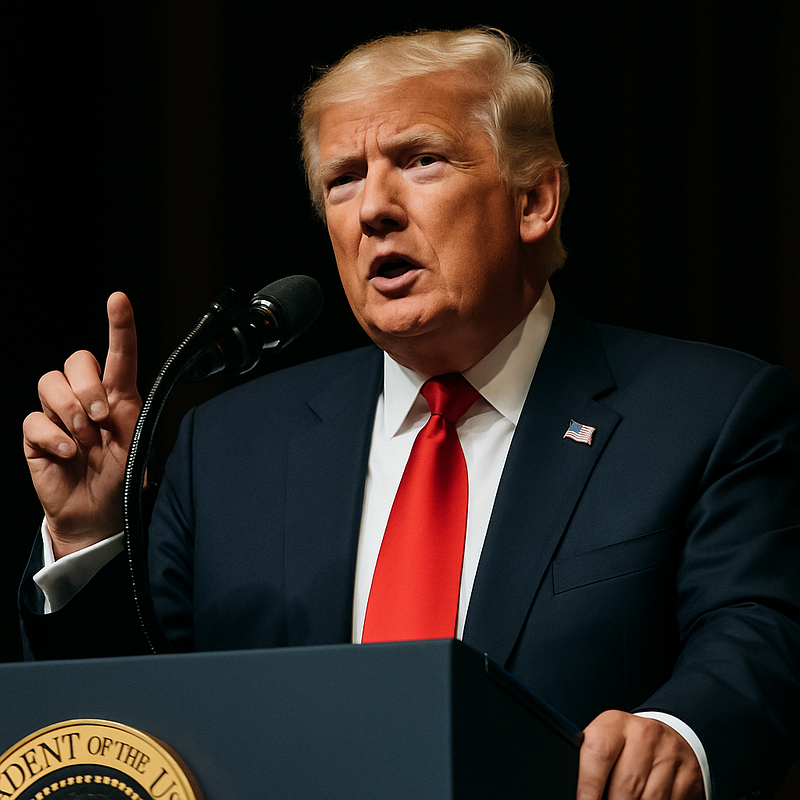
Donald Trump stepped to the microphone.
No theatrics.
No escalation.
No diplomatic choreography.
Just nine words.
“If they don’t pay, there will be no guarantee.”
For a heartbeat, the room stopped breathing.
A European minister tightened his jaw.
A diplomat froze mid-note.
A journalist whispered a quiet Mon Dieu.
This was not shock.
It was recognition.
“The guarantee you relied on was not withdrawn.
It was never unconditional.”
NATO did not fracture that night.
The illusion surrounding it did.
The Sentence That Redrew the Strategic Map
Commentators dismissed it as bluster.
Analysts filed it under rhetoric.
Opponents waved it away.
They missed the geometry beneath it.
For seventy-five years, Europe built its foreign policy on a single assumption. The United States would always defend Europe. Not because obligations were met. Not because treaties were sacred. But because the transatlantic axis was once the hinge of global power.
Trump shattered that assumption in nine words.
No payment.
No guarantee.
This was not performance.
This was an unveiling.
The sentence replaced emotional mythology with strategic reality. Washington had always understood the alliance this way. Europe simply never allowed itself to hear it.
The Reality Beneath the Promise
Europe misread NATO’s emotional register for decades.
Europe heard solidarity.
America meant strategy.
Europe assumed obligation.
America assumed interest.
Europe treated the alliance as family.
America treated it as instrument.
“Alliances survive on clarity, not sentiment.”
NATO was never a family. It was a conditional structure built on American power projection. Europe slipped from partner to dependent, slowly enough to feel like stability.
The continent built museums while others built missiles.
Trump did not break the contract.
He read it aloud.
America’s Strategic Recalibration
To understand the sentence, one must understand the twenty-first-century American mind.
The United States no longer sees Europe as the world’s central theatre. That centre moved years ago, quietly, without ceremony.
American strategy now orbits the Indo-Pacific. China’s maritime expansion. Taiwan’s vulnerability. Semiconductor supremacy. Great-power competition.
Europe is no longer the battlefield.
It is the balcony.
“Security in Europe is a cost.
Security in the Pacific is survival.”
This pivot is structural, not personal. It predates Trump and will outlast him.
This sentence could have been spoken under any American president.
Great powers do not drift.
They reallocate.
The centre of gravity always moves before allies notice. By the time they do, the architecture has already shifted.
Europe’s Great Unspoken Fear
Europe’s reaction was not emotional.
It was existential.
Because Europe knows a truth it pretends not to see.
Europe cannot defend itself without the United States. Not against Russia. Not against missiles. Not against sustained high-intensity conflict. Not against hybrid war.
The numbers are merciless.
The United States provides nearly all NATO strategic airlift. The ISR backbone. The nuclear umbrella. The command-and-control architecture. The logistics for any Article 5 response.
And then there is the detail no one dares to say out loud.
Europe has fewer than twenty operational long-range aerial refuelling tankers.
The United States has over four hundred.
Airpower without fuel is theory, not deterrence.
“Europe outsourced survival and called it unity.”
Trump did not create this dependency.
He exposed it.
The Continent That Outsourced Its Survival
Europe’s weakness is not financial. The money exists.
The weakness is psychological.
The continent believed peace was permanent. That borders had retired. That diplomacy could replace deterrence. That Article 5 was automatic rather than political.
Europe regulated everything except its own vulnerability.
Here the truth sharpens.
Europe heard the sentence as rupture.
Washington meant it as reminder.
Trump said nothing the United States had not believed for decades. Europe simply mistook continuity for commitment, presence for promise, routine for obligation.
“The misunderstanding was never about the guarantee.
It was about who believed it existed.”
How Moscow Heard the Sentence
Moscow did not hear aggression.
It heard opportunity.
Russia understands something Europe forgot.
Doubt is a weapon.
Doubt slows decisions.
Doubt fractures unity.
Doubt corrodes deterrence.
“A West in self-reflection is a West without trajectory.”
Trump did not strengthen Russia.
He quieted Europe.
And silence is a resource.
How Beijing Heard the Sentence
Beijing heard confirmation.
The United States cannot sustain two full-scale deterrence theatres indefinitely. If the Indo-Pacific is priority, Europe becomes optional.
Chinese military thinkers already assume the Atlantic is yesterday’s ocean. That American resources will shift east. That Europe will eventually face its own geography.
Trump did not invent a post-American security order.
He validated it.
The Pacific is tomorrow’s centre of gravity.
The New NATO: Conditional, Competitive, Calculated
After the sentence, NATO is not weaker.
It is clearer.
The alliance becomes what it always was beneath its slogans.
A hierarchy of capability.
Those who invest shape strategy.
Those who hesitate lose influence.
Those who assume lose security.
“Deterrence is not a slogan.
It is a capacity.”
This is not Trump’s rule.
It is the physics of geopolitics.
Europe at the Crossroads
Europe now stands before the door it avoided for seventy years.
Rearm or retreat.
Unify or drift.
Invest or depend.
Strategic autonomy is possible, but not rhetorical. It demands integrated defence industries, joint command structures, continental air and missile defence, and a credible European deterrent.
Dependence is easier. But it comes with terms.
The guarantee is conditional.
And the bill always returns.
“Europe must decide whether it wants to be a pillar or a client.”
Trump’s sentence forces the choice.
The Question Europe Fears Most
There is one question no European leader dares to voice. Not because it is radical, but because it is geographic.
Can Europe secure its future without redefining its relationship with Russia?
The United States can step back.
Russia cannot step away.
Geography does not negotiate.
A Europe without an automatic American guarantee must either grow strong enough to face Russia alone, or design a modus vivendi that defuses fear.
Neither path is comfortable.
Both are inevitable.
Trump did not invent the dilemma.
He revealed it.
Closing Reflection | The Anchor That Was Never There
What broke that night was not NATO.
NATO is hardware. Hardware can be repaired.
What broke was Europe’s emotional architecture. The belief that the United States would always arrive in time.
Trump did not introduce uncertainty.
He vocalised it.
He did not create a new world.
He unveiled the one Washington had lived in for decades.
History will not remember the applause.
It will remember the silence after the sentence.
The silence in the hall.
The silence in Brussels.
The silence inside every assumption built since 1949.
“If they don’t pay, there will be no guarantee.”
Nine words that ended the era of automatic protection.
Nine words that turned the page on the Atlantic century.
The anchor was never a promise.
The anchor was a price.
And the world has finally said it aloud.
Related from The Manifest Archive