A second-hand price is made by strangers. A seller lists a car, buyers who owe the seller nothing decide what it is worth, and the number that comes out tells the next owner, the lender and the insurer what the car is worth to people who do not own it. The mechanism works only while three things hold. The owner is free to sell to whoever pays. The buyer can work out what the car will cost to run. And somebody can look up what similar cars fetched last month.
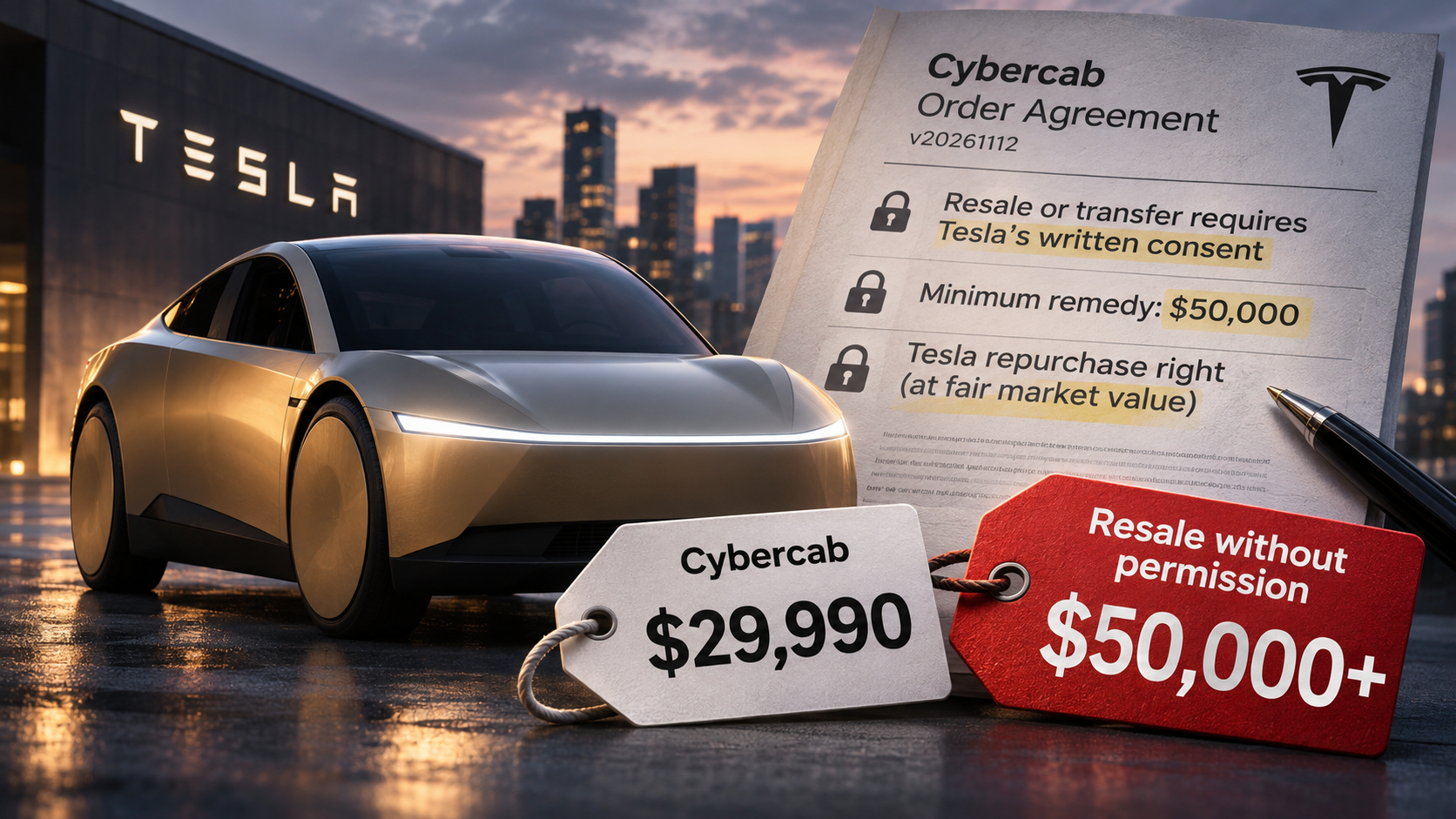
The Cybercab agreement that Tesla attached to its first personal sales on 13 November 2026 touches all three. As reported by Axios and several Tesla-focused outlets, it requires Tesla's written consent for any sale or transfer of the car, sets a penalty of at least $50,000 for selling without it, and gives Tesla a right to buy the car back at a price Tesla determines. It also turns the car's running cost into a monthly fee that Tesla can change with one month's notice.
The result is a $29,990 car whose second-hand price nobody can yet predict with confidence, and whose owner cannot be sure of turning it into money. This investigation sets out what the documents are reported to say, which of those reports are firm and which are thin, and what each of Tesla's controls would do to the price a second owner would pay. It also puts the clause beside two earlier ones from the same company, because the history of this particular sentence is older than the car. This is the fifth piece in a series on the used electric car, and it asks a question the first four took for granted.
What the Series Measured, and What It Assumed
The first piece in the series started from a puzzle. Used electric cars lost nearly a third of their price in 2023 and later rose again, while their batteries only ever aged in one direction. Whatever moved the price, it was not the battery. The price followed what the alternatives cost: a new car, a litre of petrol, a subsidy that came and went.
The second piece took Tesla out of the comparison. The depreciation stayed, and the question moved to who was holding the car on the day its value changed. That piece separated three measurements that are usually run together. Published depreciation sets the list price against the resale price. Economic loss sets the price actually paid against what the car fetched. Residual risk asks who owned the car when the value moved. Many of the cars in the data were on lease, so the holder on that day was often a leasing company and not a household, and Tesla itself resold the cars that came back off its own leases, according to Reuters as reported in that piece.
Those cars are only beginning to return. By Cox Automotive's estimate, electric cars were 4.4 percent of the leases that ended in the United States in 2025. Cox puts the share at 9.9 percent for 2026 and 18.4 percent for 2028. A rising stream of electric cars is heading for a second-hand market, and every price in the series so far came from a market of the ordinary kind: an owner free to sell, a buyer who could price the running cost, a record of comparable sales.
None of the three is a law of nature. Each is a term in a contract or a habit of the trade, and a contract that changes one of them changes what a second-hand price means.
The Documents and How They Reached Us
Two documents are involved. The Cybercab Order Agreement governs the purchase, and the Cybercab Autonomy Subscription Agreement governs the software that drives the car. The Gadgeteer reports that together they run to 11 pages. Electrek identifies the subscription agreement as version 20261112 and says it appeared on Tesla's configurator late on Friday 13 November, hours after Tesla began inviting select customers to order.
The public trail starts with Tesla's Robotaxi account on X, which invited select customers to buy a Cybercab for personal use and showed the order page: $29,990 before taxes, a $1,000 non-refundable deposit, a $299 monthly Autonomy Subscription with the first month included, and an estimated delivery in December in Austin. The page also says the subscription and regular vehicle maintenance are required to operate the car.
The purchase terms reached the public through an invited customer. A Tesla owner who posts on X as Spencer shared the order agreement and the subscription agreement after receiving an invitation, according to outlets that quote his thread. Electrek, Drive Tesla Canada, The Gadgeteer, EVWire, Teslarati and Transport Topics followed. On 18 November Axios published its own account and said it was based on Tesla's initial sales agreements, which it had obtained. None of the reports I read includes a statement from Tesla about the terms. One report notes that Tesla has no press office to ask.
I have checked the subscription agreement against Tesla's own page, at a configurator address that Tesla serves, and the version I retrieved matches the reports on price notice, cancellation, suspension, zones, remote control and personal use. I read it through a fetch tool that returns a summary, so I treat the match as strong but not as a verbatim reading. The same version has nothing on selling, transferring or repurchasing the car, on family sharing, or on what happens when the car gets a new owner. Those terms are reported from the order agreement, which I could not find on any Tesla page and have not read. That limits what I can say about resale, and the next section shows how much confidence each clause deserves.
Reports also differ on where the cars may go. EVWire describes the first deliveries as limited to five Texas cities, with Texas plates at first. Electrek says the supported service areas are in Texas and Florida. I do not resolve that difference here. It does not change the argument, but it is a reminder that the zone is a term that other people are still describing.
What the Agreements Are Reported to Say
The table lists the terms that touch a car's second-hand value, with the outlets that report each one and a note on how firm the reporting is. Where a clause appears in only one report, I say so.
| Term | As reported | Reported by | How firm |
|---|---|---|---|
| Sale or transfer | Not allowed without Tesla's prior written consent. The ban covers selling, transferring, assigning and encumbering the car | Axios, Drive Tesla Canada, EVWire, The Gadgeteer | Firm |
| Penalty | At least $50,000, or the full value received if higher, including value that is not cash | Axios ("at least"), Drive Tesla Canada, EVWire, The Gadgeteer | Firm on $50,000; "greater of" in three outlets |
| Consequences of an unauthorised sale | Tesla may disable the car remotely. A sale without consent is void. Tesla may stop autonomous driving and connectivity and refuse the owner future vehicles and services | Axios and EVWire (disabling); The Gadgeteer (all four) | Disabling firm; the rest one source |
| Repurchase | Tesla may buy the car back at any time at a fair market value it determines. The owner pays the cost of returning it | Drive Tesla Canada, The Gadgeteer, EVWire, Transport Topics | Several outlets, but not in Axios's summary |
| Who may use the car | The registered owner, present for the whole trip. Lending restricted; exceptions through Tesla's app only as Tesla enables them | The Gadgeteer, Axios | Two outlets |
| Commercial use | No ride-hailing, delivery or rental without Tesla's written authorization. Entry to Tesla's own Robotaxi network not allowed at first | Electrek, EVWire | Two outlets |
| Subscription | Required for the car to operate. Monthly renewal. Tesla promises one month's notice before a price change and may change the terms themselves, with continued use counting as acceptance. No pro-rata refund on cancelling | Tesla's own agreement page, Electrek, The Gadgeteer | Firm, primary |
| Suspension | Three or more misuse strikes switch off autonomous driving for a week. The fee is not reduced | Tesla's own agreement page, Electrek, Drive Tesla Canada, The Gadgeteer | Firm, primary |
| Operating area | Tesla-approved zones, which Tesla may expand, reduce or relocate at any time | Tesla's own agreement page, Electrek, Drive Tesla Canada, The Gadgeteer | Firm, primary |
| Remote control | Tesla may locate the car, restrict it, put it in a "safe state" or end the owner's access, with no remedy beyond the terms | Tesla's own agreement page, Electrek, The Gadgeteer | Firm, primary |
| Mileage at delivery | About 250 miles from testing and transport, counting toward warranty limits | EVWire, from Spencer's breakdown | One source |
| Charging | Only NACS fast charging at DC stations, including Superchargers. The owner pays | EVWire | One source |
| Insurance | Owner must insure and show proof at delivery. Cover also applies to trips with nobody aboard | EVWire | One source |
| Quantity and plates | One vehicle per customer unless Tesla agrees otherwise. Texas plates at first | EVWire | One source |
Three things stand out when the table is read for firmness. The consent requirement and the $50,000 figure are the best supported terms in the set, and Axios, which obtained the documents, confirms both. The buyback is reported widely but is absent from Axios's summary, so I treat it as likely and unconfirmed by the most careful outlet. The voiding of an unauthorised sale and the refusal of future vehicles rest on The Gadgeteer alone.
Three things are missing from every report I have found. None says what happens to the subscription agreement when the car changes hands. None describes how a request for Tesla's consent is made, how long Tesla has to answer or on what grounds it may refuse. And none says whether the consent requirement ends at some point. The two earlier Tesla clauses discussed below each ran for the first year of ownership. The reports I have seen do not describe an end date for the Cybercab, and one invited customer's summary says only that the agreement specifies no fixed time limit, a phrase that could refer to either point. I do not rely on it.
The $50,000 term is what contract law calls liquidated damages: an amount fixed in advance, so that nobody has to prove what a breach cost. Whether a court would enforce such a figure, or a clause that voids a sale of personal property, is a legal question I am not qualified to answer, and none of the reports I read tests it. A demand in a contract is not the same as an amount a court would award. Tesla's subscription agreement names Texas law and arbitration through JAMS, with a thirty-day opt-out by mail. I could not see which law or forum governs the order agreement, where the $50,000 is reported to sit.
Who May Use the Car
A second-hand buyer pays for what the car may do, which is narrower than what it could do. The use case that attracted most attention in the first week shows the difference.
Joseph Orefice's essay on Medium, published after the order page went up, argued that the Cybercab ends the tie between a car and its driver. In his example one car takes the father to work, returns for the mother and fetches a grandmother during the day, so that a single Cybercab replaces a household's second car. He mentions in passing that resale needs Tesla's approval, and he expects the terms to change. As a description of what a driverless car could do, it is a fair one.
The agreements, as reported, set a narrower scope for the first buyers. The Gadgeteer says only the registered owner may use the car, and only while physically present for the whole trip, with lending and shared access forbidden except for family sharing through the app and trips without passengers, and only to the extent Tesla switches those functions on. Axios describes it the same way: sending a Cybercab to a relative without riding along is restricted or needs Tesla's approval, and Tesla may grant exceptions through the app.
Two other terms point the same direction. The insurance requirement, according to EVWire's summary, applies to trips with nobody aboard, such as drives to a charger or to service. So the owner insures movements that the owner, by the terms, is not allowed to arrange. And only fast charging through NACS connectors is supported, which leaves out the slow overnight charge at home that most electric-car owners rely on. The summary does not say how Tesla expects a personal owner to charge at home, and Tesla has not said.
None of this is hidden or unusual for a first release. It does mean the car that the first week's essays described and the car the contract describes are different cars. A second-hand buyer would have to guess which of the two Tesla will deliver in 2029. That is why this section belongs in a piece about price: a future buyer has to judge not only what the car can do but what the contract allows it to be used for.
What the $299 Actually Buys
Before the fee can be weighed against a price, it helps to know what is in it. The Not a Tesla App site, which covers Tesla's software and plans, reports that the subscription bundles more than driving. It lists unsupervised driving, Premium Connectivity, tires, windshields and roadside assistance, and it says insurance, charging and registration stay with the owner. The order page says regular vehicle maintenance is required to operate the car.
That matters for reading Musk's remark. He replied to the reviewer Marques Brownlee within hours of the launch that the fee should match what Tesla charges for its driving software and connectivity on other models, which he put at about $115 a month. One outlet that covers Tesla breaks the comparison down: the supervised driving subscription costs $99 a month and Premium Connectivity about $10. If the Cybercab fee fell to that level, the same site observes, Cybercab owners would get more for less than a Model Y owner pays for the same group of services.
So the $299 is a bundle, and part of the question is how much of it is the driving and how much is the rest. The agreement as reported does not itemise the price. It names no figure at all, according to the outlets that read it, and the number lives on the order page, where Tesla can change it.
Four Controls and the Price They Leave Open
Suppose the first owner of a Cybercab wants to sell in 2029. Four things decide what a buyer would pay, and as the agreements are reported, Tesla controls all four.
The first is consent. Without Tesla's written consent the sale is barred, penalised and, according to one outlet, void. A buyer has to learn whether Tesla will agree, how long it will take and what it will ask. No report describes the process.
The second is the fee. At $299 a month, with the first month included, five years of ownership cost $47,631: the $29,990 price plus 59 payments. Electrek arrives at the same figure and puts it before insurance, registration, charging and taxes. At $115 a month the same five years cost $36,775 by my calculation. The difference is $10,856, or 36 percent of the purchase price, and Tesla can change the number with thirty days' warning. Musk gave no date for a change, and the order page was not altered in the reports I have seen.
A buyer who comes in later feels the same gap in a shorter window. By my arithmetic, a second owner who expects to keep the car for three years pays $6,624 more at $299 than at $115, since 36 months times $184 is $6,624. That sum comes out of what the buyer is willing to pay for the car, and it is the one a seller cannot know in advance.
The third is the zone. The car works only inside areas Tesla approves, and Tesla may expand, shrink or move them at any time. According to The Gadgeteer, Tesla may also restrict the car by type of road, weather, investigations, software rollouts or regulation. Electrek says its own tests found that Tesla's Robotaxi service areas, which the car must stay inside, were covered in practice at 59 to 78 percent of what is advertised. That is Electrek's measurement and not a term of the agreement, but it shows that the zone is a working variable and not a fixed map.
The fourth is the buyback, which I will call a repurchase right. It resembles what finance calls a call option, a right to buy at a price you set, and as reported the holder is Tesla. The resemblance is loose. A classic option has its terms fixed in advance, and the reports describe only a fair market value that Tesla determines, reasonably so according to The Gadgeteer. Nothing reported says who values the car by what method, whether the owner can contest the number, or whether Tesla can in fact act at any moment. Those four questions decide how much the right is worth. No report describes the matching right for the owner, an ability to sell the car to Tesla at a price known in advance. A buyer on the open market would have to allow for the chance that Tesla exercises its option, and the owner has no floor under the car. This is my interpretation of the clause as reported and not something any outlet has said.
A fifth question sits behind the four. The reports do not say what happens to the subscription agreement when the car changes hands. The second owner might inherit the existing fee, sign a new agreement or be offered Tesla's terms at that day's price, and each version gives the same car a different value. The subscription does the driving. A buyer who does not know its terms does not know what has been bought.
The reported ban on encumbering the car matters for the same reason. A lender who wants to take the car as security would need Tesla's consent, on that reading of the clause. I have found no report on how Tesla would treat a lender in practice. Insurers face an open question of their own. Reports on the launch, including from The Verge as relayed by other outlets, raise questions about safety standards and about who is liable when the car is the one driving.
| Variable | Who sets it, as reported | What a buyer cannot learn in advance |
|---|---|---|
| Right to sell | Tesla (written consent) | Whether, when and on what conditions consent is given |
| Running cost | Tesla (monthly fee, one month's notice) | The fee in each year of ownership |
| Where the car works | Tesla (zones, any time) | How large the usable area will be |
| Exit | Tesla (buyback at its fair value) | Whether Tesla will buy, and at what number |
| Subscription on transfer | Not described | Whether the new owner inherits, re-signs or is repriced |
A used-car price is where all of these answers get combined into one number. For the Cybercab the inputs are not set by the market. They are set by a party that also sold the car and answers for how it drives.
Whoever holds the title carries the loss. Whoever holds the contract sets its size.
In a conventional car those two are different parties who never meet. For a Cybercab, as reported, they signed the same document.
What Tesla Has Said About the Fee
Tesla has said little about the terms, and most of what exists comes from Musk on X. He told Brownlee that the Cybercab would be available nationwide as Tesla receives regulatory approval and that the fee was too high. He did not say when or by how much it would fall. The order page still showed $299 in the reports published afterwards. One outlet that covers the launch notes that whether early buyers would get any lower rate is not stated.
The direction of Tesla's pricing for driving software is documented in more detail. On 14 January 2026 Musk announced that the one-time purchase of the supervised driving software would end on 14 February, leaving a monthly subscription as the only option, according to TechCrunch. He has also said that the $99 monthly price of that software will rise as its capabilities improve, as reported by AOL and Yahoo Finance.
Two statements by the same person point in opposite directions. One says the Cybercab fee should fall to about $115. The other says the fee for driving software will rise as the software gets better. Both can be true at different moments. For a buyer who wants to know the cost of owning the car in 2029, neither gives a number. What the sequence does show is a pattern: a product once sold as a purchase became a monthly fee, and the owner's price stopped being a number printed on a page.
The Cybertruck Precedent
Tesla has used this kind of clause before, and the history is less one-directional than the Cybercab terms suggest.
In November 2023, shortly before the first Cybertruck deliveries, Tesla added a section to its order agreement barring resale in the first year without Tesla's permission. According to The Register, Tesla reserved the right to demand liquidated damages of $50,000 or the resale price, whichever was greater, and a ban on buying future Teslas was among the threats. Even with permission, Tesla had to be offered the truck first, at the price on the buyer's final price sheet less $0.25 per mile driven, reasonable wear and tear and the cost of repairs.
The section disappeared within days. InsideEVs reported that the entire section threatening legal action had been removed, without explanation, and Edmunds said it changed after media coverage. Electrek, which reported the clause as aimed at early-VIN trucks, said the removal followed a weekend of backlash. Weeks later it reportedly returned. TechCrunch reported on 11 December 2023 that an apparent early buyer had posted a screenshot of the threat on a forum, and Ars Technica, as relayed by Yahoo, reported a Foundation Series buyer whose contract included it. Tesla did not comment on either.
Then it left for good. Electrek reported on 22 August 2024 that Tesla had quietly removed the no-resale clause from the purchase agreement, and said it appeared to be because Tesla was catching up with demand. Electrek said it was not aware of anyone Tesla had actually pursued for the $50,000. Carscoops, summarising the same events, noted reports that some flippers were contacted by Tesla and barred from future purchases. Those are reports from owners, and I have not seen Tesla confirm them.
Electrek also reported that some early owners tried to sell anyway and some succeeded, and that the resale market for the truck started to crash by March, about four months after deliveries began. I do not claim that the clause caused or stopped anything. The point is narrower. A clause whose stated purpose was to protect scarcity was written into the agreement in November 2023, removed, reinstated and finally dropped, and over those months the truck went from scarce to available.
The Precedent From April
The second precedent is recent, and it is the closer one. On 16 April 2026, Electrek reported that Tesla was making buyers of its last Signature Edition Model S and Model X sign a No Resale Agreement. An invited buyer shared it with the outlet. The terms follow the Cybertruck clause almost line for line: no sale in the first year after delivery, a written notice to Tesla if circumstances force a sale, and a reasonable time for Tesla to buy the car back at the original price less $0.25 per mile, wear and tear and the cost of bringing it up to Tesla's used-vehicle standard. If Tesla declines to buy and approves a third-party sale, the buyer may proceed only after written consent. A breach, or a breach Tesla reasonably expects, allows an injunction against the transfer of title and liquidated damages of $50,000 or the full sale value, whichever is greater, with a possible refusal of future sales. Gizmodo and Teslarati reported the same terms.
Electrek called it a revival of the strategy Tesla tried and abandoned with the Cybertruck. It also said why this case differs from the truck: the Signature Edition supply is permanently limited at 350 units, whereas Cybertruck supply was constrained only early on. That is Electrek's reading, and it is a reasonable one.
Put the three clauses side by side and a pattern appears that the Cybercab agreement, as reported, breaks.
| Cybertruck (2023 to 2024) | Signature S and X (April 2026) | Cybercab (November 2026, as reported) | |
|---|---|---|---|
| Consent to sell | Yes, after buyback offer | Yes, after buyback offer | Yes |
| Duration | First year | First year | No end described in the reports I read |
| Penalty | $50,000 or value, whichever greater | $50,000 or value, whichever greater | At least $50,000 or full value |
| Tesla's buyback | First refusal at price less $0.25 per mile | First refusal at price less $0.25 per mile | Any time, at Tesla's fair market value |
| Owner must offer car to Tesla first | Yes | Yes | Not described |
| Fate | Removed, reinstated, removed in 2024 | In force when reported | In force when reported |
The first two clauses protected a limited launch for a year. The third, as reported, is longer in time and wider in the control it hands over. The earlier clauses gave Tesla a first refusal on a sale the owner had decided to make. The reported Cybercab buyback lets Tesla ask for the car at any time. That is a different instrument. It does not need a sale to be triggered, and it is not tied to the first year.
I want to be careful here. The comparison rests on reports of the Cybercab agreement, and a clause that is absent from a report is not necessarily absent from the contract. The table shows what has been described, nothing more.
What Can and Cannot Be Said
The documents allow several explanations for the same text, and the evidence does not separate them.
One is launch protection. The first Cybercabs are scarce, sold by invitation at a price well under what many buyers would expect, and an owner who could flip one for a profit would turn a safety rollout into a trading market. Electrek's account of the Signature Edition and the Cybertruck fits this. A second explanation is liability management. A company that answers for a car nobody is steering may want a say in where the car goes, who owns it and what is done to it, and several terms, including the bans on modifications and the zone limits, read that way. A third is that the terms describe the kind of market Tesla wants for these cars in the long run, one in which second owners exist only on Tesla's terms.
I take no position on which of these is right. The method that governs this archive describes function before intent: what a mechanism does, not what its author meant. The effect on the price is the same under all three explanations for as long as the terms stand. A second-hand price can still exist for a car whose consent rule, fee, zone and buyback are all set by one party and published by none, because buyers discount uncertainty with a lower bid or a risk premium. What the terms put in doubt is the ordinary market around that price.
The Strongest Objection
The strongest objection accepts the documents as reported and disputes what follows from them. These are launch terms. The sale is by invitation, one car per customer, with the first deliveries still ahead. Tesla is selling a vehicle that nobody steers and that, by Musk's own account, will reach other states only as regulatory approval comes. A company in that position might reasonably want control over resale. It has already shown that it removes such a clause when supply catches up, as it did with the truck in 2024, and Musk has already said the fee is too high. The buyback, on this view, may be an owner's way out in a market that does not yet exist, since somebody has to buy the first Cybercabs back. And the pattern Electrek describes for the Signature Edition, a clause justified by permanently limited supply, is the pattern a launch-protection reading predicts.
One distinction would sharpen the case. Some control may be needed for safety, because a car with no driver depends on software, zones and updates. Control over who may buy the car later is a different thing, and nothing in the reports shows that the first requires the second. Where the line falls is the real institutional question.
That objection is serious, and most of it is probably right about the first year. It explains why Tesla would want control while the car is new. It does not by itself explain a consent requirement with no reported end date, and a buyback that Tesla alone may exercise does not give the owner an exit. The Cybertruck clause could be dropped when supply caught up, because the truck was a product that Tesla had finished selling to an owner. The Cybercab is sold with a subscription that keeps Tesla attached to every car for as long as it runs. The reason to loosen the clause is weaker, because the reason to keep control does not expire when supply grows.
The claim made here is therefore narrower than a claim about Tesla's plans. Until the contract changes, a Cybercab's second-hand price will be set under conditions that Tesla controls and the seller cannot see in advance. A price can exist. What the reported terms put in doubt is a free market in which the seller can count on realising it, and the person who carries that risk has no say over any of the variables.
How This Reading Can Fail
The reading fails in several ways. If the order agreement, once someone publishes it, differs from the reports, the clauses that rest on one outlet fall first: the voiding of an unauthorised sale, the refusal of future vehicles and, if the most careful reading of Axios is right, the buyback. If Tesla removes the consent requirement, or gives it an expiry date as the earlier clauses had, the clause was launch protection and the objection above wins. And if Tesla publishes terms under which a second owner takes over the car and its subscription at a known price, with consent given in advance, the variables stop being open and a seller can count on a price.
I am registering the tests on 22 November 2026, with a baseline of the order page and the Autonomy Subscription Agreement, version 20261112, as reported on 13 and 14 November. They will be scored on 1 March 2027, or thirty days after the first delivery to a private owner if deliveries slip past January.
Test A, transferability: is Tesla's written consent still needed for a sale or transfer, and has the requirement gained an expiry date or end condition?
Test B, repurchase control: does Tesla keep its right to buy the car back, and is there a valuation or dispute process attached to it?
Observation C records the listed price of the Autonomy Subscription and whether the terms for passing it to a new owner have become clear. Musk has said about $115 without giving a date, so C is something to note and tests nothing.
The outcomes fall into four classes. Strong confirmation: both restrictions remain materially unchanged. Partial confirmation: one remains and the other is removed or substantially limited, and the part of the argument that rests on the removed term falls. Weakening: both are removed or become clearly time-limited. Inconclusive: the agreements cannot be read in their current form. Persistence alone would not prove a lasting effect on prices.
I expect Tests A and B to hold. My confidence is better than even and well short of certain, because Tesla dropped similar language within days in 2023 and for good in 2024. That is my estimate and not a measurement. A private Cybercab sold to a second owner with Tesla's consent, together with the price it fetched, would be the first real observation of this market. Nobody can say when that will happen, so it is not registered.
A further kind of evidence would settle more than any of these. If anyone obtains the order agreement and publishes it in full, the table above can be corrected clause by clause, and the claims that now rest on one outlet can be confirmed or dropped. The scoring will need a way to read the agreement in force, and without an invitation that means a report or an invited customer. The score will say which.
Three Prices and a Fourth
The order page lists three prices: $29,990 for the car, $1,000 for the deposit and $299 a month for the software that makes it move. They are the ones that were read aloud, argued about and shared, and all three describe the cost of entering ownership.
The fourth is in the clause about leaving. It describes what follows from selling without Tesla's consent, and it is larger than the price of the car. The number a second owner would need sits in neither document. Every used car has an unknown future price. What differs here is that, as reported, the maker keeps a say in whether the owner can turn that price into a sale. Depreciation moves the offer a buyer will make. A transfer restriction can decide whether the owner is free to take it. The first Cybercabs are due in Austin in December, and their second owners are not in the contract yet.
Evidence Map
Facts, interpretations, forecasts, and disconfirming signals.
Core claim. As reported from the order agreement, the Cybercab agreements give Tesla control over four variables that set a second-hand price: consent to sale, the subscription fee, the operating zone and a buyback right. Until they change, the seller cannot count on realising a second-hand price; a price can exist, but the market around it is conditional.
Evidence level. Facts: the order page terms, Musk's reply, the Cybertruck and Signature Edition clauses (several outlets). Reported but not read at source: every clause of the Cybercab agreements. Interpretation: the buyback as a repurchase right held by Tesla that resembles an option, the effect on lenders, the gap over the subscription transfer. Forecast: the three registered checks.
What would confirm this. The consent requirement and the buyback still in the agreement on 1 March 2027, and no published terms for a second owner's subscription.
What would disprove this. The consent requirement removed or time-limited, a published transfer route at known terms, or primary agreements that differ from the reports.
Watchlist. Changes to version 20261112; the first private delivery in December; any resale with Tesla's consent; Tesla's response to the reports; a change in the $299 fee.
Sources. Primary: Tesla's Cybercab Autonomy Subscription Agreement, v. 20261112, read through a summarising fetch tool. The Cybercab Order Agreement was not found. Reports on the agreements: Axios, 18 November 2026; Electrek, 14 November 2026; The Gadgeteer; Drive Tesla Canada; EVWire, 16 November 2026; Not a Tesla App. Earlier clauses: The Register, 15 November 2023; InsideEVs, November 2023; TechCrunch, 11 December 2023; Electrek, 22 August 2024; Electrek, 16 April 2026.
Jerry van der Laan writes The Manifest Archive, Forensic Narrative Intelligence Writing on the systems beneath power, money, and history. He traces the structures beneath them.
The questions, the editorial judgments and the responsibility for every published claim are mine. AI assists with the research, the drafting and the source checks.
Related from The Manifest Archive
The Ownership Illusion: License vs. Ownership in the Digital Age
A Reader Blamed Tesla for the Used-EV Crash. So I Took Tesla Out.