In April 2023 Germany switched off its last three nuclear reactors. The government framed the moment as the end of a danger, a long-promised liberation from the atom. To keep the lights on through the following winters it burned more coal and imported more gas, which is to say it leaned harder on the deadliest fuels humanity uses in order to retire its safest source of power. Coal kills, by the best available estimates, on the order of twenty-five people for every unit of electricity it produces, counted in mining accidents and, overwhelmingly, in the particulate air pollution that shortens millions of lives a year. Nuclear, across its entire history including its worst accidents, kills a small fraction of one person for the same unit. A country had just shut down the source that almost never kills and turned back toward the one that kills constantly and quietly, and it called the decision a victory for safety.
This looks like a failure of arithmetic. It is not. The numbers were never hidden; they are published, uncontested, and easy to find. It is a failure of a different kind, and naming it correctly is the whole task, because there is a seductive wrong answer waiting here and most accounts reach for it. The wrong answer is that a clean and independent technology was deliberately strangled by the fossil interests it threatened. That story is satisfying, and it is false, and believing it hides the real mechanism, which is duller, larger, and far more useful to understand. The atom was not murdered. It was outpriced and out-feared, by forces that needed no coordinator, and the proof is what is happening to it right now.
What the atom actually is
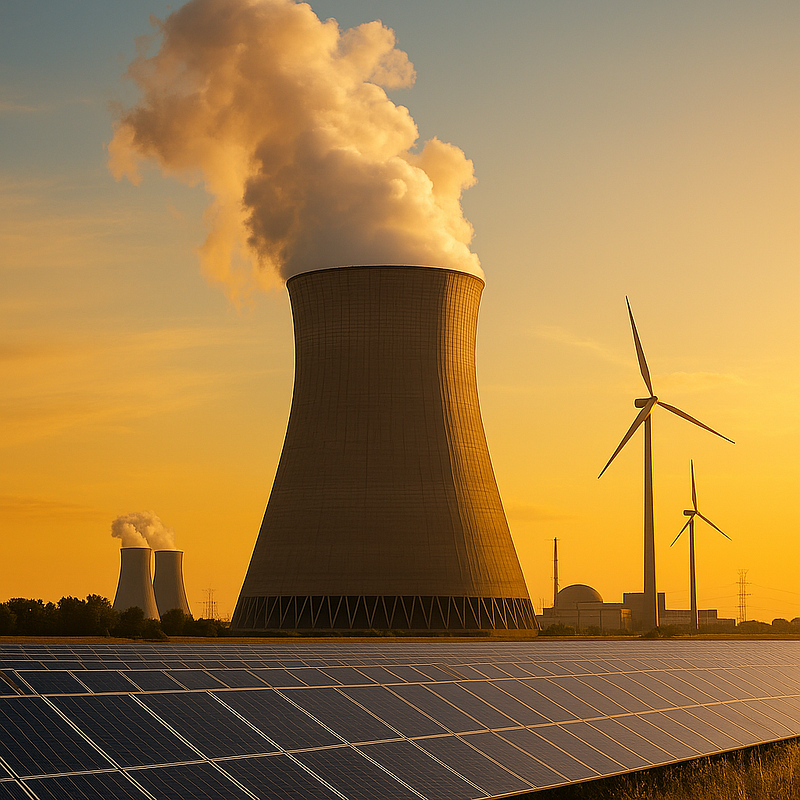
Start with the thing the fear obscures, because it is not in dispute. When a uranium nucleus splits, it releases on the order of a million times more energy than the chemical burning of a carbon atom. The reaction emits no carbon dioxide, no soot, no sulfur, none of the particulate haze that fossil combustion pours into the air of every city. Measured across the full life cycle, the carbon footprint of nuclear electricity sits roughly level with wind and below solar. And unlike wind and solar it runs without pause: a reactor delivers what engineers call baseload, a steady output that does not stop when the wind drops or the sun sets, for years between refuelings.
One country took this logic to its conclusion. Beginning in the 1970s, France built a national fleet of reactors that came to supply roughly seventy per cent of its electricity, and in doing so it decarbonized its grid decades before the phrase existed, while its lights never once flickered for want of generation. France is the standing proof that a large industrial society can run, reliably and cleanly, on the atom. The technology works. That was never the question.
The safety record is the part most people find hardest to believe, because it contradicts a lifetime of images. Set the images aside and look at the counts. Coal, by the death-rate measures used in public-health research, is responsible for something near twenty-five deaths per terawatt-hour; oil for roughly eighteen; natural gas for around three. Nuclear, wind, and solar all sit beneath a tenth of a single death for the same energy. Nuclear produces, by these estimates, on the order of ninety-nine point eight per cent fewer deaths than coal. It belongs, statistically, in the safest tier of all energy sources ever deployed. And almost no one believes this, which is itself the first piece of the real explanation.
The myths and the counts
Three names carry the public fear of nuclear power, and all three, examined, say something other than what they are remembered to say.
At Three Mile Island in Pennsylvania in 1979, a stuck valve and a cascade of misread instruments led to a partial core meltdown. The images were indelible: the cooling towers, the evacuations, the live broadcasts. The radiation released to the public was minimal, and no death has ever been attributed to it. The accident killed no one and frightened a generation, and the fright, not the harm, became its legacy.
Chernobyl in 1986 was a genuine catastrophe, and it must be counted honestly rather than minimized or inflated. A flawed Soviet reactor design, operated recklessly inside a system that punished honesty, exploded and burned, throwing radioactive material across Europe. The acute death toll was in the dozens. The long-term toll is genuinely contested: the UN scientific committee found no major public-health impact beyond several thousand thyroid cancers, of which around fifteen were fatal, while other models project some thousands of eventual deaths. Take the higher estimates seriously, and Chernobyl still sits beside a single bad month of global coal pollution. It was the worst the technology has ever done, produced by a design the rest of the world did not use, and it became the permanent archetype of nuclear power as such.
Fukushima in 2011 completed the pattern. An earthquake and tsunami overwhelmed the plant's flooded backup generators, cooling failed, and hydrogen explosions tore the buildings apart on camera. The radiation killed, by the official accounting, essentially no one; one death was later attributed to it. The evacuation itself, the forced uprooting of the old and the sick, is associated with on the order of two thousand deaths. And the same tsunami that caused the meltdown killed roughly eighteen thousand people directly. The headlines belonged almost entirely to the reactor. The wave that did the killing was the backdrop.
Here is the asymmetry that runs under all three, and it is a fact about human cognition before it is a fact about politics. People do not fear in proportion to body counts. They fear the rare, the dramatic, the involuntary, and the invisible, and nuclear accidents are all four, while the daily slaughter of fossil combustion is gradual, familiar, chosen, and unseen. A death from coal smoke thirty years on is a statistic no camera records. A reactor venting steam is a global event. The dread is real, it is human, and it is wildly miscalibrated, and no conspiracy is required to produce it. The mind does it on its own.
Risk researchers have a name for this, dread risk, and they have catalogued the levers that swell it: a hazard feels far larger when it is involuntary rather than chosen, when its harm is catastrophic and concentrated rather than spread thin, when it is unfamiliar and poorly understood, and when its agent is invisible and lingering, as radiation is. Nuclear power trips every one of these at once, which is why a single accident with few or no deaths can reorder a nation's energy policy, while the fuels that kill at industrial scale every single year trip none of them and so provoke almost no fear at all. Add the availability heuristic, the mind's habit of judging how likely a thing is by how easily an example comes to mind, and the picture completes itself: everyone can summon the image of a reactor exploding, and no one can summon the image of the asthma ward filling slowly downwind of a coal plant. The fear is not stupidity. It is the predictable output of a perceptual system that evolved to flee the sudden and the strange, applied to a risk that is quiet and statistical, and a perceptual system cannot be argued out of its own architecture with a chart.
This is also why the image, once set, would not move. In the public imagination nuclear power froze in 1986, the year of Chernobyl, the meltdown rehearsed ever since in film, headline, and memory until it became the meaning of the word. In the laboratories and on the construction sites of the countries that kept building, the technology kept advancing toward designs that shut themselves down and reactors that cannot melt. The culture stayed at 1986 while the engineering moved on, and the gap between the two was not engineered by anyone. It is simply what happens when a vivid catastrophe becomes the permanent stand-in for a slow, technical, undramatic reality. The story stopped at the explosion. The thing it described did not.
The cost the conspiracy theory hides
If fear were the whole story, the countries least frightened would have kept building, and cheaply. They did not, and the reason is the part the suppression narrative cannot see, because it is not dramatic and has no villain. Nuclear power has a cost problem so fundamental that it may be the rarest thing in modern technology: a negative learning curve.
Almost everything humanity builds gets cheaper with repetition. Solar panels have fallen in price by orders of magnitude as cumulative production has grown; this is the ordinary learning curve, the reason mass manufacture works. Nuclear runs the other way. Across seven decades of "large" nuclear power, unit construction costs did not fall with experience; in many places they rose. The recent megaprojects are the evidence in concrete and overrun budgets. The Vogtle expansion in Georgia, the only new reactors built in the United States in a generation, came in around twenty-five to thirty-five billion dollars, roughly double its initial estimate and years late. Finland's Olkiluoto-3 finished about thirteen years behind schedule at some three to four times its original price. Britain's Hinkley Point C has been revised upward toward forty billion pounds and beyond, more than double the estimate it carried when approved. Even France, the one nation that scaled successfully, has been shown by economists to have experienced "negative learning by doing," its later reactors costing more than its earlier ones.
The reasons are intrinsic, not incidental. A reactor is a bespoke megaproject, lumpy and enormous, demanding the management of staggering complexity on a single site, which defeats the standardization and mass production that drive costs down everywhere else. Each serious accident, rationally, triggers another layer of regulation and redesign, so the next plant is less like the last rather than more. And as building slows, the supply chains and the skilled workforces atrophy, so that each new attempt is more nearly a first attempt, with first-attempt costs. The result is a technology that becomes harder to build the longer a society waits between builds, a ratchet that tightens itself.
Then, after 2008, cheap shale gas arrived in the United States and undercut the economics entirely, and renewables began their long price collapse alongside. Nuclear did not need to be suppressed to lose. It had made itself expensive, an accident-and-regulation ratchet had made it more so, and a cheaper rival had appeared. A reactor that takes fifteen years and thirty billion dollars to build does not fail because shadowy interests want it dead. It fails the meeting where someone compares it to a gas plant that can be built in three years, and the fear in the public square ensures no politician spends capital overruling that meeting. Fear and cost did not compete as explanations. They reinforced each other.
There is a financial detail underneath this that decides more than it seems. A nuclear plant is almost all upfront capital: the fuel is cheap and the running costs are low, but the construction swallows the money years before a single kilowatt is sold. That makes the technology brutally sensitive to two numbers, the interest rate and the build time, because every year of delay is a year of paying interest on tens of billions of borrowed dollars with no revenue against it. A gas plant earns within a couple of years; a reactor borrows for a decade and then hopes. So a delay does not merely annoy. It compounds, financially, until a plant that was viable on paper is ruinous in practice, and the same regulatory ratchet that lengthens the build is therefore also, silently, a multiplier on the interest bill. The cost problem and the time problem are the same problem seen from two angles, and together they make nuclear the most finance-dependent way to boil water ever devised.
The ratchet, not the hand
This is the place to be precise about mechanism, because the difference between the true account and the conspiracy is the difference between a structure and a hand.
It would be satisfying to say the oil and gas lobby strangled the atom. Fossil incumbents are real, they did lobby, and they unquestionably benefited from nuclear's stall; Germany's deepened dependence on imported gas was a windfall for its supplier. All of that is true, and none of it amounts to a plan, because the outcome needs no plan. Picture the loop. An accident occurs and the public dread spikes. Regulators, responding to a genuine and democratic fear, add requirements. The added requirements raise costs and lengthen timelines. Higher costs and longer timelines mean fewer plants get approved. Fewer plants mean the engineering and construction expertise dissipates. Thinner expertise makes the next plant slower and more expensive still, which feeds the perception that nuclear is hopelessly costly, which hardens the political will against it. Every step in that circle is individually reasonable, and the circle as a whole shuts the industry down without anyone deciding to.
That is the forensic point, and it is the discipline the dramatic version abandons. You do not need an empire of fossil interests conspiring in a room. You need a dread that is cognitively real, a cost structure that is intrinsically perverse, and a regulatory reflex that is democratically legitimate, and those three, looping, produce the stall on their own. The fossil interest is a beneficiary of the loop, not its architect. Who profits is a real and answerable question here; who arranged it is not, and conflating the two is exactly the error that turns a sound structural finding into a story that a serious reader can dismiss.
Germany is the loop made visible. In 2011, within days of the Fukushima images, Chancellor Angela Merkel reversed her own government's policy: months earlier she had extended the lifetimes of Germany's reactors, and now, reading the public dread correctly, she announced an accelerated phaseout instead. The last reactors went dark in April 2023. There was no fossil cabal in that decision; there was an elected leader responding, with democratic legitimacy, to a genuine surge of fear after a disaster on the other side of the planet that had killed no one by radiation. And the consequence was documented and predictable. With nuclear gone faster than renewables could replace it, Germany leaned on coal and on imported gas through the transition, its emissions higher than they would have been had the reactors stayed, its dependence on a single eastern gas supplier deeper, a vulnerability that the later energy crisis exposed in full. Every step was reasonable from inside. The sum was a wealthy, environmentally serious country making its grid dirtier and its supply more fragile in the name of safety, and experiencing that as a moral achievement. That is the loop, not a plot, and it is more sobering than any plot, because there was no one to vote out who could have stopped it.
The East kept building, and that is the proof
The clearest test of whether the cost problem is intrinsic to the atom or to the way the West stopped building it is to look at who never stopped. While Europe and North America let their programs lapse, Russia and China did the opposite, and the result quietly demolishes the idea that nuclear is simply, everywhere, too expensive.
China is building reactors at a pace and a price the West can no longer match, completing them in something closer to five to seven years and at a fraction of the Western cost, with more reactors under construction than any other country, roughly half of all those being built in the world. Russia's state builder became the dominant exporter of turnkey plants, financing and constructing reactors abroad and binding the customer for decades, because whoever builds your reactor supplies your fuel and trains your engineers. This is geopolitical, and the dependence it creates is real. But the analytically important part is the cost. China builds cheaply for the most unglamorous reason imaginable: it builds continuously. A standing workforce, a stable supply chain, a repeated and standardized design, the same teams moving from one site to the next. In other words, China has restored the ordinary learning curve simply by never letting it break, which is the exact mirror image of the Western negative curve and the strongest possible evidence that the curve, not the atom, was the problem. The technology was never intrinsically doomed to cost more each time. It costs more each time only when you build it rarely, bespoke, and from a standing start. Build it the way you build anything else, often and the same, and the cost behaves like everything else.
That reframes the whole Western story. The West did not discover that nuclear is unaffordable. It made nuclear unaffordable by building it almost never, and then read the high cost of its own hesitation as a property of the technology. The East is the control group, and it failed to reproduce the result.
The atom got smaller
The West could not simply copy the East. It had no standing workforce, no repeated design, no political appetite for a decade of giant builds. So the industry made a different bet, and it is aimed directly at the mechanism this essay has been describing. If the negative learning curve comes from building enormous, bespoke reactors rarely and from a standing start, then the way to defeat it is to stop building them enormous and bespoke. Make the reactor small. Make it identical. Build it in a factory, on a line, the way everything else that ever got cheap got cheap.
This is the small modular reactor, and the name carries the whole thesis. Small: a few hundred megawatts or less, a fraction of a conventional giant, so a single unit is a smaller lump of capital and a smaller bet against the interest clock that ruined the megaprojects. Modular: the major components are manufactured in a central factory as standardized modules and shipped to the site to be assembled, rather than poured and welded bespoke in the field, which is exactly where the giant projects bled their years and their billions. The wager is that a reactor built like an aircraft, many of the same unit down a line by the same hands, will finally behave like an ordinary manufactured good and slide down the learning curve instead of climbing it. The small modular reactor is not first of all a safety story or a climate story. It is an attempt to buy back the curve the West broke.
The designs also answer, at least on paper, the two objections that did the most work. Take safety first, because it targets the exact failure that produced the images. Three Mile Island, Chernobyl, and Fukushima all turned on cooling that stopped when pumps or power stopped. The newer reactors lean on what engineers call passive or inherent safety: a smaller core and a lower power density that can shed its heat by natural convection and gravity alone, reaching a safe shutdown with no operator action and no outside power at all. A reactor that cools itself when everything fails, because physics and not a pump carries the heat away, is aimed precisely at the 1986 archetype. This does not abolish risk, and "walk-away safe" is a design goal under test rather than a proven property, but it is the engineering reply to the specific fear that froze the public.
Then yield, in two senses. Some advanced designs run far hotter than a conventional water reactor, hot enough to deliver industrial process heat and hydrogen rather than only electricity, which widens what the atom is good for. And the fast reactors, like the sodium-cooled Natrium unit now beginning construction at a retiring Wyoming coal site, burn a much larger share of their fuel and can consume the spent fuel and depleted uranium that today's plants leave behind, turning part of the waste problem, the strongest point in the honest case that follows, into feedstock. The existing fleet already runs above ninety per cent capacity, the highest of any source; the new designs aim to add fuel efficiency and flexibility on top of that.
Hold the enthusiasm, though, because none of it is proven at price. As of 2026 only a couple of small modular reactors are actually operating anywhere, and both are in the East, a Chinese design and a Russian one, while well over a hundred remain on paper or early in construction. The Western flagships are permits and first pours, not delivered electrons: a GE Hitachi unit breaking ground in Ontario for the end of the decade, the Natrium plant under non-nuclear construction in Wyoming awaiting its final permit, an American design certified but not yet building after its first flagship project collapsed on cost in 2023. The factory-cost promise is exactly that, a promise, because a production line only pays off once it produces at volume, and no one has yet built the hundredth identical reactor the whole argument depends on. The bet is coherent and it is aimed at the right mechanism. It has not yet been won.
When the atom is a weapon
There is one more asymmetry, and it is the sharpest, because it exposes that the fear was never really about the physics. The same societies that recoil from a power plant tolerate, without debate, the thing the atom can actually do at its worst.
Thousands of nuclear warheads sit funded and maintained in silos, submarines, and bombers, each able to erase a city, together able to end the species many times over. Their existence is called deterrence and their budgets pass without controversy. A reactor designed to light a million homes is presented as an unacceptable hazard; an arsenal designed to incinerate millions is presented as a sober necessity. The atom, when it belongs to the state and the military, is sacred. The same atom, when it belongs to a utility and a civilian grid, is suspect. The physics is identical. Only the custody changes, and with the custody, the entire emotional and political verdict.
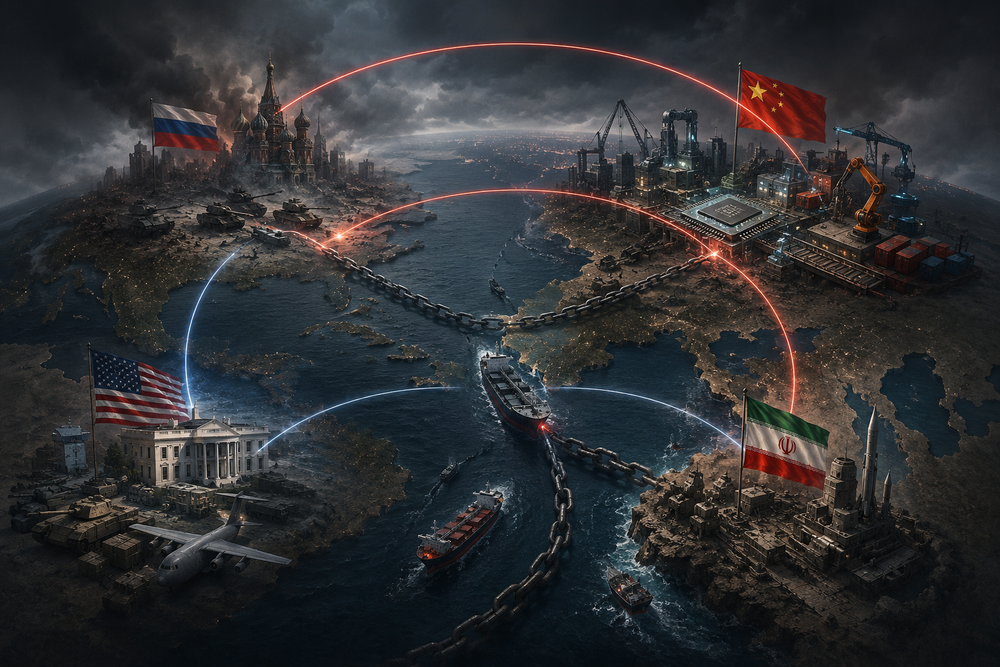
Nothing shows this more starkly right now than Iran. The contested object there is enrichment, the same process that fuels a civilian reactor carried further toward the level a weapon would need. In June 2025 and again in a larger campaign in early 2026, the United States and Israel struck Iran's enrichment sites at Fordow, Natanz, and Isfahan, citing its nuclear program as an imminent threat. As of 2026 Iran holds a large stockpile of uranium enriched to sixty per cent, well beyond any civilian need and a short technical step from weapons grade, and it has shut the international inspectors out. And the head of the international agency states, carefully, that there is no evidence Iran has actually built a bomb, while its stockpile and its secrecy are real causes for concern. Hold the politics aside, because the point here is narrower and structural. The centrifuge does not change as it spins. What changes is the verdict imposed on it, the judgment of whether this spinning is energy or threat, and that verdict is rendered by who holds the machine and by the politics around them, not by the machine itself. Enrichment in one jurisdiction is a clean-energy program; the identical enrichment in another is a casus belli. The atom is whatever the holder is permitted to make it mean.
The honest case against the atom
This essay would be its own kind of propaganda if it pretended the fear had no rational core, so state the real case against nuclear at full strength, because parts of it are sound.
First, waste. Spent fuel stays dangerous for time spans that dwarf any institution that might guard it, and for seventy years no country operated a permanent disposal site, leaving the material in temporary storage and the long-term problem genuinely unsolved. Second, proliferation, which the Iran case makes concrete: the same enrichment and reprocessing that serve a civilian program can open a path to a weapon, so spreading the technology spreads the risk. Third, the tail. Even granting that the expected death toll is tiny, a reactor's worst case is uniquely catastrophic and effectively uninsurable, and a society can rationally place extra weight on a small chance of an irreversible disaster rather than judging by the average alone. Fourth, opportunity cost, which is the strongest argument of all: every decade and every billion poured into one slow reactor is a decade and a billion not spent on renewables and storage that are now cheaper per unit of energy and far faster to build.
These are serious, and they are why the verdict is not a slogan. But weigh them honestly and they reshape the dismissal rather than justify it. The waste volume is, against all intuition, strikingly small, the entire output of decades of a national fleet occupying a space measured in a single warehouse rather than a landscape, and the first permanent deep repository is now opening in Finland after forty years of the task being called impossible. Proliferation is a problem of custody and safeguards, of who is permitted the technology and under what watch, which is precisely the point the Iran section made: it is a question of the holder, not of the power source as such. The catastrophic tail is real and must be set beside the other tail we have simply chosen not to see, the certain, ongoing, annual mass death from fossil combustion, a slow catastrophe so familiar it no longer registers as one. And the opportunity-cost argument, the best of the four, is exactly what the present moment is testing, because the one thing renewables still cannot cheaply deliver is firm, around-the-clock power, which is the specific thing the new buyers are returning to nuclear to get. The honest conclusion is not that the atom always wins. It is that the dismissal was miscalibrated, weighted by dread and sticker shock against a rival whose costs are paid invisibly, and that is a different and more defensible claim than either side usually makes.
The proof is the return
If nuclear had been killed by a conspiracy of suppression, it would stay dead, because the suppressors would still be there. Instead it is coming back, and the manner of its return is the cleanest evidence that cost and fear, not a cabal, were always the gate.
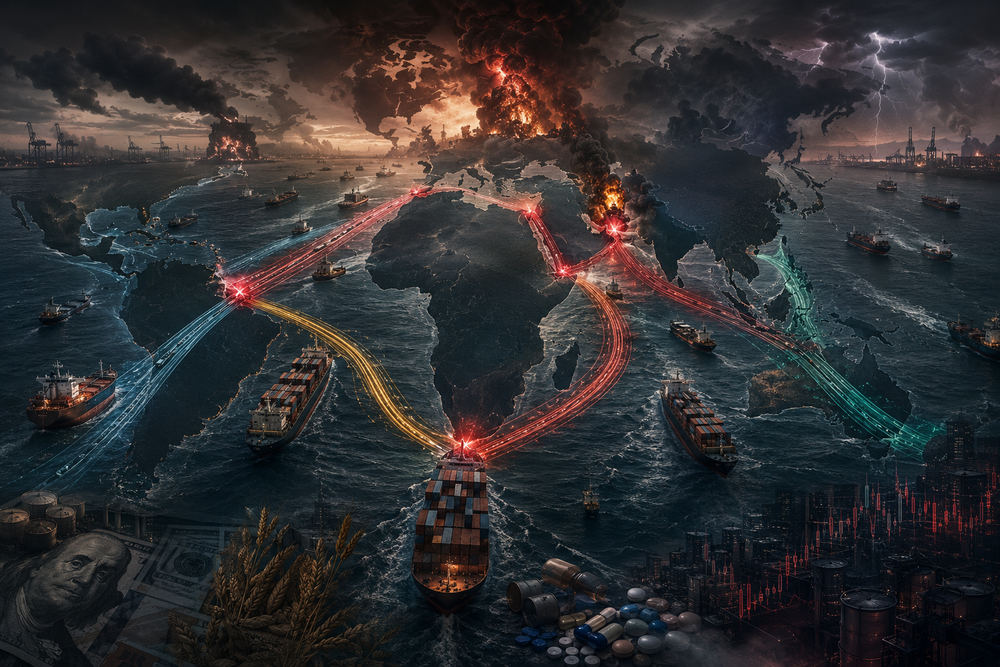
The driver is not mainly the climate, though that is the official language. Two forces are pulling the atom back, and neither is idealism. The first is electricity demand from artificial intelligence. Data centers already draw several per cent of United States power and are projected to roughly double that draw by the end of the decade, and the companies building them need vast amounts of firm, around-the-clock power that wind and solar alone cannot guarantee. The second is that the fossil order those companies would otherwise lean on has begun to look fragile in plain view: a single strait that can be closed, a gas supply that can be switched off, a price that leaps on a headline. Firm power that no foreign chokepoint can throttle is worth more the moment the chokepoints start to bite.
So the same technology declared obsolete is suddenly being bid for, and the bidding has turned into a stampede. Microsoft signed a twenty-year deal to restart a reactor at Three Mile Island itself, the very name that had meant nuclear dread, to feed its data centers before the decade is out. Amazon put more than twenty billion dollars into a nuclear-powered computing campus in Pennsylvania. Google contracted a fleet of small modular reactors from Kairos Power. Meta, at the start of 2026, signed for up to six and a half gigawatts. In a single year the technology companies contracted more than ten gigawatts of American nuclear supply, more than the entire grids of many countries. Governments moved with them: Belgium repealed the phase-out law it had passed in 2003, Italy began unwinding its own ban, and even Germany's chancellor called the 2023 shutdown a huge mistake, though his coalition would not put a reversal in writing, which is the dread keeping its veto. The count of nations pledged to triple nuclear by mid-century has climbed past thirty.
Watch what that reversal demonstrates. A capability that returns the instant a buyer appears who can pay for it and will not flinch at its name was never obsolete and was never truly forbidden. It was uneconomic under the old incentives and stigmatized by a real dread, and both of those are conditions, not verdicts. Change the incentive, and the condition lifts. The atom did not become safer between 2022 and 2026; the images did not improve; the waste problem was not solved. What changed was that customers arrived rich enough and desperate enough for firm power to pay the brutal cost and ignore the old fear, and the silence broke within a year.
This is also where honesty requires restraint, because the revival is not yet a triumph and the cost problem has not been solved. As the previous section showed, the small reactors that carry most of the optimism are still unproven at price, and the atom is being outbid back into relevance by an extraordinary surge in demand, not because anyone has yet made it cheap. If the AI demand cools, or the first restarts run over budget the way the last megaprojects did, the return could stall as quickly as it began. The determining variable has not changed. It has only, for now, been overpowered.
What the stall cost
The loop had a price, and because the price was paid in the same invisible currency as fossil death, almost no one added it up. Every reactor not built was, in practice, a gas or coal plant built instead, or kept running past its retirement, and every one of those burned for decades. The atom that the West declined to scale did not leave a clean gap; the gap filled with combustion.
Put a number to the road taken instead. One analysis by scientists at NASA estimated that the nuclear power the world did build, between 1971 and 2009, had already prevented on the order of sixty-four billion tonnes of carbon-dioxide-equivalent emissions and, by displacing fossil combustion, avoided roughly 1.8 million air-pollution deaths that those fuels would otherwise have caused. That is the measured benefit of the reactors that exist. The reactors that do not exist, the ones cancelled, deferred, or shut early across half a century of the dread-and-cost loop, are the photographic negative of that figure: the carbon not avoided, the pollution not prevented, the deaths that did occur because the cheap, frightening, clean alternative was left on the blueprint. None of it appears on any ledger, because a death from a coal plant that ran because a reactor was cancelled is attributed to no one and recorded nowhere. It is the purest example of the asymmetry the whole essay turns on: the harm of nuclear is counted obsessively and the harm of its absence is not counted at all, and a society that counts one side of a ledger and not the other will reliably make the wrong call and feel virtuous doing it.
This is not an argument that nuclear was the only answer, or a costless one. It is the simple observation that the bill for the stall came due in carbon and in lungs, quietly, over decades, while the public conversation remained fixed on the rare and spectacular harm of the thing that was avoided. The expensive, frightening atom had a shadow price, and the shadow price was paid by people who never knew they were paying it.
What was actually abandoned
So return to the German control room in 2023, the switch thrown on the last reactor while the coal plants ran harder, and read it correctly this time. It was not the act of a society that had been deceived by an oil cartel. It was the act of a society doing something far more ordinary and far harder to fix: pricing a technology by its sticker shock and its accidents rather than its deaths and its carbon, and feeling, sincerely, safer for having done so. The arithmetic was always available. It simply could not compete with the dread, and the dread did not have to be manufactured, only left uncorrected, which is cheaper and more durable than any conspiracy.
We feared the reactor that could barely kill us and funded the warhead that could end us. We called the safest source a hazard and the deadliest fuels a necessity, and we did it not because we were lied to but because fear is bad at arithmetic and complexity is expensive, and no one with an interest in correcting either had a reason to. The atom was never the problem. The cost was real and the fear was real, and only one of the two is now being solved, by a buyer who cares about neither the planet nor the dread, only the uninterrupted current its machines require.
That is the duller truth the conspiracy was hiding, and it is the more unsettling one, because a cabal can be exposed and removed while a self-tightening loop of cost and fear and reasonable regulation cannot. There is no one to depose. There is only a mechanism to see clearly, and a set of numbers that were always on the table, waiting for a reason large enough to make us read them.
Evidence Map
Facts, interpretations, forecasts, and disconfirming signals.
Core claim. Nuclear power's decades-long stall was not a fossil-industry conspiracy but an overdetermined, emergent outcome of three reinforcing forces: a genuine cognitive dread (rare/dramatic/involuntary risk fears far exceed body counts), an intrinsic and unusual negative cost-learning curve (bespoke megaprojects plus an accident-and-regulation ratchet plus lost expertise), and the arrival of cheaper rivals. Fossil interests benefited (cui bono) but did not engineer it (not cui fecit). The 2023-2026 revival, driven by AI electricity demand and by a fossil order that suddenly looks fragile, proves the gate was cost and fear, not suppression: change the incentive and the "abandoned" technology returns. The small modular reactor is the industry's deliberate attempt to reverse the negative learning curve through factory standardization rather than continuous large builds; whether it lowers cost at volume is the central open test, not yet settled.
Evidence level. Facts (high): death rates per TWh (coal ~25, oil ~18, gas ~3, nuclear/wind/solar <0.1; OWID); TMI 1979 no attributed deaths; Chernobyl dozens acute, UNSCEAR no major public-health impact beyond ~5,000 thyroid cancers (~15 fatal), higher long-term models contested; Fukushima ~0-1 radiation deaths, ~2,000+ evacuation-related, tsunami ~18,000; France ~70% nuclear; Germany shut its last reactors April 2023; Vogtle ~2x over budget, Olkiluoto-3 ~3-4x and ~13 years late, Hinkley Point C several times its estimate; documented "negative learning by doing"; COP28 (2023) pledge to triple nuclear by 2050 (now 33 countries); Microsoft-Constellation Three Mile Island restart (~835 MW, accelerated to ~2027); Amazon $20B+ / 1.9 GW Susquehanna; Google-Kairos SMR fleet; Meta up to 6.6 GW (Jan 2026, Oklo/Vistra/TerraPower); big tech contracted 10+ GW US nuclear in a year; Belgium repealed its 2003 phase-out law (2025), Italy moving to overturn its ban (2025), Germany's Merz called the phaseout a "huge mistake" but no coalition reversal; ~2 SMRs operating worldwide in 2026 (both East), 100+ in build/planning; BWRX-300 construction Darlington/Ontario (2025, ~2030); Natrium non-nuclear construction Kemmerer WY, permit decision H1 2026; NuScale certified, flagship SMR cancelled 2023; passive/inherent-safety and fast-reactor (higher-burnup, waste-consuming) designs as design goals not yet proven at price; Iran enrichment strikes (June 2025, early 2026), ~440 kg of 60% uranium, IAEA access lapsed from mid-2025, Grossi: no evidence of a built bomb but serious concern. Interpretation (medium, marked): the three-force overdetermined reading; the dread asymmetry as cognition not propaganda; the enrichment "energy-or-threat" verdict as a custody/legitimacy judgment; the revival as proof of the cost-and-fear gate; the SMR as a deliberate bet to restore the learning curve.
What would confirm this. Nuclear returning specifically where a buyer can pay its cost (AI/data centers) rather than uniformly; restarts and SMRs continuing to struggle on cost rather than on hidden obstruction; the dread easing as the spectacle recedes.
What would disprove this. Evidence that cheap, on-time nuclear was actually available and was blocked by coordinated fossil action (which would make suppression the better model); nuclear costs having fallen with experience like solar (they did not); the revival being actively prevented despite favorable economics.
Watchlist. Whether the Three Mile Island and other restarts come in on budget; whether any SMR reaches the hundredth identical unit and a competitive factory price (the BWRX-300 in Ontario and Natrium in Wyoming are the first tests); whether the AI demand surge and the fossil-insecurity premium hold; whether Germany's rhetorical reversal becomes a real one; how the Iran enrichment standoff resolves the civilian-versus-weapon line.