The long shadow of liberation
In 1945, American power arrived in Europe as liberation.
It did not come as conquest or occupation. It came with food, reconstruction, security guarantees, and the promise that the catastrophe of total war would not return. Cities were rebuilt. Economies restarted. Armies went home. For millions of Europeans, the United States became associated with relief rather than control.
That beginning mattered.
Liberation created trust. Trust created legitimacy.
And legitimacy allowed power to operate without constant explanation. For decades, American influence did not need to insist. It did not need to threaten. It did not need to describe itself as domination.
It felt like protection.
Liberation did not announce power.
It made power unnecessary to explain.
What followed was not forced submission, but organized participation. Economic recovery programs, security arrangements, financial rules, and shared institutions gradually replaced direct pressure. Power moved out of sight without disappearing. It settled into systems that felt technical, neutral, and stabilizing.
Over time, what began as an exception became routine. Decisions once explained as temporary responses hardened into standard procedure. Authority no longer needed moral language because it appeared practical and inevitable.
This is where history usually stops.
But the structures built in that moment did not remain in the past. They became the environment in which later choices were made, limits were defined, and alternatives quietly disappeared.
What was built to solve a crisis
became the space in which normal life unfolded.
This text does not ask how liberation turned into dominance.
It asks what happens when power born as liberation is allowed to operate for eight decades without serious resistance, until it no longer feels historical at all.
Trust turned into structure
After the war, Europe faced a choice that did not look like a choice.
Rebuild alone, slowly and at great risk, or rebuild inside a system designed and financed by others. The second option was faster, safer, and politically easier. The benefits were immediate. The costs were distant and unclear.
Security guarantees replaced national defense planning. Economic integration replaced industrial independence. Monetary alignment replaced long-term financial control. None of this felt imposed. It felt sensible.
European states rebuilt inside frameworks they did not design, but willingly entered. National armies shrank. Defense industries merged, relocated, or disappeared. Strategic thinking shifted from self-reliance to coordination.
These were not reckless decisions.
They were reasonable responses to exhaustion.
As long as protection felt permanent, dependence did not register as danger. As long as stability held, preparation looked unnecessary. Choices made under those assumptions accumulated quietly, year after year.
Nothing dramatic happened.
Autonomy was not taken away.
It simply weakened from lack of use.
When power insisted on being seen
The twentieth century revealed a hard lesson about domination that presents itself too clearly.
In the 1930s, power in Germany relied on visibility. Authority was announced, displayed, and enforced in public. Hierarchy was explicit. Obedience was demanded through spectacle, purification, and ideology.
Control was meant to be unmistakable.
This worked in the short term.
It failed in the long run.
Visibility removed doubt. Purification removed neutrality. Power that insisted on being seen gave those subjected to it moral clarity. Resistance did not grow despite repression, but because of it.
Occupation produced underground networks.
Public coercion created solidarity.
Violence gave meaning to opposition.
The collapse that followed was not only political or military. It was structural.
When power is easy to locate, it can be targeted. When responsibility is clear, it can be confronted. Domination that must constantly show itself exhausts its own position.
What collapsed in 1945 was not only a regime.
It was a particular way of holding power, the kind that has to be seen.
The men who stayed
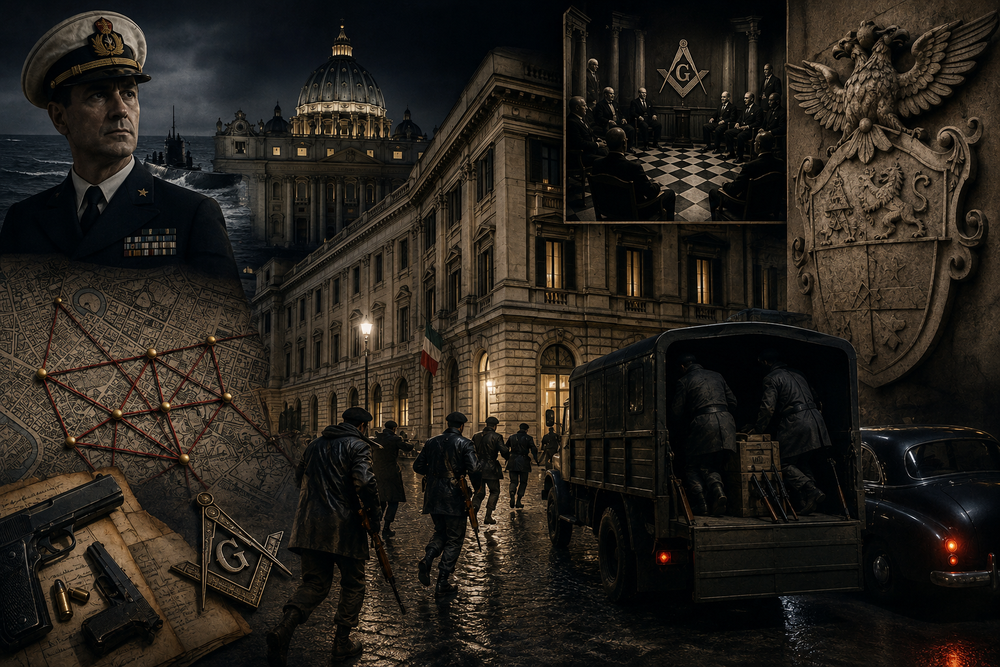
Begin with the literal moment. When Hitler killed himself on 30 April 1945, the Reich did not end; it filed paperwork. Admiral Karl Donitz, named successor in the will, set up a rump government in the northern town of Flensburg and carried on for three more weeks, issuing orders, holding cabinet meetings, administering what was left, until Allied troops arrived on 23 May and arrested the lot. For twenty-three days after the Fuhrer, the apparatus of the Reich simply continued to operate, out of habit, because an apparatus does not stop when its leader dies. That small, almost bureaucratic afterlife is the whole theme in miniature. The man was gone. The machine kept running, looking for someone to run it. There is a literal answer to the question the title asks, and it is the quietest part of the whole story. After the Führer, most of the men who had run his state simply kept working. The regime was destroyed, its leaders tried, its symbols banned. The bureaucracy underneath it largely remained. Denazification, the Allied program to remove former Nazis from public life, was wound down within a few years, and in 1951 the West German parliament passed the law known by the constitutional article behind it, Article 131, which allowed officials dismissed after the war to return to the civil service. By common estimate, around a hundred and fifty thousand of them returned. The ministries, the courts, the police, and the foreign service of the new democracy were staffed, to a striking degree, by the personnel of the old dictatorship.
The single clearest case sat at the very center of power. Hans Globke had co-written the official legal commentary on the 1935 Nuremberg race laws, the text that told German courts how to apply the persecution of the Jews. After the war he was not prosecuted. He became State Secretary and chief of staff of the Chancellery under Konrad Adenauer, holding that post for a decade and helping decide who else was hired. The man who had annotated the racial laws now ran the office of the leader of the new democratic Germany. This was not a scandal that was hidden; it was an arrangement that was tolerated, because the alternative, purging the entire trained administrative class, was judged too costly for a state that needed to function. The visible regime had fallen. The people who operated it had been re-papered and retained, which is the same mechanism, applied at home, that the rest of this archive traces abroad.
The arrangement at its plainest looked like this. In the Chancellery in Bonn through the 1950s, the man who helped decide which officials the new democracy would hire, who sat at the right hand of its first chancellor and screened the staff of the state, was the same man who had told the courts of the old dictatorship how to apply the laws that stripped the Jews of their rights. Hans Globke did not hide. He went to the office, every day, at the center of the government, and the government found him useful. No one had to conspire to arrange it. They had only to decide that the work mattered more than the past of the man who could do it, and they made that decision quietly, a thousand times over in a thousand offices, until the decision was simply the shape of the state.
Globke was the visible peak of an invisible mass. The same pattern ran through the institutions that decide guilt and represent the nation. Studies commissioned decades later found that the West German judiciary and the Foreign Office had absorbed former Nazi Party members in numbers that would have been unthinkable to admit at the time; the ministry's own 2010 historical inquiry concluded it had been far more complicit, and far more continuous, than its postwar self-image allowed. For years the machinery of the old state judged and represented the new one. The reckoning, when it came, came late and partial: it took until the Frankfurt Auschwitz trials of the mid-1960s, twenty years after the war, for German courts to begin trying the camp personnel in earnest, by which time most of the bureaucracy had long since been quietly reabsorbed. The lesson the period teaches is not that Germany failed to punish a few men. It is that an apparatus is almost impossible to remove once a state decides it cannot function without it.
The intelligence service made the continuity literal. Reinhard Gehlen had run Hitler's military intelligence on the Eastern Front; in 1945 he offered his files and his networks to the Americans, who set him up to run a German intelligence organization under their patronage. On the first of April 1956 that organization was handed to the West German government intact, staff and all, and renamed the Bundesnachrichtendienst, the federal intelligence service, with Gehlen as its first president for the next twelve years. The new democracy's spy agency was, quite simply, the old regime's, re-flagged. And the numbers behind the famous names were starker than the postwar state ever admitted. The Justice Ministry's own later inquiry, the Rosenburg report, found that by 1957 some seventy-seven percent of its senior officials had been members of the Nazi party, a third of them former members of the SA. The institutions that wrote the laws, judged the guilty, represented the nation abroad, and watched its enemies were staffed, at the top, by the people who had done those same jobs for the dictatorship. The apparatus had not been defeated. It had been re-papered.
The reckoning came late, when it came at all
If the apparatus survived, it also learned to protect itself, and the proof is in how long it took to be told the truth about what it had done. Three institutions trace the same arc, and none of them is the civil service or the spy agency already named. They are the foreign ministry, the courts, and the chemical industry, and each waited decades before its own past was forced into the open.
Begin with the diplomats. For sixty years the German Foreign Office told a flattering story about itself, that it had been a quiet island of professionalism that served the state while keeping its distance from the regime's crimes. In 2010 that story collapsed. An independent commission of historians, working from the ministry's own archives, published an eight-hundred-page report, Das Amt und die Vergangenheit, the office and the past, that concluded the opposite. The Foreign Office had not stood apart from the Holocaust but had taken part in it, lending its diplomatic machinery to the organization of deportations, and then, after the war, had shielded and re-employed its compromised personnel while burnishing the legend of its own innocence. The report had been commissioned by one foreign minister and delivered to another, which is to say the institution finally investigated itself, and what it found was that the cover story had outlasted the men it protected. Sixty-five years passed between the crime and the admission.
The courts took twenty. For two decades after the war the German judiciary, staffed as the Rosenburg report would later show by a majority of former party members, showed little appetite for trying the perpetrators in its own jurisdiction. The break, when it came, had to be forced from inside, against the grain of the apparatus. Fritz Bauer, the attorney general of Hesse, a Social Democrat of Jewish origin who had himself been interned in a camp in 1933 and spent the war in exile, spent years assembling the case that became the Frankfurt Auschwitz trial, which opened in December 1963. He knew he was working against his own profession; he is remembered for saying that when he stepped out of his office he was in enemy territory. The trial brought camp personnel before a German court in earnest for the first time, almost twenty years after liberation, and even then the sentences were uneven and many of the guilty were never reached at all. The machinery that was supposed to deliver justice had to be dragged to it by one man who did not trust the machinery around him.
Then the factories. The chemical conglomerate IG Farben had built a synthetic-rubber plant at Auschwitz worked by tens of thousands of slave labourers, many of whom died there, and had supplied the gas used in the killing. At the Nuremberg IG Farben trial in 1948 its director Fritz ter Meer, who had overseen the Auschwitz works, was convicted of enslavement and plunder and sentenced to seven years. He was released in 1950. In 1956 he was elected chairman of the supervisory board of Bayer, one of the successor companies into which IG Farben had been broken up alongside BASF and Hoechst, and he held that chair until 1964. A man convicted at Nuremberg for the use of slave labour sat, eight years later, at the head of one of the largest companies in the new democracy, and the firm that elevated him is a household name to this day. The conglomerate was dissolved. Its leadership, its plants, and its market position were not.
Why does this happen, again and again, across institutions that share nothing but their indispensability? Not because anyone defends the crimes. Because the state needs the function more than it can afford to punish the functionary. A country rebuilding from rubble needs diplomats who know the cables, judges who know the codes, chemists who know the processes, and there are only so many people who do. The incentive runs entirely one way. Every single decision to keep a useful man is locally reasonable, and the sum of those reasonable decisions is an apparatus that has quietly retained almost everyone. No one chooses impunity. They choose competence, a thousand times over, and impunity is simply what competence costs when the competent are compromised.
And the institutions are still here. The foreign ministry that took sixty-five years to tell the truth still conducts the country's diplomacy. The successor firms of IG Farben are still among the largest in Europe. The judiciary that needed a Fritz Bauer still sits. Continuity is not a historical curiosity that ended when the last defendant died. It is the ordinary condition of institutions, which is exactly why the question the title asks, what happens after the leader is gone, has the same answer in every era. The leader goes, and the institution that outlived him goes on deciding.
The same machine, at home and abroad
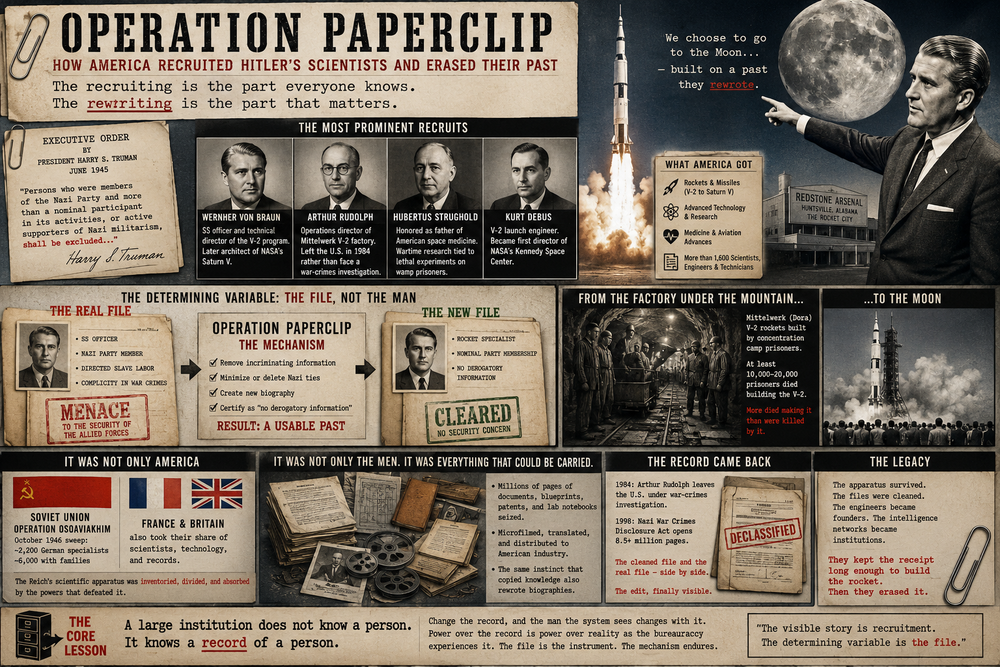
What happened inside Germany was the domestic edition of a method the same victors were running across the world. The men who had built the Reich's rockets were shipped to Alabama, its eastern-front spymaster was put back to work against Moscow, and its administrators were re-papered into the ministries of the new democracy. The principle was identical in each case, and it is the principle this archive returns to again and again: a regime can be destroyed while its apparatus is preserved, because the victor needs the machine more than it needs to punish the men who ran it. Denazification was real, the trials were real, the symbols were banned, and underneath all of it the personnel and the procedures of the old state were quietly retained, because a functioning state cannot be assembled from scratch in a year. The lesson is not that justice failed. It is that an apparatus, once a state decides it cannot do without it, is almost impossible to remove, and that this is true whether the apparatus is a rocket team, an intelligence network, or an entire civil service. The regime is the visible thing that falls. The machine is the invisible thing that stays.
And it was not only Germany. In Japan, occupied and remade by the same victor in the same years, the pattern ran identically. Kishi Nobusuke had helped run the wartime economy and signed the declaration of war against the United States; he was arrested as a Class A war crimes suspect and held for three years. He was never tried. Released in 1948 as the occupation's priorities shifted from punishment to a stable anti-communist ally, he re-entered politics and, in 1957, became prime minister of Japan, the office he held while binding his country tighter to Washington's security system. The same hand that had built one war machine was trusted to run the postwar state, because the postwar order needed a functioning Japan more than it needed a purged one. Two defeated enemies, two reconstructions, one method.
Power learns to hide
After 1945, dominant power reorganized itself around a simple idea:
Resistance grows where domination is obvious.
Control no longer depended on spectacle or belief. Authority moved into rules, procedures, contracts, and organizations where no single person could be held fully responsible. Leadership became replaceable. Decisions became distributed.
Power did not disappear.
It stepped back.
Universities became research hubs. Corporations became policy tools. Law became insulation. Influence no longer needed loyalty. It needed continuity.
This shift did not announce itself. It unfolded through paperwork, procurement, regulations, and administrative habits that felt boring rather than political.
Distance reduced resistance.
Distance reduced friction.
Distance made participation feel voluntary.
The scaffolding of participation
The structure was not a metaphor; it had names, dates, and budgets. In 1948 the Marshall Plan sent roughly thirteen billion dollars, an enormous sum at the time, into the rebuilding of Western Europe, on terms that knit the recipients into an American-led economic order. In 1949 NATO bound their defense to Washington's. The Bretton Woods system had already tied their currencies to the dollar. Each was a genuine good, freely accepted, and each also moved a piece of sovereignty from the national capital into a shared frame that the United States anchored. The genius of the arrangement was that it never had to be imposed, because it was wanted. A grant is not an occupation. An alliance is not a conquest. A monetary peg is not a command. The same logic built the institutions that became the European Union: the Coal and Steel Community of 1951 pooled the two industries a nation most needs to wage war independently, coal and steel, precisely so that no member could rearm alone without the others knowing. Integration was sold, rightly, as the cure for European war, and it was. It was also the mechanism by which the capacity for independent action was, deliberately and with consent, designed out of the system. And yet, accepted together and renewed for eighty years, they produced a continent that could not easily act without the power at the center of the frame, and had slowly lost the habit of trying.
Europe inside the system
Europe did not lose control overnight.
It postponed it.
Security was outsourced. Strategic planning weakened. Defense industries shrank. Energy systems were built for efficiency, not resilience. Backup options looked wasteful. Independence seemed unnecessary.
Again, these were not foolish choices.
But choices made under stable conditions harden into constraints when conditions change. By the time pressure returned, Europe’s ability to act on its own had thinned.
Europe gained predictability.
It lost leverage.
The moment of exposure
For eight decades the arrangement held because it was never tested. Then it was. When an American administration began, in the mid-2020s, to treat the alliance as a transaction, to question the automatic defense guarantee, to impose tariffs on its own partners and to demand they pay far more for their own protection, the invisible structure snapped into view. Europe discovered, all at once, what it had slowly stopped being able to do: field a defense without American enablers, settle its trade without the dollar system, decide its security without Washington in the room. Germany, which had already created a hundred-billion-euro special defence fund after the invasion of Ukraine in 2022, moved in 2025 to loosen the constitutional debt limit it had kept for generations so it could spend far more, and the continent began talking, urgently, about strategic autonomy, the very capacity it had spent eighty years allowing to atrophy. The dependence had been there the whole time. It only became visible the moment the power at the center stopped pretending it was not power.
What feels new today is not behavior, but visibility.
As global conditions shifted, the systems that once carried authority quietly began to strain. Resources tightened. Competition increased. Automatic agreement faded.
Under these conditions, power does not reinvent itself.
It becomes clearer.
What once worked quietly now requires effort.
What once relied on trust now relies on pressure.
This does not signal a change in character.
It signals a change in conditions.
Strategic autonomy, named at last
The forcing of it back into view has a recent and documented shape. As an American administration began, in the mid-2020s, to treat the alliance as a transaction, to question the automatic defense guarantee, to put tariffs on its own partners and to demand they pay far more for their own protection, the dependence that had been invisible for eighty years acquired a name in every European capital: strategic autonomy, the capacity to act without the power at the center of the frame. The naming was the admission. You do not campaign for an autonomy you still possess.
The response was measured in money and in law. Germany, which had already created a special defence fund of around a hundred billion euros after the invasion of Ukraine in 2022, moved in 2025 to loosen the constitutional debt brake it had guarded for a generation, exempting defense spending above a set share of output from the limit and standing up a separate fund of roughly five hundred billion euros for infrastructure. The alliance as a whole began debating spending targets that would have been unthinkable a decade earlier. Each step was framed as a free choice, and each was also the visible repair of a capacity that eighty years of dependence had allowed to waste. The dependence had been there the whole time. It became a headline only when the power at the center stopped pretending it was not power, and the continent discovered, all at once, what it had slowly lost the habit of doing for itself.
The law it reveals
By now the pattern has all but named itself, and it transfers far past 1945. The deepest distinction in this whole story is not between democracy and dictatorship, nor between liberation and conquest. It is between power that is seen and power that is felt, and that single variable decides how long a system lasts. Power that insists on being seen creates the target and the moral that organize resistance, which is why the Reich, for all its machinery, lasted barely a decade: the swastika on the wall told everyone exactly what to refuse, and the clarity manufactured its own opposition. Power that has dissolved into procedure, budget, treaty, and collateral rule offers nothing to refuse and no one to blame, which is why the order that replaced it lasted eight times as long. There is no square to march on when the constraint is a clearing rule, no villain to name when the decision was made by a committee following a mandate.
This is the determining variable, and it is the spine of a larger inquiry into how visibility is governed: what is allowed to be seen, what stays off the agenda, and what never becomes a question at all. The Reich made the elementary error of being visible. Its successor learned to be felt instead, and a power that is felt but not seen can endure until the day something forces it back into view. Everything else in this piece, the retained officials, the freely accepted treaties, the atrophied autonomy, is an instance of that one law. The most durable power is the kind that does not look like power, right up until the moment it forgets to stay hidden.
The strongest case against this reading
The honest objection is that none of this was domination at all. The postwar order genuinely rebuilt a ruined continent, kept the peace among states that had fought twice in thirty years, and lifted living standards across generations. The Marshall Plan was a gift, NATO a shield freely chosen, European integration the deliberate cure for European war, and all of it worked. To call a mutually beneficial order a hidden form of control, the objection runs, is to mistake successful cooperation for subjugation, and to insult the Europeans who built it as dupes.
The objection has real force, and this piece does not deny the benefits. They were the whole reason the order was wanted. But the two readings are not in conflict. A thing can be both a genuine good and a structure that quietly removes the option of refusing it, and the test is what happens when one side stops cooperating. A partnership you can leave is a partnership. A partnership you have lost the capacity to leave is a dependency, whatever it felt like on the way in. The benefits were real. So was the atrophy. What the mid-2020s revealed is which of the two had become load-bearing.
Power without a counterweight
For eight decades, the United States acted in a position where its actions rarely faced equal resistance. Not because it used force constantly, but because the system around it absorbed the impact.
As long as this worked, power did not feel excessive.
It felt necessary.
That situation is ending.
Power without a counterweight does not disappear easily.
It tightens.
When power could hide, it did.
When it could not, it showed itself.
That is where we are.
Evidence Map
Facts, interpretations, forecasts, and disconfirming signals.
Core claim. Power that must be seen is fragile, because visibility creates the target and the moral that organize resistance. Power dissolved into structure, procedure, budget, and treaty is durable, because there is nothing to refuse and no one to blame. The Reich insisted on being seen and fell in a decade. The order that followed it, built from genuine goods freely accepted, learned to be felt instead, and lasted eighty years, until the power at its center stopped pretending it was not power.
Evidence level. Facts (high): the Flensburg government's twenty-three-day afterlife under Donitz; Article 131 and the return of roughly a hundred and fifty thousand dismissed officials; Hans Globke's role and career; the Gehlen Organization becoming the BND in 1956; the Rosenburg report's finding that seventy-seven percent of senior Justice Ministry officials in 1957 were former party members; the Foreign Office's 2010 inquiry; the Marshall Plan, NATO, Bretton Woods, and the Coal and Steel Community; Germany's 2022 special defence fund and its 2025 loosening of the debt brake. Interpretation (medium, marked): that visibility is the determining variable distinguishing the fragile order from the durable one; that the postwar benefits and the atrophy of autonomy are two faces of one structure. Forecast (speculative): that as the central power turns transactional, the dependence keeps becoming visible and Europe's strategic-autonomy effort accelerates.
What would confirm this. Continued European rearmament and autonomy initiatives as the alliance turns transactional; the dependence staying visible rather than receding.
What would disprove this. A return to the automatic, unspoken guarantee with no loss of European capacity; evidence that European autonomy never meaningfully atrophied.
Watchlist. European defence spending and the debt-brake reforms; the transatlantic alliance's terms; whether strategic autonomy moves from rhetoric to capacity.
Jerry van der Laan writes The Manifest Archive, forensic journalism on the systems beneath power, money, and history. He traces the structures beneath them.
Related from The Manifest Archive
- Hitler Lost the War. Von Braun, Gehlen and Dulles Won the Peace.
- Operation Paperclip: How America Recruited Hitler's Scientists
- The Reich After the Reich
- Reinhard Gehlen Surrendered in 1945. American Intelligence Hired Him in 1946.
- Everyone Is Watching the Reopened Strait. Nobody Is Asking Who It Reopened For.