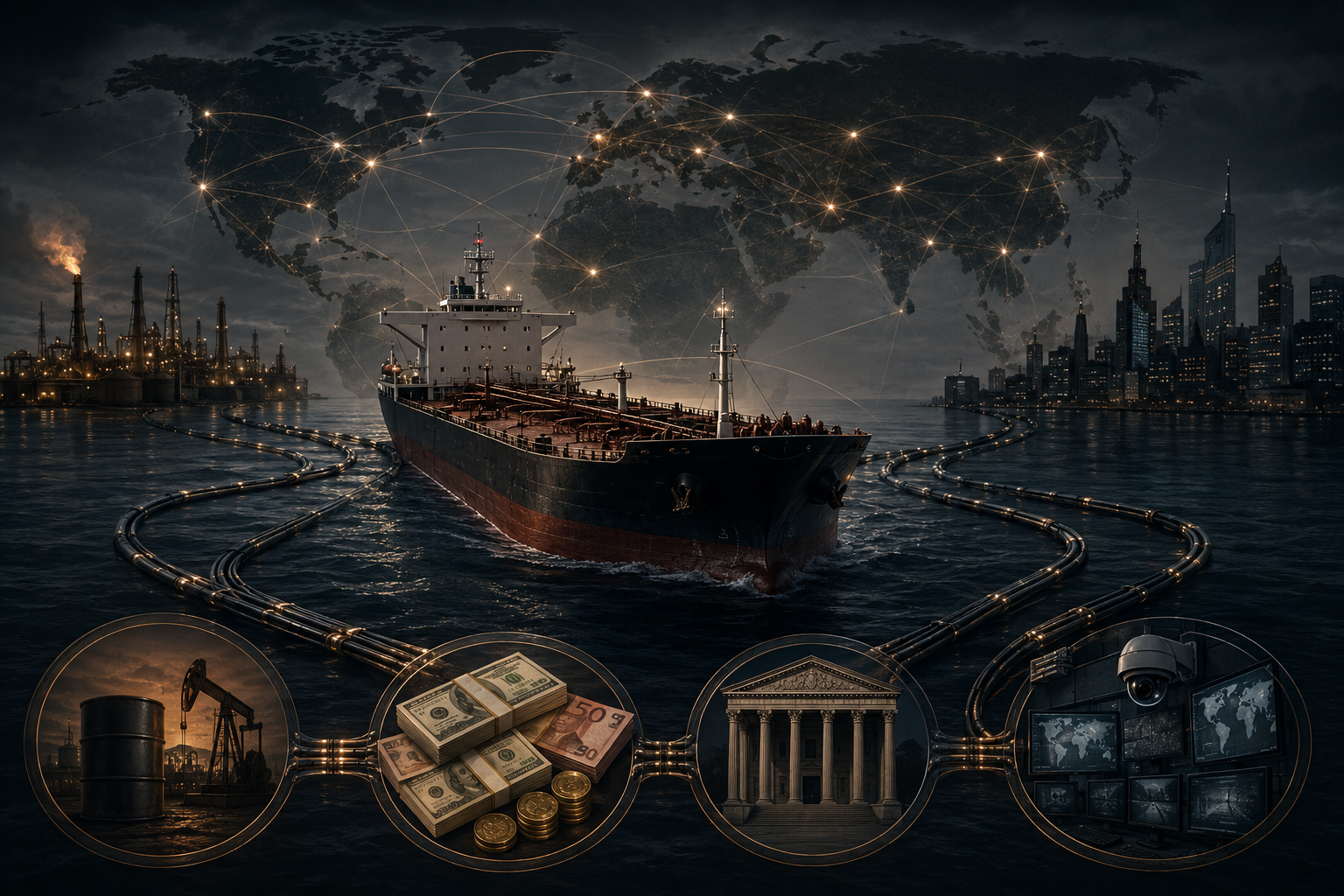
Somewhere off a Russian coast, at night, a tanker finishes loading and sails into open water, and then switches off the transponder that is supposed to make every large ship on earth visible. It goes dark. In the hours that follow it may pull alongside another vessel and pass its cargo across, hull to hull, so that oil that boarded as Russian crude sails on as something with no clear birthplace. Its insurer answers to no Western regulator. Its owner is a shell behind a shell. Its flag belongs to a state that asks no questions. No single law is broken that anyone can easily name. A whole logistics system has simply rearranged itself, in the open, around the one lever the West believed it held.
That ship is the most honest picture we have of how the world's autocracies actually connect to one another. Not a summit of strongmen, not a shared faith, not a coordinated plan. A vessel changing its name in the dark.
The story everyone tells is a different one. It is a story about what the dictators believe. The new authoritarians, the telling goes, are forming a bloc, an axis, a brotherhood of strongmen united against the democratic West. It is a story about ideology, about values, about a clash of systems. And it is watching the wrong thing, because the regimes in question agree on almost nothing, and what actually binds them is not a creed at all. It is a set of pipes.
Anne Applebaum got the shape of this right in her 2024 book Autocracy, Inc. The autocracies of the present, she argued, are not held together by a shared ideology in the way the Communist bloc once was. A theocracy in Tehran, a party-state in Beijing, a kleptocracy in Moscow, a Bolivarian regime in Caracas: they have no common doctrine, no shared utopia, nothing they are all for. What they have in common is something narrower and more durable, a determination to hold their wealth and power, and a set of practical arrangements for helping each other do it. Applebaum named the network. This piece is about the thing underneath it, the determining variable her account gestures at but does not fully name: the autocracies are bound not by what they believe but by what they use, and the infrastructure they share is the load-bearing fact that the language of ideology hides.
That infrastructure has victims, and one of them was a woman on a small European island who never went near an autocracy in her life. Her name was Daphne Caruana Galizia, and her death belongs later in this story. First the pipes, because it is the pipes that explain her.
Applebaum named the network. The infrastructure is the layer beneath it.
Applebaum's catalogue of cooperation is accurate and worth keeping. When the West dropped Russia's RT from its satellites, a Chinese satellite picked the channel up and kept the propaganda flowing to the developing world. China supplies arms to Venezuela; Iran supplies drones to Russia. Iran sends Venezuela oil and technical help; Venezuela has laundered money toward Hezbollah and handed out passports to its officials. None of this requires the parties to share a worldview. It requires only that each can do something the other needs, which is the logic of a market, not a movement.
Applebaum does not miss the West's role in this. Her central chapter is about exactly that, the Western enabler economy, the City of London and the European property markets and the lawyers, bankers, and public-relations firms who move and clean the money. The place her account stops one layer short is not whether the West enables the autocrats but what makes their cooperation possible and durable in the first place, and where that machinery came from. It is tempting to leave the West there, as the negligent enabler, guilty of greed and inattention but not of authorship. The less comfortable reading is that the democracies did not merely look away while the machine was assembled. They assembled it, for their own purposes and long before the autocrats arrived to use it. The pipes through which autocratic money, messaging, and matériel move are not foreign systems the democracies merely failed to police. They are, to a substantial degree, the democracies' own institutions, built decades earlier for their own purposes and now rented out, which makes the West not a bystander to this infrastructure but, in large part, its contractor. This does not refute Applebaum. It stands on her. She named the network; this piece traces the infrastructure beneath the network, the determining variable that makes the whole arrangement work, and follows it back to the people who built it. The democracies did not lose these regimes to a rival order so much as supply much of the order the regimes now use, and everything that follows is the evidence for that uncomfortable sentence.
Four pipes
Look at the plumbing concretely, because the abstraction "they cooperate" dissolves into something more specific and more damning when you trace the actual conduits. There are roughly four.
The first is payment. Picture the concrete reality first, before the acronyms. A Russian refiner sells crude to a Chinese buyer; the buyer pays in yuan; the money moves from one account to another inside a Chinese-run network, and at no point does a dollar exist or a New York bank see the transaction. A trade that three years earlier would have passed through the Western banking system now passes through Shanghai, and the West does not know it happened. That is the pipe. Cut out of the Western messaging system, Russia leaned on its own small network, the System for Transfer of Financial Messages, used by something on the order of five to six hundred organizations, including foreign banks in roughly two dozen countries such as Belarus and Cuba, and increasingly on China's Cross-Border Interbank Payment System, CIPS, which by 2025 spanned participants across more than a hundred and eighty countries and had processed cumulative flows in the tens of trillions of dollars equivalent. A parallel financial rail is being built, in yuan, for exactly the actors who fear being cut off from the dollar. The honest qualifier matters and will return below: roughly four-fifths of CIPS transactions still rely on the Western SWIFT network to carry their instructions, and the yuan remains a sliver of global payments against the dollar's near-half. The alternative pipe is real, and it is also still plumbed into the old one.
The frontier of this pipe is no longer just messaging but the money itself. Central banks, China's among the most advanced, have been building digital currencies and cross-border bridges to settle in them directly, without the dollar, the Western correspondent bank, or the Western messaging network touching the transaction at all. These efforts are still experimental and small, and most have non-autocratic members too, which is the lesson: the technology that lets a sanctioned regime settle outside Western reach is the same technology any state that resents one government's grip on the world's banking is helping to build. The exit door is being constructed in plain view, by a mixed crowd, for reasons that have nothing to do with ideology.
What is building the alternative is instructive in its own right, because it is the West's own weapon. The dollar's centrality is itself a choke point, and the United States has used it aggressively, cutting Iran from the messaging system in 2012, cutting Russian banks after 2022, threatening secondary sanctions on anyone who deals with either. Iran sells oil to China priced in yuan precisely because dollar channels are closed to it. The autocracies are not building a parallel financial rail because they love the yuan. They are building it because the West demonstrated, repeatedly and publicly, what it can do to anyone who stays inside the dollar and falls out of favour.
The second is the sea. When the West tried to cap the price of Russian oil, it did so not with a blockade but through insurance, barring Western underwriters from covering cargoes sold above the cap. The autocratic answer was a shadow fleet, hundreds of aging tankers operating outside Western cover, insured through an opaque tangle of state-backed and offshore arrangements. A whole maritime evasion layer materialized within months, because the choke point the West held, marine insurance, was one that a determined seller could route around at a cost. The pipe was improvised in the open.
The tanker that opened this piece is one of hundreds. The dark fleet has been counted in the hundreds of vessels and reported on routinely; none of it is hidden. It is simply built faster than it can be policed, and once it exists it serves not only Russian oil but anyone who later needs to move a sanctioned cargo without asking the West's permission.
The third is money itself, and here the Western address is undeniable. The dirty wealth of autocrats does not hide in Tehran or Pyongyang. It is laundered and legitimized in London and New York, through what a 2020 report by Britain's own Intelligence and Security Committee called an "industry of enablers", the lawyers, accountants, estate agents, and public-relations firms who move and clean the money. That report described estate agents as having functioned as "de facto Russian agents" and concluded that Russian wealth had so integrated into the City that government measures amounted to damage limitation rather than prevention. Britain's National Crime Agency has estimated that something on the order of a hundred billion pounds of dirty money flows through the United Kingdom each year. The route in was, for years, semi-official: the "golden visa" that granted residency in exchange for a large enough investment, a scheme Britain ran until it was suspended in 2022, effectively selling a place in the democracy to whoever could move the funds through the enabler firms. The kleptocrat's capital is not stored in an autocracy. It is stored in a democracy, by professionals who are paid well to ask no questions.
When the political weather finally turned and some of these fortunes were sanctioned, the result exposed the arrangement rather than ending it. Mansions in the best London districts were frozen, not seized, their owners barred from selling but not parted from ownership, the buildings left standing empty and intact, waiting. The image is the whole mechanism in one frame: the looted wealth had been converted so thoroughly into legitimate-looking property, through so many layers of professional service, that even a government that now wanted it gone could only put it on pause. The pipe had done its work too well to be reversed in a hurry. The capital was inside the democracy's own walls, behind the democracy's own laws, defended by the democracy's own lawyers.
The fourth is narrative and surveillance, the soft and the hard ends of control. The propaganda travels on commercial distribution, and the clearest illustration is also the simplest. When Western satellite operators dropped Russia's RT after the invasion of Ukraine, the channel did not go silent; a Chinese satellite picked it up and carried the same broadcasts onward, especially into the developing world. One autocracy's banned signal became another autocracy's relayed one, not by ideological agreement but by the availability of a transponder. The cruder online version is the typo-squatted news site, a fake dressed in a real outlet's clothes, the address off by a character, built to borrow credibility it has not earned. The infrastructure of persuasion, like the infrastructure of money, is rented and repurposed rather than believed in. And the tools of domestic control travel as exports: the surveillance cameras, the censorship architecture, the monitoring systems that one autocracy perfects and then sells to the next, so that a technique for watching a population in one country becomes a product in another.
There is no axis. There is a market.
Consider the case that looks most like a brotherhood and is most clearly a transaction. In 2020, with its refineries failing under sanctions, Venezuela could not produce enough gasoline to keep its own cars running. Iran, itself sanctioned, sent it. A flotilla of Iranian tankers crossed the Atlantic with fuel and refinery components, escorted into Venezuelan waters; Iranian technicians arrived to help restart the plants. What flowed back, by multiple accounts, included gold, lifted from Venezuela's reserves and flown out, because neither country could settle the bill through any normal banking channel that the dollar system would touch. Two regimes with no shared project, separated by an ocean and by language and by the entire content of their politics, conducted a barter of oil for gold because each held something the other could not otherwise buy. That is not solidarity. It is a spot market between two parties the rest of the market has refused to serve, and it ran on improvised pipes precisely because the ordinary ones were closed to them.
Put the four pipes together and the usual frame collapses. An axis implies a shared purpose and a center; what the evidence shows has neither, only a set of services available to whoever can pay, used by regimes that would have nothing to say to each other at a dinner table. Iran and Venezuela are not ideological kin. China and Russia are historic rivals with a long border and longer suspicions. They are not allied by what they believe. They are bound by what they use, and a market does not require its customers to agree about anything except the price.
It is worth measuring this against the thing it is mistaken for. The old Communist bloc was an axis in the true sense: a shared doctrine, a coordinating center in Moscow, parties that took the same line, an international built to spread one idea. That is what people are unconsciously reaching for when they speak of an axis of autocracies today, and it is exactly what does not exist. There is no shared doctrine, no center, no line. Run the counterfactual and the difference is stark. Strip the Comintern of its ideology and there is little left, because the ideology was the bond. Strip today's autocracies of their shared infrastructure, the rails, the fleets, the enablers, the supply chains, and the cooperation has nothing to fall back on, because there was never a common belief beneath it, only a common set of services. Remove the pipes and the "axis" does not become a weaker alliance. It stops being an alliance at all, and reverts to a collection of mutually suspicious regimes with no reason to coordinate. That counterfactual is the proof of which variable is doing the work.
This is why the determining variable is the infrastructure and not the ideology. Watch for a shared belief, a new Comintern, a doctrine the autocrats are spreading, and you will keep not finding it, and conclude either that the threat is exaggerated or that the autocrats are simply irrational. Watch the plumbing instead and the picture resolves at once. The autocracies are not a faith. They are a clientele, and what makes them collectively formidable is not what is in their heads but what runs between them.
The contractor has a Western address
Here is the part the bystander framing is built to avoid. If the binding agent is infrastructure, the decisive question is not what the autocrats believe but who supplies and maintains the pipes, and the answer implicates the democracies far more deeply than negligence. The enabler economy is not in Moscow; it is in Mayfair, and the people who run it are not foreign agents who slipped past the border but domestic professionals operating legally, or close to it, inside the financial capitals of the democratic world. The golden-visa schemes that sold residency for investment were written by democratic governments; the offshore conduits run through the democracies' own dependencies and treaty networks.
So the West did not lose the autocrats to a rival system. It rented them its own. The most effective infrastructure of autocratic impunity is not an autocratic invention; it is the democracies' financial and professional machinery, available for hire, and that is the fact the language of an "axis" is perfectly designed to keep out of view. It is easier to describe a brotherhood of distant despots than to notice that the plumbing runs through one's own city, maintained by one's own compatriots, for a fee. Autocracy, Inc. is not only a foreign firm. It has a Western address, a Western staff, and Western invoices.
The pipes are not new
There is a question the "axis" story never asks, and it is the one that exposes the whole frame: where did this infrastructure come from. It was not built by autocrats. The offshore financial world, the network of low-tax, low-disclosure jurisdictions through which the planet's hidden money moves, was constructed largely by and for the West, beginning in the City of London in the late 1950s with the eurodollar market, a pool of offshore dollars deliberately placed beyond the reach of national regulators. Britain spent the following decades cultivating a web of dependencies and territories, the Caymans, the British Virgin Islands, Jersey, that turned secrecy into a national export industry. The United States built its own versions, the anonymous shell companies of Delaware and a handful of other states, so effective that America itself is regularly ranked among the world's easiest places to hide ownership.
This matters because it answers the question Applebaum's frame leaves open: the kleptocratic system did not arrive from the autocracies. It was waiting for them. The democracies built the secrecy machine for their own corporations and their own wealthy long before a Russian oligarch or a Chinese princeling needed it, and when those customers arrived they did not have to construct anything. They subscribed. The plumbing predates the tenants. That is why "they spread to us" is only half the story. We laid the pipe, and then they moved in.
The scale of that system is not marginal. Economists who study offshore wealth estimate that a sum equal to around eight percent of global household financial wealth, roughly a tenth of world economic output and on the order of several trillion dollars, sits in offshore accounts beyond the reach of the tax authorities of the countries where it was earned. That figure is not autocrats' money alone; most of it belongs to the wealthy of the democracies themselves and to the corporations that book their profits in zero-tax jurisdictions. But that is precisely the point. A secrecy system large enough to hide that much of the world's private wealth is not a back alley the autocrats discovered. It is a principal thoroughfare, and they merged onto it alongside the traffic that built it. The autocrat's stolen billions and the multinational's avoided taxes move through the same conduits because the conduit was never designed to distinguish between them. It was designed not to ask.
Who else maintains the pipes
The enabler economy is not only British, and seeing its full extent kills the comforting idea that this is a Mayfair problem. The United States, for years the loudest voice against foreign kleptocracy, was simultaneously one of the world's great laundromats, its anonymous limited-liability companies allowing ownership to vanish behind a registered agent's address. The leaked compliance reports known as the FinCEN Files showed major global banks moving vast sums they had themselves flagged as suspicious, filing the paperwork and processing the transfers anyway. The point is not a single villainous firm but a structural arrangement: an entire professional class, lawyers, bankers, accountants, corporate-formation agents, public-relations specialists, whose business model is the discreet handling of money whose origin it is not in their interest to examine.
The hardest end of the infrastructure has its own suppliers, and they are not all in autocracies either. The surveillance tools that let a regime watch its population, the cameras, the network-monitoring systems, the "safe city" packages, are a major Chinese export, sold across the developing world as a turnkey product. But the most invasive instruments, the commercial spyware that can turn a dissident's own phone into a microphone, have come substantially from firms based in democracies and democratic allies. When a reporting consortium examined a leaked list of likely targets of one such tool, it found the numbers of journalists, human-rights defenders, and opposition figures across many countries, some of them jailed or dead soon after. The product was built inside a democratic ally and used to watch dissidents inside autocracies, running straight across the line the "values" frame insists divides the two worlds. Repression is a supply chain, and a meaningful share of it originates inside, or just beside, the democratic world that decries the use.
There is a pattern in how each of these markets answers to Western pressure, and it is the pattern that should worry the democracies most. Each time the West tightens a choke point, it does not close the system; it teaches the system to route around the West. Sanction the banks and the alternative payment rail gains a customer. Cap the oil price through insurance and the shadow fleet gains a tanker. Expose the enabler firms and the money learns a quieter channel. The leverage is real, but every exercise of it is also a lesson in independence delivered to the people on the other end, and the pipes that result are, by design, the ones the West can no longer see into. The supplier is teaching the client to need him less, one sanction at a time.
The deepest pipe is not a pipe
There is a layer beneath the four, and it is the one that makes the other four possible. It is not a conduit but the ground the conduits are laid in: the law. Not law as legislation, but law as infrastructure, the private machinery of contracts, courts, corporate forms, and property rights through which value is owned, moved, and disputed. And this machinery runs almost entirely in two registers, English law and the law of New York, no matter who is using it.
Consider where the world's commerce actually goes to be adjudicated. A dispute between a Kazakh company and a Chinese one, with no British party and no British asset, will frequently be governed by English law and heard in London, because English law is the default operating system of international contracts. In a recent year well over half of the litigants before London's Commercial Court were foreign, drawn from more than eighty nationalities, and in earlier counts roughly half of the cases were between parties with no connection to Britain at all. The arbitration bodies tell the same story, with the great majority of those who appear before London's main arbitration court holding no British nationality. The autocrat's oil major and the kleptocrat's holding company write their contracts, hold their assets, and settle their fights inside a legal system built and staffed in the democratic world.
The structures themselves are legal fictions supplied by that same world. A trust that separates the man who controls a fortune from the man who legally owns it, a shell company that lets ownership vanish behind a registered agent, a holding vehicle in a treaty-friendly jurisdiction: these are not laws of nature. They are inventions of commercial law, and they are the instruments through which every one of the four pipes does its work. The shadow tanker is owned through them. The laundered townhouse is held through them. The propaganda outlet is incorporated through them.
And the same machinery can be aimed at a single person. This is where Daphne Caruana Galizia returns to the story. When the Maltese journalist was killed by a car bomb in 2017, she was facing dozens of libel suits at once, many of them filed in friendly foreign courts by the wealthy interests she had reported on, a barrage designed less to win than to drain and intimidate. The instrument that buried her, the strategic lawsuit against public participation, was honed in the service of oligarchs and corporations who learned that a reporter could be silenced not by a state censor but by the cost of a defense under someone else's commercial law. The pipe that hides a fortune and the pipe that silences the journalist investigating it are the same pipe, and it is not a metaphor to the people it runs over.
And the law binds even the regimes that defy it. In 2014 an arbitration tribunal sitting under the Permanent Court of Arbitration in The Hague ordered Russia to pay fifty billion dollars to the former shareholders of Yukos, the oil company the Russian state had dismembered. The claimants were not Western governments; they were holding companies registered in Cyprus and the Isle of Man, the same offshore legal fictions that move autocratic money, turned this time against the autocrat. The award ran on the Energy Charter Treaty, a body of Western-built investment law, and years later Russian assets abroad are still being pursued under it. The legal infrastructure that lets a regime hide its wealth can also be used to seize it, and both directions run through the democracies' courts. That is the deepest pipe. Ownership is a legal fact, a contract is enforceable somewhere, a company is a person, and the world in which all three are true was built by the commercial law of the democracies, inside which the autocrats, like everyone else, operate.
Why ideology was always the wrong thing to watch
The deeper lesson reaches past this set of regimes, because it is about where to look for power at all. To read geopolitics through belief, which side is for freedom, which doctrine is advancing, is usually misleading, because belief is the visible layer and infrastructure is the determining one. Regimes come and go and ideologies are discarded, but the pipes persist, and whoever supplies them shapes the outcome regardless of what anyone professes. The Cold War trained a generation to look for the creed. The present rewards looking for the conduit.
History keeps making the same point for anyone willing to read it that way. The offshore system that launders an oligarch's billions today was carrying the flight capital of dictators and tax-shy magnates two generations ago; the customers changed, the pipe did not. The dollar's role as the world's reserve currency outlasted the gold standard that birthed it, the Bretton Woods institutions that managed it, and every administration that wielded it. Infrastructure has a longer half-life than ideology because it is expensive to build and easy to inherit, and because each regime that comes to power finds the conduits already laid and simply moves in. This is the durable law beneath the topical story: ideologies are what regimes say, and infrastructure is what they keep. To predict what a system will do, watch what it cannot afford to rebuild, not what it claims to believe. The creed is the costume; the conduit is the body.
Watch the plumbing, not the creed. The question that actually predicts behavior is not "what does this regime believe" but "what does it route its money, its oil, its messages, and its repression through, and who owns that route." Answer that and you see the alignments the speeches obscure, including the uncomfortable ones that cross the democratic-autocratic line, because the same pipe often serves both ends.
This is a general method, not a one-off observation. To locate real power in any contested system, do not rank the actors by what they profess or even by their size; find the crossing point, the conduit through which their money, goods, information, or legitimacy must pass, and ask who controls and supplies it. Applied to the autocracies, the method dissolves the axis into a set of pipes and a market in their use. Applied elsewhere, it keeps finding the same thing: that the determining variable is rarely the belief on display and almost always the infrastructure underneath. The shared infrastructure is the alignment. Everything else is commentary, including the speeches the alignment is mistaken for. Watch the creed and you will miss the conduit; watch the conduit and the creed explains itself.
The plumbing flows both ways
The open, connected world was supposed to spread democracy into the autocracies. Instead the autocracies spread into the democracies, and the mechanism is the shared infrastructure. A pipe carries in both directions. The same conduits that let autocratic money into London let autocratic methods in with it.
Watch the techniques migrate. The libel suit weaponized to silence a reporter, the strategic lawsuit against public participation, was refined in the service of oligarchs and is now a standard tool against journalists in the democracies themselves. The surveillance products perfected on captive populations abroad are sold to police forces at home. The disinformation methods built to confuse foreign electorates run just as well on domestic ones, on the same platforms, often through the same firms. Kleptocratic capture, the quiet purchase of influence through property, donations, and the enabler professions, does not stop at the border of the democracy whose services it buys; it begins to shape that democracy's own politics. This is the boomerang the bystander story cannot account for: if the West were merely looking away, the damage would stay abroad. Because the West is wired into the same plumbing, the damage comes home through the pipe. The infrastructure that serves the autocrat is the same infrastructure that, used at home, makes a democracy a little more like him.
The honest objection
The strongest case against this reading runs in two directions, and both deserve to be stated at full strength. The first is that it overstates the autocrats' escape. The alternative rails are still half-built: most CIPS transactions still ride on Western messaging, the yuan is a small fraction of global payments against the dollar's dominance, the shadow fleet is costlier and clumsier than the system it evades, and the West's leverage over the core financial architecture remains decisive, which is precisely why the autocracies are scrambling to build alternatives rather than enjoying ones that already work. By this account the plumbing is real but leaky, and Western power over it is the actual headline.
The second objection cuts the other way and is sharper: that singling out the "autocracies" lets the West off too easily, because the same infrastructure, the offshore conduits, the enabler professions, the surveillance exports, serves plenty of governments the West calls friends, and the kleptocratic global system was not built by dictators but by the democracies that now decry it. A critic would say that "Autocracy, Inc." is a flattering frame precisely because it locates the rot abroad.
Both objections narrow the claim and neither dissolves it, and together they sharpen it into its honest form. The point is not that the autocracies have escaped Western power; it is that the binding agent among them is infrastructure rather than ideology, and that the infrastructure is shared, contested, and substantially Western-supplied. The leakiness of the alternative rails is not a counterargument; it is the reason the enabler economy and the evasion layers matter so much, because they are where the contest over the pipes is actually being fought. And the fact that the same plumbing serves friendly regimes too is not an exoneration; it is the deepest version of the thesis. The infrastructure does not care about the creed of the customer. That is exactly why watching the creed misleads, and watching the pipe does not.
The pipe, not the speech
So the dictators will keep giving the speeches, and the coverage will keep parsing them for doctrine, for signs of an axis, for the shape of a coming ideological war. Watch that, and you will be watching a screen. The thing that determines whether sanctions bite, whether a war can be funded, whether stolen wealth becomes legitimate property, whether a population can be surveilled into silence, is not the speech. It is the infrastructure underneath it, the payment rail and the shadow tanker and the law firm and the camera, and the question of who builds, owns, and maintains each one.
The autocrats are not bound by what they believe. They are bound by what they use, and a surprising amount of what they use was built by the people who claim to be their opponents. The axis was never the danger. The plumbing is, and the plumbing, traced to its source, keeps arriving at addresses much closer to home than the story about distant dictators was ever meant to reach.
Daphne Caruana Galizia understood that before most governments did. She was not killed by an axis. She was killed at the end of a pipe that ran through courtrooms and law firms and reputations for hire, the same pipe that lets a sanctioned cargo change its name at sea and a stolen fortune become a London townhouse. The tanker that went dark off the Russian coast and the journalist who died on a road in Malta are connected, and what connects them is not a creed. It is the system, and the system has a Western address.
And here the frame turns one last time. The infrastructure does not bind the autocracies to one another so much as it binds them to us. The same courts, the same law firms, the same payment rails, the same offshore vehicles serve the oligarch and the pension fund, the sanctioned tanker and the legitimate one, the dictator's holding company and the democracy's own corporation. There are not two systems, a free one and an unfree one, plumbed separately and touching only at the border. There is one system, with one set of pipes, and the line we draw down the middle of it, them on that side and us on this, is the part the infrastructure does not recognize. This is not a claim that the regimes are the same. It is a claim that the machine is.
And then comes the part the comfortable story can never reach, because it is the part that costs us something. The democracies are not merely confronting this infrastructure. They live on it. The fees clear in London, the offshore capital lifts London property, the disputes bill the London and New York law firms, and the dollar's reach through these same channels is the very source of the leverage the West then congratulates itself for holding. To close the pipes that serve the autocrat, a democracy would have to shut an industry that serves itself, dismantle a flow of money it has come to depend on, and surrender a form of power it is not willing to give up. That is the real reason the plumbing endures, and it is a heavier reason than greed or inattention. It was never only their infrastructure. It is ours, we are paid by it, and the last system anyone agrees to see clearly is the one that is paying him.
Evidence Map
Facts, interpretations, forecasts, and disconfirming signals.
Core claim. The world's autocracies are bound not by a shared ideology but by a shared infrastructure of impunity: payment rails (CIPS/SPFS), maritime sanction-evasion (the shadow fleet), kleptocratic finance and its professional enablers, propaganda and surveillance supply chains, and beneath all four the legal infrastructure (English/New York commercial law, offshore corporate forms, investor-state arbitration) that makes ownership, contract, and the shell company possible at all. The determining variable is this infrastructure, not belief, and much of it is built, maintained, and staffed inside the democracies, which makes the West a supplier rather than merely a negligent bystander. The sharpest form of the claim: there are not two separate systems but one, serving autocracies and democracies through the same pipes.
Evidence level. Facts (high): Applebaum's documented cooperation cases (RT carried by a Chinese satellite, China-Venezuela arms, Iran-Russia drones, Iran-Venezuela exchange); CIPS scale (180+ countries, ~1,683 participants, tens of trillions cumulative) and the qualifier that most CIPS traffic still relies on SWIFT and the yuan is a small share of global payments; Russia's SPFS; the price-cap-driven shadow fleet; the UK Intelligence and Security Committee's 2020 "industry of enablers" finding and the NCA's ~£100bn/year dirty-money estimate; the FinCEN Files; the offshore-wealth estimate (~8% of global household financial wealth, ~10% of world output); Iran's 2020 oil-for-gold supply run to Venezuela; the Pegasus spyware reporting; the mBridge cross-border CBDC project; the dominance of English/New York law in international contracts (the majority of London Commercial Court litigants are foreign) and the 2014 Permanent Court of Arbitration Yukos award (~$50bn against Russia, claimed through Cyprus/Isle of Man vehicles under the Energy Charter Treaty). Interpretation (marked, Level 2.5): that these constitute a single "shared infrastructure of impunity" mechanism, that the binding agent is infrastructure rather than ideology, and that the West functions as supplier. No coordinating central intent is claimed; the explicit model is a market, not a cabal.
What would confirm this. Autocratic alignment continuing to track shared infrastructure (rails, fleets, enablers) rather than shared doctrine; the enabler economy persisting in democratic financial centers despite rhetorical condemnation; evasion layers expanding precisely where the West holds a choke point.
What would disprove this. Evidence that the autocracies coordinate on ideological grounds independent of practical infrastructure; or that the shared financial/professional infrastructure is marginal rather than load-bearing to their cooperation; or that Western enabler industries play no significant role.
Watchlist. CIPS/SPFS growth and how much remains dependent on SWIFT; enforcement against professional enablers in London and New York; the size and insurability of the shadow fleet; surveillance-technology export flows.
Related from The Manifest Archive
- Everyone Is Watching Trump and Iran. A Committee in London Decides If the Peace Is Real
- Iran Never Forgot What Happened to Russia. That Is Why the Islamabad Talks Failed
- The Power Behind the Dutch Throne
- The CLOUD Act Defeated European Digital Sovereignty. Europe Endorsed It
Jerry van der Laan writes The Manifest Archive. He traces the structures beneath the events.