Prologue. The Window of False Predictions
Snow pressed against the café window with the quiet insistence of something that had seen too many endings to be impressed by forecasts.
Inside, a man refreshed the same set of numbers as if repetition alone could force the world to obey his expectations.
Industrial output rising.
Inflation softening.
A currency bruised but intact.
Factories humming at midnight.
Unemployment near the levels of nations that congratulate themselves for stability.
Nothing aligned with the promised collapse.
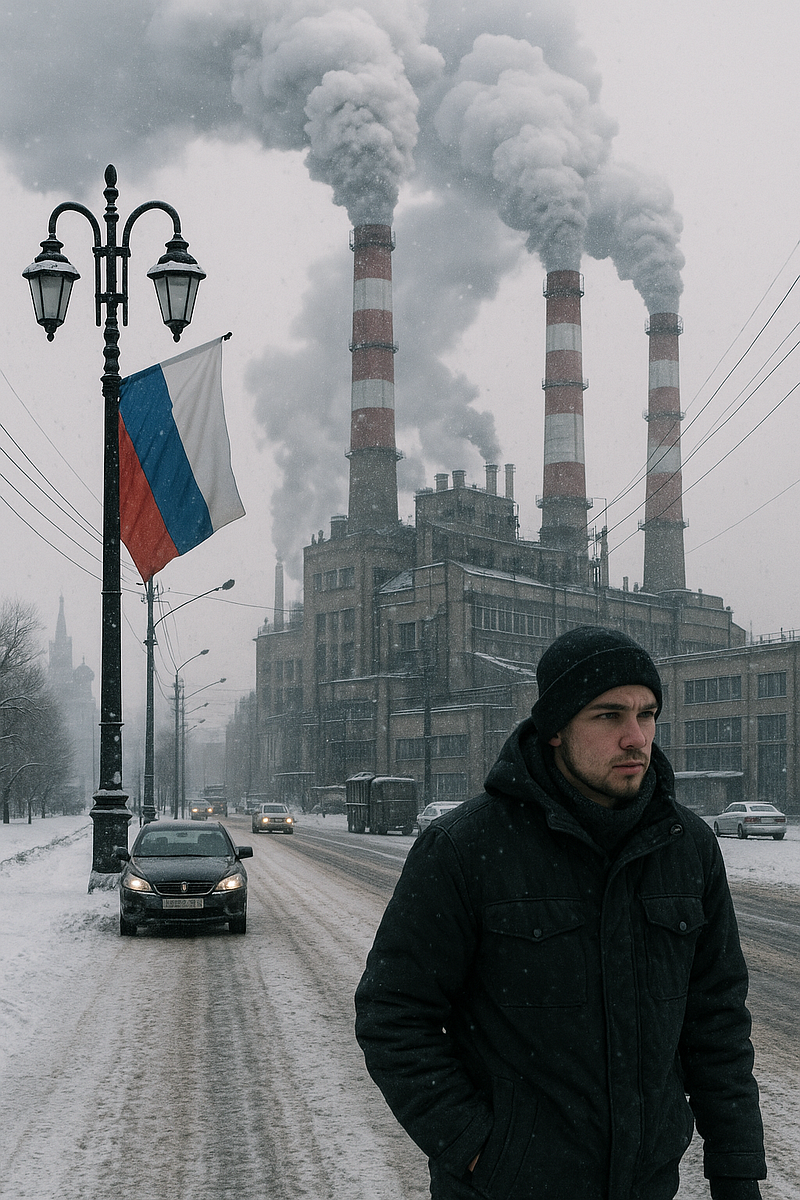
Outside, a woman brushed ice from a car older than she was.
A convoy of trucks pushed through fog thick as breath.
Two students posed beside a black SUV with laughter that did not belong to fear.
Moscow, wrapped in winter, moved with the calm of a city that had outlived too many prophecies.
The man whispered the truth he had been avoiding.
“It should not work. It does.”
He did not yet understand that Russia’s economy is not designed to succeed.
It is designed to endure.
“Collapse only happens to systems that assume they are immune to it.”
The Predictions That Fell Apart
Why Western collapse forecasts failed
Western analysts did not misread Russia because they lacked intelligence.
They misread Russia because they lacked context.
They treated economic laws as universal truths.
They assumed collapse was inevitable because collapse was logical in their architecture.
But Russia has never operated inside that architecture.
A Western economy is a web of trust.
A Russian economy is an archive of memory.
Where Western systems value efficiency, Russia values continuity.
Where Western systems require confidence, Russia requires endurance.
The West kept asking why Russia did not break.
The answer is simple.
Russia is not built in a way that allows breaking.
“A system engineered for disaster does not fail when disaster arrives.
It activates.”
This is the first hinge of misunderstanding, and it opens the door to all the rest.
The Anatomy of a Survival Economy
How Russia’s structure absorbs shocks
Russia’s economy behaves like an organism shaped by centuries of scarcity and seismic upheaval.
Its structure is not accidental.
Its structure is inherited.
Memory forms its spine.
Scarcity forms its instincts.
Energy forms its blood.
And this inheritance explains why the collapse never came.
Memory
Factories were built for repair, not replacement.
Improvisation became a principle rather than a flaw.
What looks inefficient to a Western engineer becomes indestructible in crisis.
Scarcity
Nations raised in abundance fear disruption.
Nations raised in hardship learn to function through it.
Substitution was never a secondary system.
It was the silent twin of the official one.
Energy
Energy in Russia is not commodity.
Energy is identity.
Cheap domestic power transforms weakness into leverage, gives industry resilience, and allows mobilisation without political collapse.
This is not prosperity.
This is permanence.
“Russia’s economy does not seek to avoid crisis.
It seeks to outlast it.”
And outlasting is a language Russia speaks fluently.
The Factory at 03:12
Inside a metalworks plant on the outskirts of Yekaterinburg, the clock read 03:12.
Steam curled from ruptured pipes.
Orange light pulsed from a furnace that sounded like a living creature breathing in the dark.
A shift supervisor walked the length of the catwalk, boots ringing against steel.
Below him, workers moved like silhouettes inside a cathedral of machinery.
The air smelled of oil, metal and winter.
Outside, the temperature was minus twenty-three.
Inside, machines older than the workers themselves pressed out components destined for artillery, rail lines, mining rigs, and half a dozen sectors that had been declared dead a decade earlier.
No one spoke.
No one complained.
They had seen too much history to expect anything else from it.
This was the part of Russia’s economy that numbers never capture.
A system that remembers what it was built for.
The Sanctions That Became a Catalyst
Why sanctions reshaped but did not break Russia
And this memory is precisely why sanctions created transformation instead of collapse.
When Western governments froze Russian reserves, they believed they had tightened a strategic noose.
Instead, they triggered an instinct older than their institutions.
The ruble stabilised through command.
Supply chains bent without breaking.
Trade rerouted by habit rather than panic.
And something deeper broke across the world.
“The world realised that money stored in the West belongs to the West.”
Trust dissolved.
Russia recalibrated instantly.
Oil flowed to Gujarat instead of Rotterdam.
Gas heated Ankara instead of Berlin.
Pipelines obeyed a different compass.
Sanctions did not end Russia’s participation in the global economy.
Sanctions forced Russia to build a new one.
And once a system learns to reroute, it never forgets how.
The Twist Beneath Every Statistic
Why Russia doesn’t require growth to survive
Russia’s economy is not strong because it grows.
Russia’s economy is strong because it can survive without growth.
A Western system breathes through expansion.
A Russian system breathes through continuity.
A Western factory at full capacity signals success.
A Russian factory at full capacity signals baseline.
“Russia did not resist collapse.
Russia resisted the idea that collapse existed.”
And that difference shapes every number in every forecast.
The War Economy That Should Have Broken, and Didn’t
How mobilisation revealed structural resilience
War activates Russia’s industrial muscle memory.
It does not create strength.
It reveals it.
Factories revive through command.
Idle plants become assembly lines.
Supply networks reawaken like nerves rediscovering sensation.
Western systems must negotiate every shift in production.
Russia only needs to announce it.
A country shaped by recurring hardship internalises mobilisation as the natural response to crisis.
This is not triumph.
This is readiness.
And readiness is a currency few nations still hold.
The Fragility Beneath the Foundation
Endurance extracts a price
Yet endurance is not a blessing without cost.
Demography contracts.
Innovation stagnates under inertia.
Dependence on China deepens.
War burns the future to heat the present.
Russia’s greatest strength is continuity.
Russia’s greatest weakness is also continuity.
“The danger is not collapse.
The danger is stasis.”
And stasis is the slowest form of decline.
What the West Misunderstands
Why Western models keep failing
The West continues to wait for a collapse that will not come.
Its models measure danger through the metrics of abundance.
Sanctions work on systems that require permission.
Russia requires only access.
And access can always reroute.
When access becomes identity, sanctions become weather.
Uncomfortable.
Persistent.
But not fatal.
Russia is not broken.
Russia is hardened.
“Hardened systems do not fall.
They fracture slowly.”
And fractured does not mean fallen.
What the Kremlin Misunderstands
Endurance is not victory
Russia can survive longer than the West imagines.
But no nation can operate indefinitely on mobilisation logic.
War economies consume possibility.
They exhaust potential to create motion.
The factories glowing at midnight are impressive.
The exhaustion beneath them is invisible.
This is not weakness.
It is cost.
And cost eventually demands a settlement.
Three Futures Hidden in the Fog
Russia’s three strategic destinies
The Orbit
A future where China becomes the gravitational centre and Russia becomes the limb.
Stable.
Predictable.
Quiet.
But shrinking.
The Fortress
A self-contained economy capable of surviving any storm but incapable of transformation.
A plateau nation.
The Experiment
A Eurasian constellation.
A Russia that conducts rather than follows.
Trade corridors from Murmansk to Mumbai.
Energy routes that redraw the century.
This path requires imagination, not memory.
It is the narrowest path.
It is the only one with expansion at its core.
The real choice is not economic.
The real choice is civilizational.
And civilizations are defined not by what they build, but by what they refuse to abandon.
Closing Reflection. The Empire of Adaptation
Night settled across the boulevard as the man from the café stepped outside.
His breath lingered, then dissolved.
Snow spiralled through the air as if tracing the outline of a country that refuses to collapse simply because others expect it to.
Russia’s economy is not strong.
Russia’s economy is not weak.
Russia’s economy is adapted.
And adaptation remains the most underestimated form of power in the modern world.
In a century defined by disruption, scarcity, reshoring and geopolitical fracture, the nations that endure will not be those that grew the fastest.
They will be those that learned how to bend without breaking.
The ones that built their architecture for winter rather than spring.
Russia did not choose this skill.
Russia inherited it.
“History does not reward the fastest.
History rewards the last survivor.”
The West waits for Russia’s ending.
Russia waits for its next winter.
One watches the news.
The other watches the horizon.
And history, as always, moves with the horizon.
Russia does not win its battles.
Russia outlasts them.
And in the architecture of global power, outlasting is a form of victory.
Related from The Manifest Archive