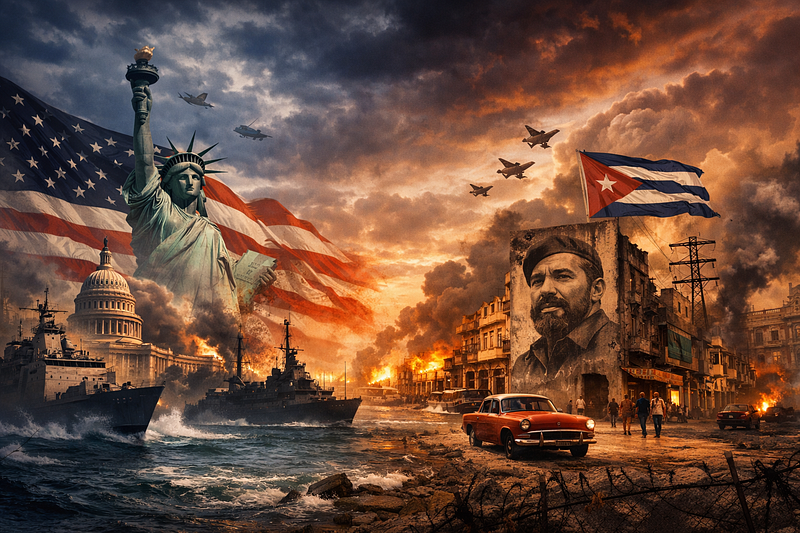
While war with Iran shakes oil routes, shipping, inflation, and alliances, Trump is still speaking about taking Cuba. That is not noise. It is a signal.
The Blackout and the Threat
The lights go out across an island already exhausted.
Refrigerators fall silent. Food begins to spoil. Hospitals strain. Families wait in the dark. A system that was fragile yesterday becomes unbearable today.
That is Cuba now.
And in the middle of that reality, Donald Trump speaks about the island in the language of possession.
That is what makes the moment so revealing. Not only the vulgarity of the remark, but the sequence beneath it. A country is weakened, worn down, pushed closer to systemic fragility, and then spoken about as though its weakness were permission.
The obscenity is not just in the tone.
It is in the reversal.
The oldest trick of empire is not conquest. It is amnesia.
The Old Siege
Cuba’s crisis did not emerge out of nowhere. It did not arrive as some mysterious collapse without context. It unfolded inside a structure that has been pressing on the island for generations.
That structure matters.
For decades, Cuba has lived under a sanctions regime that has narrowed trade, finance, energy access, and room to maneuver. Whatever one thinks of the Cuban state, and its internal failures are real enough, no serious analysis can pretend the surrounding pressure is incidental. A country can be internally rigid and externally strangled at the same time. Those truths do not cancel each other out. They reinforce each other.
That is why so much of the language used about Cuba feels dishonest from the start. It often describes the damage while leaving out the cage. It shows the crisis while muting the siege. It points to breakdown while treating the machinery around that breakdown as background noise.
But it is not background noise.
It is part of the story.
And that is why one of the least fashionable observations is also one of the truest: it is remarkable that Cuba is still standing at all.
A country under prolonged economic siege is not simply failing. It is also enduring.
After more than sixty years of pressure, isolation, sanctions, and economic constriction, the more revealing question may no longer be why Cuba is struggling. The more revealing question is how it has managed to endure for this long.
Iran and the Widening Field
If Trump were speaking this way during a quiet geopolitical moment, the remark would still be grotesque.
But he is not.
He is doing it in the middle of a war with Iran that is already sending tremors through the world economy. Oil routes are under stress. Shipping is under stress. Insurance is under stress. Inflation fears are spreading again. Governments far from the battlefield are already being forced to calculate the secondary costs of a crisis they do not control.
This is precisely the sort of moment in which a disciplined power would narrow the field.
It would calm rhetoric. It would stabilize allies. It would avoid introducing new signals of territorial appetite. It would try, at minimum, to look like a manager of order.
Instead, the opposite is happening.
While a major war is already threatening the global system, Trump is still reaching for the language of acquisition elsewhere. Cuba enters the sentence not as a neighboring society in distress, not as a humanitarian problem, not even as a diplomatic problem, but as one more object in a widening field of pressure.
That is what makes the moment feel less like strategy and more like drift.
Or worse.
A system responding to instability by multiplying it.
While war shakes the global system, Trump still speaks in the language of possession.
When Allies Become Instruments
The Cuba remark is not a standalone incident. It sits beside the tone Trump has used toward allies over Iran.
That matters because it reveals the broader style.
When Washington escalates and then demands that others help absorb the consequences, alliance begins to change its meaning. It no longer sounds like coordination. It starts to sound like hierarchy. When countries hesitate, they are no longer treated as sovereign partners with their own voters, economies, and limits. They are treated as instruments that owe obedience.
That is not the language of confidence.
That is the language of command.
And command is often the fallback of a power that senses persuasion is no longer enough.
When alliance turns into coercion, power has already begun to lose its mask.
This is why the tone feels so abnormal. It is not just aggressive. It is possessive. It assumes that once the United States has moved, others must follow. If they do not, the problem is not the original escalation. The problem becomes their refusal.
Greenland Was Not an Exception
This is also why Greenland belongs in the same frame.
At first, Greenland looked like one more bizarre Trump fixation, another surreal headline that would burn for a few days and then disappear. But it was more than that. It revealed the same underlying grammar now visible in Cuba and in the pressure placed on allies over Iran.
Territory was discussed not as sovereign space with people, history, and limits, but as something desirable, strategic, obtainable.
Seen in isolation, Greenland looked eccentric.
Seen beside Cuba, it looks diagnostic.
Seen beside the demands placed on Europe, it becomes harder to dismiss as improvisation. Territory, allies, trade, sea lanes, sanctions, energy pressure, all of it enters the same field of thinking. Not coexistence. Not careful diplomacy. Not strategic restraint.
Control.
The point is not that every case is identical. The point is that the same appetite keeps surfacing in different forms.
And appetite is not strategy.
Pressure as Policy
This broader pattern matters more than any single remark.
Iran, Cuba, Venezuela, Russia, China. These are different cases with different histories, and flattening them into one slogan would weaken the analysis. But there is still a recurring American reflex visible across them. Pressure is not used only to punish. It is used to shape the environment in which other states must survive.
Sanctions narrow oxygen. Financial restrictions narrow choices. Trade pressure narrows growth. Military threats narrow political space. Even when these methods do not break a state, they change the field around it.
And then comes the second move.
When the target shows visible strain, that strain is presented as proof that the target is dysfunctional, unstable, dangerous, or in need of correction. The pressure that helped produce the instability is pushed out of view. The story is cleaned up. Cause and effect are rearranged.
That is where propaganda does its quiet work.
It removes the prehistory. It deletes the siege. It strips out the pressure and then presents the result as self-generated collapse.
That is not analysis.
That is stage design.
The empire wants the world to see weakness and call it destiny.
The Panic of a Fading Empire
This is the heart of the matter.
Why does all of this feel so feverish?
Because it no longer resembles a power comfortably managing a system it understands. It resembles a power that still has immense force, but less patience, less credibility, and less confidence that the world will keep bending automatically.
That is why the word panic hovers in the background, even if it must be used carefully.
States do not panic like people do. They do not shake in public. They do not gasp for breath. But systems can behave in panicked ways. They overextend. They widen the theatre. They confuse pressure with strategy. They react to diminishing control not by prioritizing, but by pushing harder in more directions at once.
That is what this moment increasingly resembles.
A confident power does not talk about taking Cuba while already caught inside a war with Iran that is shaking global energy markets.
A confident power does not pressure allies over one crisis while destabilizing them through another.
A confident power does not keep returning to the language of possession in a world already crowded with volatile borders and exhausted systems.
What does that leave?
Not confidence.
Nervous dominance.
Overextended authority.
A style of power that grows louder because it senses it can no longer command quietly.
A fading power does not become quiet. It becomes louder.
The Point Without Return
The most dangerous thing about moments like this is not escalation alone.
It is normalization.
The first time a president speaks this way, people call it scandal. The fifth time, it becomes another headline. The tenth time, it enters the bloodstream of expectation. What was once outrageous becomes procedural. What was once unthinkable becomes bargaining language. What was once a rupture becomes atmosphere.
That is how the political imagination is degraded.
Not in one dramatic moment, but through repetition.
This is why Trump’s language about Cuba matters far beyond Cuba itself. It trains the ear. It conditions the public. It makes naked pressure sound ordinary again. Territory becomes discussable. Sovereignty becomes conditional. Allies become instruments. Economic strangulation becomes routine. Escalation becomes management.
And once those shifts become normal, the field changes for everyone.
Markets hear instability.
Rivals hear permission.
Allies hear threat.
Smaller states hear precedent.
The world hears that might is trying to become grammar again.
The Closing Line Beneath the Noise
Cuba is still there.
Still pressured. Still sanctioned. Still wounded. Still standing.
That endurance says something Washington does not want to hear.
It says pressure is not omnipotence. It says strangulation is not legitimacy. It says survival itself can become a rebuke.
And it says that the story of Cuban failure, repeated for decades in the language of inevitability, has always been incomplete. The hardship is real. The damage is real. But so is the hand that kept tightening around the throat while pretending merely to observe the suffocation.
Once that becomes visible, the rest of the pattern sharpens.
Cuba stops looking like an isolated case.
Greenland stops looking like a curiosity.
Europe stops looking like a partnership.
Iran stops looking like a contained war.
The whole field changes.
What emerges is not one outrageous politician improvising in public. What emerges is a wider behavior. A power that cannot accept limits. A power that answers resistance with pressure. A power that keeps widening the field because narrowing it would require admitting that force has limits too.
That is not order.
That is the fraying edge of order.
And the most dangerous part is that those producing the pressure still insist they are merely responding to it.
A stable power knows where to stop. A fading one keeps pushing.
Related Chapters of The Manifest
The Manifest is an ongoing investigation into power, history, finance, and the structures that continue beneath the surface of modern events.
If this chapter spoke to you, you can follow the publication here.
Related from The Manifest Archive