Trump’s Tariffs: Power, Courts, and the Fragile World Order
Subtitle
When “national security” becomes elastic, constitutional boundaries shift, and allies learn to price in American unpredictability.
You remember the image because it was staged to be remembered.
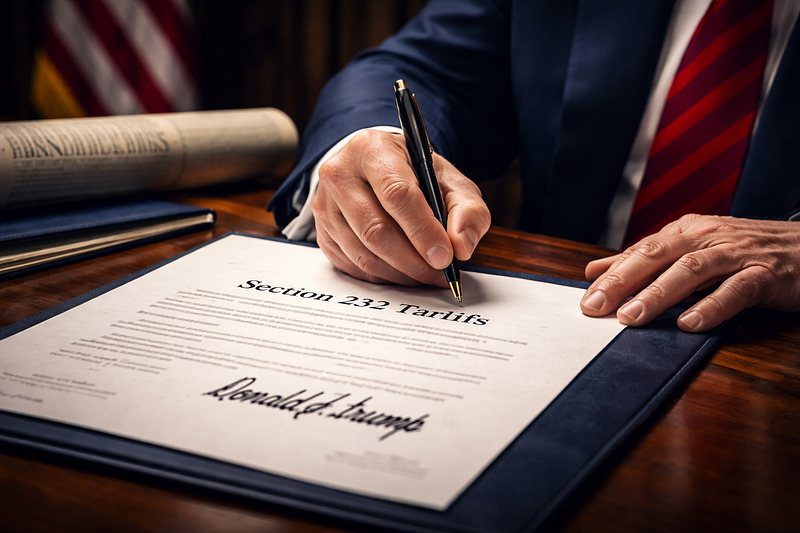
Hard hats. Steelworkers. The Roosevelt Room. President Donald Trump holding the pen a fraction longer than necessary before signing. The numbers were clean enough to fit on a banner and loud enough to feel like certainty. Twenty five percent tariffs on steel. Ten percent on aluminum. One phrase doing the work of a doctrine: national security.
Most people filed it under trade. A bargaining chip. A headline war. A rough season in globalization.
But the tariff was never the point.
The point was the button. Who gets to press it, how wide the definition can stretch, and what happens when a republic quietly accepts that a word as elastic as “security” can move billions of dollars, punish allies, reorder supply chains, and still avoid a real constitutional reckoning.
That question stopped being abstract on February 20, 2026, when the U.S. Supreme Court ruled that President Trump could not use the International Emergency Economic Powers Act to impose sweeping tariffs, rejecting the idea that an emergency statute silently authorizes import duties. (AP News)
That decision mattered. Not because it ended the tariff era. The same week, reporting and analysis focused on what remained: refund battles, legal rerouting, and the fact that other tariff tools still existed. (AP News)
In other words, one door was closed, but the older door was still standing.
That older door has a name.
Section 232.
The tariffs were loud. The precedent was quiet. Quiet precedents shape louder futures.
This chapter begins with steel and aluminum. It ends at the outer boundary of American authority. Because when Trump invoked Section 232 of the Trade Expansion Act of 1962, he did more than impose tariffs. He normalized a principle: that the executive branch can tax foreign commerce by expanding the meaning of “national security,” while Congress watches and courts decline to narrow the definition.
And once that normalization happens, the consequences do not remain domestic.
They travel.
The Moment That Looked Like Trade But Wasn’t
Section 232 is often described as a trade instrument. In practice, it functions like a constitutional shortcut.
It authorizes the president to “adjust” imports deemed to threaten national security. In 2018, the Trump administration used that authority to impose 25 percent tariffs on steel and 10 percent on aluminum. (The White House)
The optics were industrial. The rationale was geopolitical. The effect was institutional.
Because the real novelty was not that America raised tariffs. Many countries do. The novelty was that the United States did it by placing a core element of fiscal power under an elastic security label, in a way that folded allies into the category of threat.
Canada was hit. Europe was hit. A tool associated with wartime vulnerability was applied to trading partners embedded in U.S. defense structures.
Even when some measures were later adjusted, the signal had already been sent: alliance status is not immunity when “security” can be reinterpreted at will. (Canada)
You can negotiate a tariff schedule.
You cannot negotiate a precedent.
The Lawsuit That Asked the Real Question
Within months, a coalition of importers sued.
The case, American Institute for International Steel v. United States, did not hinge on whether tariffs raised prices. It hinged on whether Congress had delegated too much of its constitutional authority over foreign commerce to the executive branch.
The legal spine was the nondelegation doctrine, the principle that Congress cannot hand over legislative power without meaningful limits.
The plaintiffs lost in the Court of International Trade. They lost again in the Federal Circuit. And on June 22, 2020, the Supreme Court declined to review the case. (SCOTUSblog)
There was no grand opinion. No reset. No institutional moment that the public could hold in its mind like a photo.
Just absence.
And in constitutional politics, absence is often the decision.
Because policy can reverse.
Precedent endures.
How Delegation Became Normal
To understand why 2018 still matters in 2026, you have to step back.
In the postwar era, Congress wanted flexibility. Trade negotiations were complex. Speed mattered. So Congress delegated power through a sequence of statutes, each carrying language that sounded like restraint.
“National security.”
“Emergency.”
“Balance of payments.”
“Unfair trade.”
Courts developed a permissive standard: Congress must provide an “intelligible principle.”
The bar was low. The incentives were obvious. Lawmakers could claim credit for economic outcomes while outsourcing blame for economic pain.
Delegation expanded quietly.
The nondelegation doctrine went dormant.
Presidents accumulated discretion not by dramatic seizure, but by incremental normalization.
In that light, Section 232 is not an anomaly. It is a mature expression of a broader pattern: democratic systems that gradually convert legislative power into executive interpretation, and call it efficiency.
Elastic Words, Traveling Authority
In 1962, “national security” meant something close to its plain reading.
Wartime vulnerability.
Defense readiness.
Strategic materials.
By 2018, the definition widened. It began to include industrial capacity in a general sense, and that widened category did what widened categories always do.
It carried authority with it.
If national security can include industrial competition, then the president is no longer adjusting imports to prevent wartime collapse. The president is managing the economy through security language.
And because Section 232 duties are administered through customs procedures that apply broadly, they are not softened by the emotional language of “allies.” U.S. Customs and Border Protection makes the point plainly: Section 232 duties may apply regardless of free trade agreements. (cbp.gov)
That is not just trade administration.
That is a doctrine of reach.
Power expands most effectively when it appears procedural.
There are no emergency sirens. Just paperwork. A determination. A proclamation. A tariff schedule.
And once courts accept the procedure, the category becomes baseline.
The Path That Was Not Taken
The United States had narrower instruments available.
It could have pursued targeted trade remedies, multilateral coordination, WTO-based strategies, or constrained actions tied to specific unfair practices. Those require negotiation and shared responsibility. They also create accountability, because they generate records and obligations that allies can contest.
Section 232 requires something different.
An executive determination.
A security label.
A quick imposition.
When narrower tools exist but a broader one is chosen, the choice itself signals trajectory. Allies do not only react to the tariff. They react to the method.
Rivals do the same.
Because method reveals intent more reliably than rhetoric.
The Alliance Layer
Trade is not separate from alliances. It is part of their nervous system.
Allies evaluate predictability. They price reliability. They plan supply chains on the assumption that the legal environment will not abruptly redefine them as threats.
When tariffs are imposed on partners under “national security,” it does something subtle but lasting.
It teaches.
It teaches Europe that proximity does not guarantee exemption. It teaches Asia that U.S. domestic politics can convert into external cost. It teaches middle powers that even inside the “rules based order,” rules can become optional when a president discovers a statute that will not be narrowed.
The architecture of Western stability is not only military. It is economic reliability. When trade volatility rises, alliance confidence recalibrates.
Not through rupture.
Through hedging.
The Courts and the New Visibility of Limits
This is why the Supreme Court’s February 20, 2026 ruling matters as a counterpoint. It shows that boundaries can still be drawn, at least around some statutory claims.
The Court rejected the idea that the emergency law Trump relied on, IEEPA, silently authorizes tariffs. In doing so, it created a new legal landmark, and it triggered a practical aftermath focused on what unwinding looks like, including disputes over which tariffs fall, what refunds follow, and how long uncertainty lasts. (AP News)
But even that boundary clarifies the deeper issue rather than resolving it.
Because the ruling did not erase the broader system of delegation. It addressed one route. It did not close all routes.
Section 232 remains structurally different from IEEPA, and it remains embedded in the idea that “security” can justify import taxes.
So the question is not whether the courts can stop a president sometimes.
The question is what happens in the far more common scenario.
When courts do not.
The Monetary Undercurrent
America’s power is not only military. It is also monetary.
The dollar’s central role, the depth of U.S. markets, the liquidity that only the United States can provide at scale, all of it rests on something that looks soft and feels invisible.
Predictability.
Tariffs, sanctions, financial exclusions, these are not only tools. They are signals about how leverage will be used.
Leverage encourages preparation.
Preparation rarely looks dramatic. It looks like alternative settlement discussions, redundancy, re-routing, regional manufacturing strategies, and the slow shift from dependency to optionality.
Confidence does not collapse overnight.
It thins through anticipation.
And tariffs justified as “security” accelerate thinning, because they imply that any economic instrument can become a security instrument when politics demands it.
The Internal Question That Becomes Global
From the outside, the United States appears stable.
Courts rule. Elections occur. Power transfers.
But unity is not silence.
It is agreement on limits.
For some Americans, tariffs restored sovereignty. For others, they stretched executive authority. That disagreement is not about steel. It is about definition.
Who defines national security in practice.
Who defines emergency.
Who defines commerce.
A republic remains stable when its boundaries are broadly accepted. When boundaries become partisan territory, uncertainty grows.
Uncertainty travels.
It reaches allies first, because allies are exposed without being represented.
The Historical Pattern of Expansion
Emergency expands executive power.
The Civil War did.
World War II did.
The Cold War did.
Each expansion was justified. Each left residue. Residue became baseline. Baseline became expectation.
Trump’s Section 232 tariffs were not wartime mobilization. They were strategic competition framed as security. That framing may prove more consequential than the tariffs themselves.
Because future presidents inherit elasticity.
Not the controversy.
The scope.
And the scope is what systems fear, because scope survives personalities.
Final Movement
Ports still move. Containers still stack. Goods still arrive with paperwork stamped by a system that looks normal.
Nothing has collapsed.
But something has moved.
The line between Congress’s commerce authority and the president’s discretion is no longer assumed fixed. It is interpreted.
And interpreted boundaries depend on trust.
Trust in courts.
Trust in process.
Trust in shared limits.
February 2026 showed that limits can still be asserted against one kind of tariff claim. (AP News)
But the deeper lesson of 2018 remains. If “national security” can be expanded until it covers ordinary industrial rivalry, then executive discretion over foreign commerce expands beyond its original frame without an amendment, without a crisis, without the drama that would force a public argument.
The tariffs were loud.
The precedent was quiet.
Quiet precedents shape louder futures.
In The Manifest, we follow boundaries.
In 2018, one shifted.
In 2026, one was partly redrawn.
And the world did what it always does when the architecture of authority becomes uncertain.
It prepared.
Related from The Manifest Archive