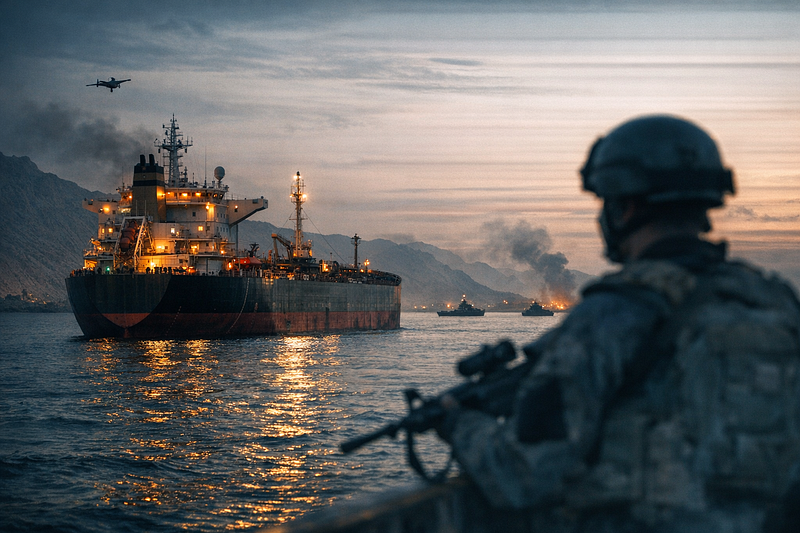
A tanker can be told the route is open and still remain trapped.
Its engines are ready. The crew is awake. The cargo matters. The world beyond the Gulf is waiting for fuel, schedules, deliveries, margins, calm. Yet the ship does not move, because permission is uncertain, insurance is punishing, the corridor is militarized, and every mile of water carries the price of politics. On a screen somewhere, markets celebrate a ceasefire. On the bridge, nothing feels reopened.
That is where this story begins.
Not in the speeches, not in the declarations, not in the word peace, but in the gap between what was announced and what the system actually believed.
A two-week ceasefire was presented as a step back from the brink. Oil dropped sharply. Equities rose. Relief spread fast through the financial imagination of the world. But the strait did not return to normal life. Iran kept asserting control over passage. Ship movement remained minimal. Insurers warned that trade would not restart in any normal sense. And within hours, the wider region was already testing the pause, with fresh violence in Lebanon and renewed claims that Hormuz had been closed again.
This chapter is part of The Manifest, an ongoing work about the structures beneath events, the systems beneath slogans, and the moments when official language stops describing reality.
The ceasefire did not solve the crisis
The public version is simple because public versions prefer simplicity. Escalation was spiraling. Diplomacy intervened. A ceasefire emerged. Markets calmed. The world stepped back.
That version is not false.
It is just incomplete.
The ceasefire was not the arrival of resolution. It was the recognition of a limit.
The limit was not moral. It was systemic.
Washington had been speaking in the register of overwhelming retaliation. Tehran had been leaning on Hormuz as leverage. Both sides still possessed means. What changed was not strength, but the cost of using strength one step further. The moment the next increment of escalation threatens oil flows, shipping confidence, insurance markets, inflation expectations and alliance stability all at once, the conflict stops behaving like a regional confrontation and starts behaving like a systems event. That is what the ceasefire really marked. Not restored trust, but discovered exposure.
The market reaction made that brutally clear. Investors were not celebrating reconciliation between enemies who had suddenly found common purpose. They were pricing out immediate catastrophe. They were responding to the possibility that one of the world’s most important energy corridors might avoid a total seizure, at least for the moment.
Relief came fast because panic had become expensive.
This was not the arrival of peace. It was the discovery of a limit.
Hormuz was never the backdrop
Too much commentary still treats the Strait of Hormuz as scenery, as if it were merely one theater inside a larger war.
It is not scenery.
It is the hinge.
When a route like this becomes unstable, everything that depends on it begins speaking a harsher language. Governments speak of deterrence and sovereignty. Shipping speaks of delay. Insurance speaks of exposure. Energy markets speak of fear. Crews speak of waiting. The system translates rhetoric into cost.
That is why the status of the strait matters more than the beauty of a diplomatic phrase. A corridor can be called open on paper while remaining broken in reality. It can technically function while commercially failing. It can pass a few vessels and still terrify the broader market. What matters is not whether movement exists in theory. What matters is whether enough actors trust the route to resume flow at scale.
Today, they do not.
Current reporting points in the same direction. The Guardian described movement through the strait as still minimal, with around 2,000 ships and 20,000 seafarers effectively stranded in the Gulf. The Wall Street Journal reported that only a handful of ships had crossed after the ceasefire began and that hundreds of ships, including more than 400 tankers, remained stuck. Maritime security analysts advised case-by-case caution rather than anything close to normal operations.
That is not reopening.
That is supervised fragility.
A corridor can be politically declared open and still remain economically broken.
The route is now a corridor of permission
This is the real break in the story.
The question is no longer whether Hormuz is simply open or closed. The question is who gets to move, under what conditions, at what cost, and under whose shadow.
The Wall Street Journal reported that Iran’s navy has continued telling ships they need explicit permission to transit the strait, with warnings that unauthorized vessels could be destroyed. Another Journal report described a toll structure in which some ships pay more than $1 million for passage, while Iranian or aligned vessels move more easily and adversarial vessels face exclusion or heightened danger. The strait, in other words, is no longer behaving like neutral infrastructure.
It is behaving like a politically managed valve.
That is the true revelation of this ceasefire.
A route does not need to be fully closed to function as a weapon. It only needs to become uncertain enough.
It only needs to become expensive enough. It only needs to become selective enough that every transit becomes a political act rather than a commercial routine.
Once that happens, the world keeps paying even when the shooting slows down.
The shipping world did not believe the headline
This is where the difference between spectacle and structure becomes impossible to ignore.
Headlines move first because headlines are built for emotion. Shipping moves last because shipping is built for consequence.
A trader can buy the relief rally in seconds. A shipowner cannot move a tanker through a militarized choke point because television says the temperature has dropped. A crew cannot treat a temporary pause as safety. A charterer cannot pretend that a corridor governed by tolls, permission and threat has returned to ordinary commercial time. The body of the system reacts more slowly because it is closer to risk.
This is why the image of the stranded ship matters. It gives human scale to what abstract language usually conceals. Somewhere in the Gulf, crews are still measuring time against radio traffic, instructions, rumors, risk advisories and changing terms. Somewhere, a vessel that can move does not move, because can and should are no longer the same word. Somewhere, a captain is reading a political event as a commercial impossibility.
That is what an unstable order looks like when it reaches deck level.
It does not sound like grand strategy.
It sounds like waiting.
Insurers are reading reality more honestly than politicians
If you want to know whether a geopolitical pause is real in material terms, do not begin with leaders.
Begin with insurers.
Leaders sell reassurance. Insurers price danger.
The Wall Street Journal reported that marine insurers do not expect the ceasefire to restart Gulf trade in any immediate or normal sense. War-risk premiums are expected to remain elevated. Lloyd’s market participants signaled that unresolved tension will continue to keep cover expensive. Maritime security advice remains cautious. The implication is unmistakable.
The insurance market itself does not yet believe the route has normalized.
That matters because insurance is where narrative collides with exposure. A government can say the crisis is easing. An underwriter has to ask whether the probability of loss has actually changed enough to justify cheaper cover. If the answer is no, then the real condition of the system is still embedded in fear, not peace.
A ceasefire can stop missiles faster than it can lower premiums.
That is the whole logic of the moment. The shooting pauses. The pricing mechanism continues.
Which means the crisis has not ended.
It has changed form.
Both sides reached the edge of clean escalation
The language of victory is too theatrical for what happened here.
The United States still had superior military weight. Iran still had meaningful leverage through geography, shipping disruption and energy risk. But neither side could continue escalating cleanly. Washington risked turning force into a global economic shock it would also have to own. Tehran risked turning leverage into a larger and more punishing response. The ceasefire emerged not because either side became generous, but because the next move had begun threatening the logic of its own position.
That is what makes this more revealing than a normal truce.
It exposed the point where power itself became disciplined by routes, prices, dependencies and flow. It showed that modern force is never only about destruction. It is also about what destruction does to the architecture your own system still needs.
In that sense, the ceasefire was not the restoration of order.
It was the admission that order is more fragile than official language likes to admit.
The crack appeared immediately
And then, almost at once, the pause began showing its limits.
AP reported that the ceasefire was threatened as Israel expanded strikes in Lebanon and Iran closed the strait again. A second AP dispatch described the deal as fragile and disputed, with major disagreement over whether Lebanon was included in its terms. The pause did not enter a calm region. It entered an overpressurized one, carrying contradictions inside it from the first hour.
That does not make the ceasefire meaningless.
It makes it legible.
It tells you this was never a clean reopening, never a stable peace, never a durable settlement. It was a temporary ceiling placed over an unstable structure.
The structure remains.
The missiles paused. The choke did not.
The glass ball
An honest look forward requires discipline. Not prophecy. Not drama. Just clear reading of pressure.
The most optimistic path still exists. The ceasefire holds long enough for talks to produce a wider framework. Hormuz becomes somewhat more usable. Insurance costs remain high at first, then slowly ease. Oil volatility settles below panic levels. Washington frames the result as disciplined de-escalation. Tehran frames it as proof that leverage worked. Nobody gets what they originally wanted, but everyone gets enough to avoid the next cliff. This path is plausible because the incentive to avoid another immediate shock is obvious to every actor in the system.
The second path is more likely in the short term. The ceasefire survives in name but not in spirit. There are violations, contradictory interpretations, selective access, rolling brinkmanship and a permanent gap between official language and commercial reality. Traffic resumes partially, under chronic stress. Premiums remain high. Owners remain cautious. Traders stop trusting each breakthrough headline fully.
This is the path most consistent with what is already visible.
The third path is darker. The pause fails quickly because Lebanon, Gulf incidents or a harder reclosure of Hormuz pull the region back into overt escalation. If that happens, the next shock may hit harder because the illusion of an off-ramp has already been spent once. Failed pauses make later repricing more violent. They teach markets and states alike that a temporary ceiling is not a structure. It is just a delay.
The fourth path is the most revealing because it is less cinematic and more structural. The war remains limited, but the precedent changes. Iran does not need a total blockade if it proves that one of the world’s most important energy arteries can be governed through coercive uncertainty. The United States does not need to look openly defeated if it preserves broad deterrence while quietly accepting that smooth, unquestioned flow is gone. In that world, Hormuz becomes neither fully open nor fully shut.
It becomes a permanently politicized valve, where passage exists, but only through chronic price, chronic permission and chronic fear.
That last scenario may be the most important of all, because it points beyond this crisis. It suggests a world in which chokepoints no longer need to be physically conquered to be transformed. They only need to become unstable enough that every transit becomes a negotiated act.
What this really exposed
It exposed that the global system is more fragile than its official language suggests. It exposed that chokepoints still discipline empires. It exposed that insurers, shipowners and traders often read reality faster than governments do. It exposed that open and usable are no longer the same word. And it exposed that modern power is not only about what states can destroy, but about what destruction does to the flows they also need.
Most of all, it exposed this: the world did not step back because peace suddenly became attractive. It stepped back because the price of one step more had become too visible to ignore, while the value of keeping the route politically unstable remained too useful to fully surrender.
This was not the arrival of peace. It was the discovery of a limit.
Closing reflection
The most revealing moments in geopolitics are often not the explosions, but the pauses that follow them.
Because a pause shows you where force met structure. Where rhetoric met logistics. Where prestige met exposure. Where domination met price.
And because somewhere in the Gulf, even now, a ship can be told the route is open and still remain trapped.
That is the image to keep.
Not the podium. Not the headline. Not the market bounce.
The ship that can move, but does not.
The corridor that exists, but does not function.
The ceasefire that pauses the missiles, but leaves the choke in place.
That is what this moment says.
Not that the region is stable.
Not that the conflict is over.
Not that peace has returned.
Only that the system looked one step further, saw the cost, and called that recognition peace.
Further Reading from The Manifest
If you want to go deeper into the larger structure behind this crisis, continue with these chapters from The Manifest. Each one reveals another layer of the same architecture, where routes matter more than slogans, dependency matters more than diplomacy, and systems speak more honestly through pressure than through promises: The Architecture of Aid: How Help Becomes Control, The Age of Managed Crisis, How the ECB, Brussels and NATO Decide Your Life Without a Vote, Deep State Explained: Myth, Mechanism, or Structural Power?, and Architecture of Power: How Modern Empires Hide in Plain Sight.
Follow The Manifest
The Manifest is not a collection of isolated articles. It is one unfolding work.
Each chapter follows the same question into a different room. Power, dependency, narrative, logistics, memory, pressure, control. What looks separate in headlines is usually part of the same architecture underneath.
Follow The Manifest if you want more than headlines.Follow if you want the structure beneath them.
Related from The Manifest Archive